Subvert: The Individualism of Dona Nelson at CANADA
We need not pretend that there is anything inherently subversive about free-standing paintings, not at a time and in a cultural milieu that seems willing to accept anything as art, whether stretched on custom strainers or duct-taped to the wall. What is, however, truly subversive (since the artworld seems intent upon that term) is a good painting—a few of which were on view last month in The Individualism of Dona Nelson at CANADA.
If we slough off the gunk built up over the past decades from self-aggrandizing misuse in artist statements and press releases, “subvert” is not so bad a term to begin to articulate what Nelson’s paintings do.
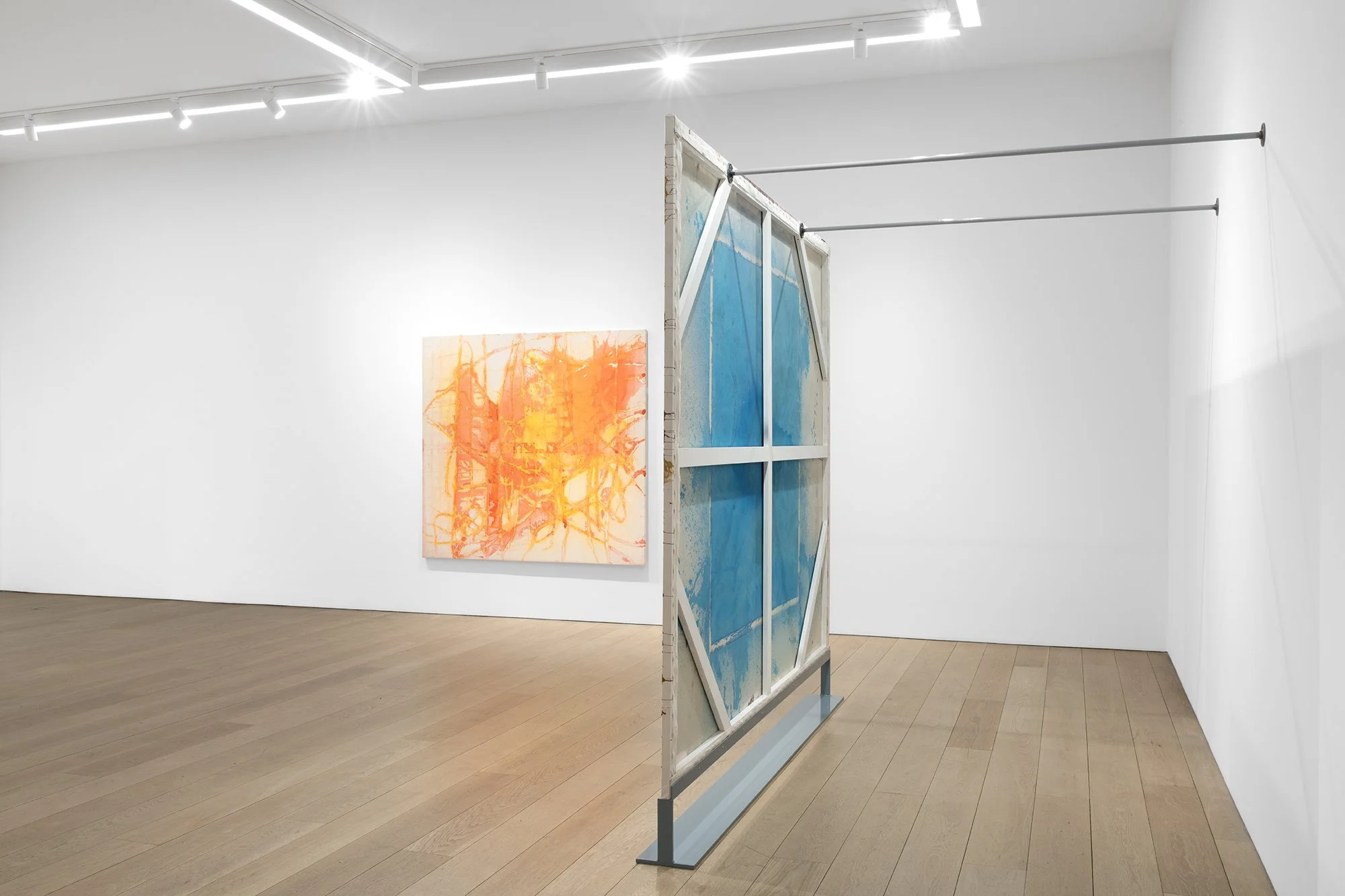
Half of the paintings in the show explicitly problematized the painting’s verso, the back side of the canvas flush against the wall; a place where signature and date, perhaps a list of media or a dedication, are usually hidden from the viewer; a surface that belongs to the mere object an artwork becomes when taken off the wall and packed up for storage or shipping, or conservation or research, or appraisal or theft. Three of Nelson’s paintings were displayed off the wall, clamped or propped upright in artist-designed, powder-coated steel stands, so that both sides were visible, recto-verso. Another hung with (what would normally be considered) its recto against the wall, its strainer, partially painted itself (part of the painting itself), facing outward. These paintings are literally sub-vers-ive. Where, they ask, does a painting begin and end? The successful paintings in the show—the artistically subversive ones—both prompt the question and give an answer; each their own.
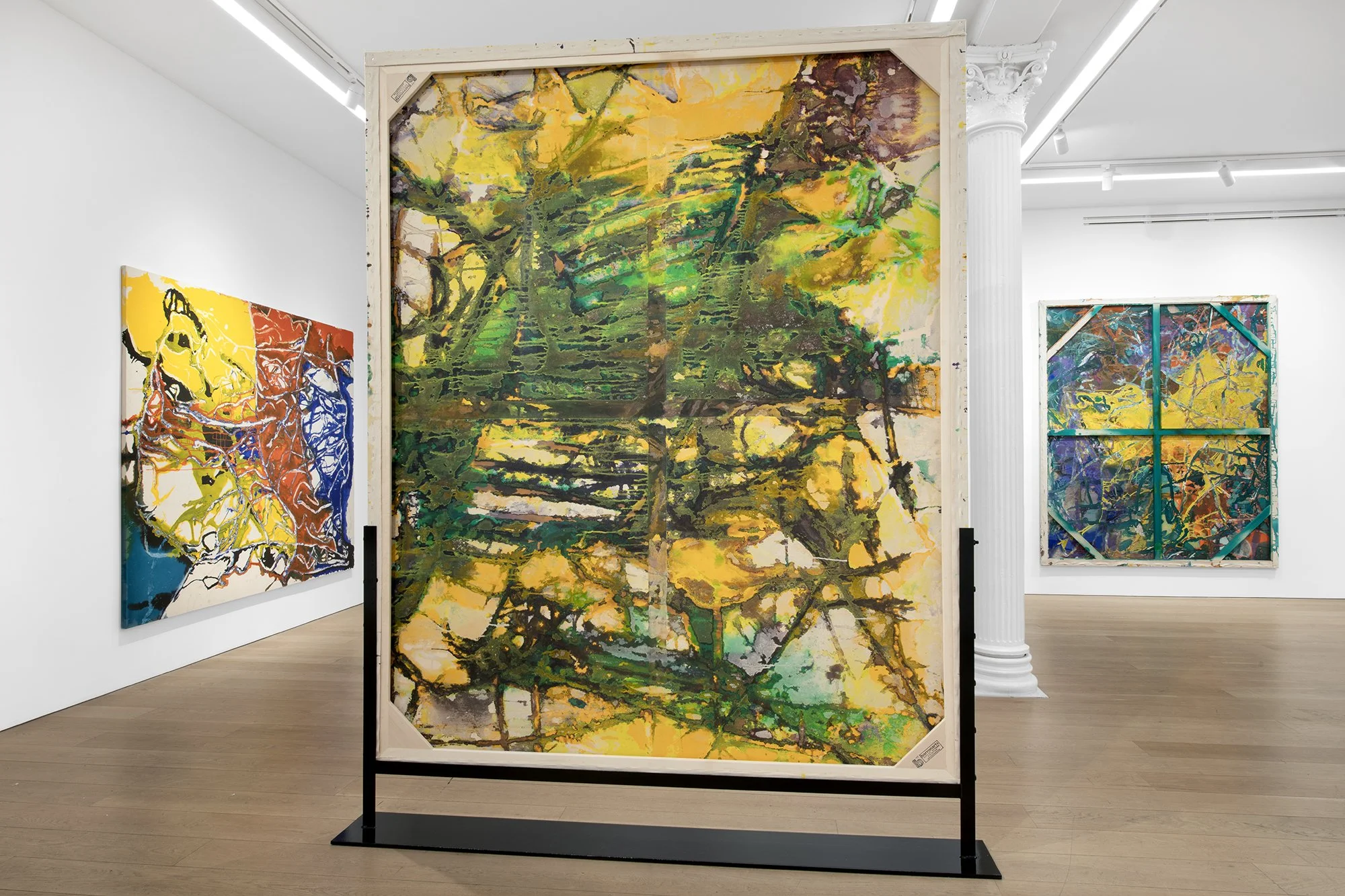
Installation view, The Individualism of Dona Nelson. Courtesy of the artist and CANADA.
Where do these paintings begin and end? If we, following common sense, take the limits of a painting to be its four edges, there were six paintings in CANADA’s main gallery. But it is generally taken as given in the artworld that the individual painting, defined by its edges, is not the relevant unit of artistic experience. We see shows, have favorite artists, read exhibition texts, comment on curation, group pieces under oeuvres and -isms, but only briefly linger before individual works. Paintings, we have been told, begin within a context (whether socio-historical circumstances or the artist’s psychology) and are intelligible within a context (the exhibition). Thus habituated to contextual categorization, we might first subsume Nelson’s abstract paintings, with their energetic lines and painterly splatters, under the category of abstract expressionism, recalling vaguely Pollock’s drips or Frankenthaler’s stains. But we find, up close, faced with their peculiar surfaces, that such superficial comparisons pale before each painting’s individuality.
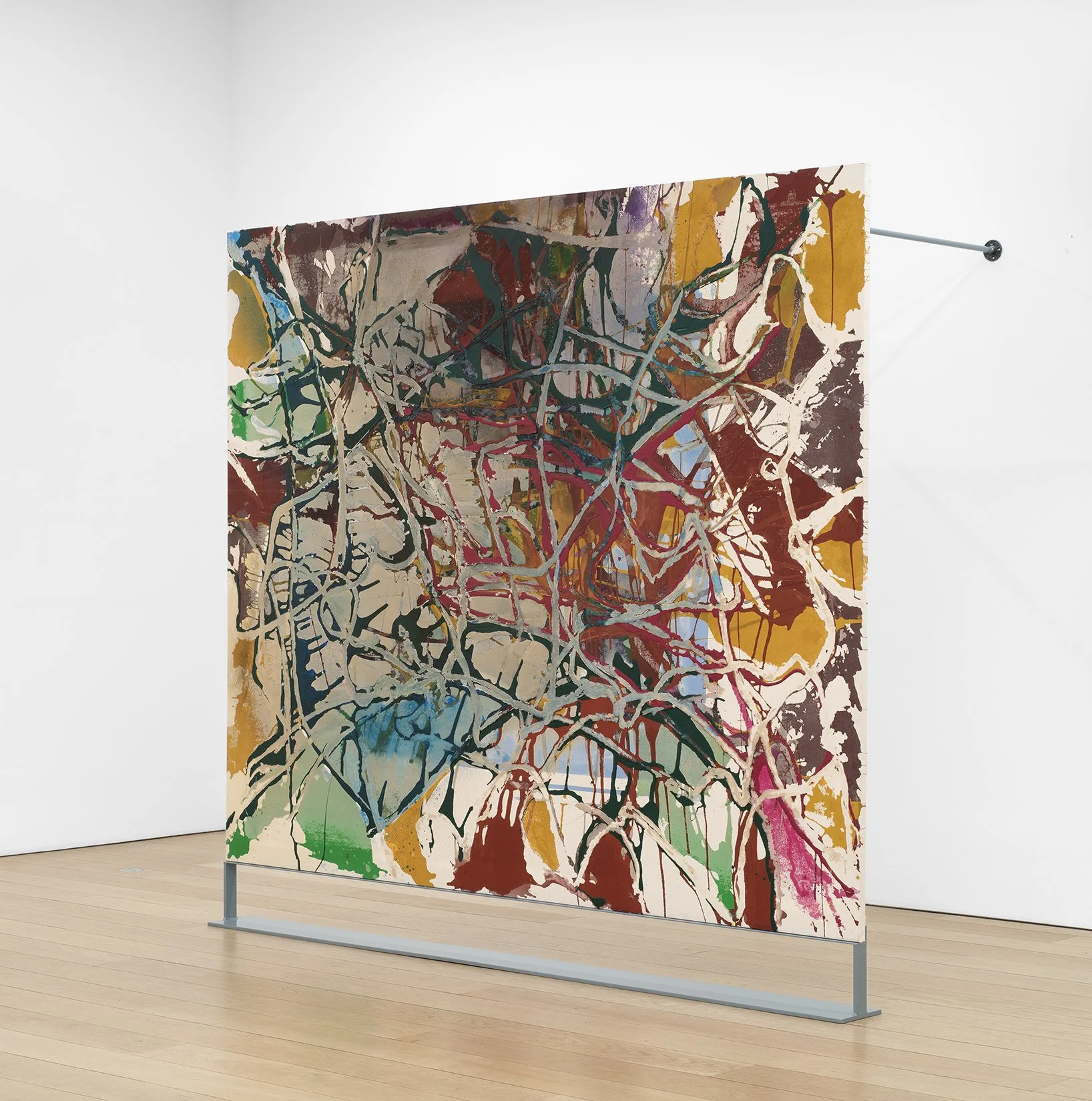
The Pollock-like lines (to a viewer who can’t resist an art historical reference) turn out to be utterly different from Pollock’s optical arabesques: scars on the surface, the consequence of acrylic-dunked muslin thrown on the canvas, left to dry, then ripped off, leaving shattered ridges with petrified remnants of cloth, some opaque with pigment, others transparent enough to show the canvas beneath. Subsequent layers of paint are built up in many layers, poured, or flung on top. The thick acrylic ridges serve as a resist, determining the path of the looser paint that trickles around them and selectively bleeds through the surrounding unprimed canvas to the other side. Materially, the paintings are as much the paint on their surface as that which once was there but is no longer, now torn away or covered up. Their past is sedimented in their present form. Each tells us its own history: the nature of itself and its antecedents.
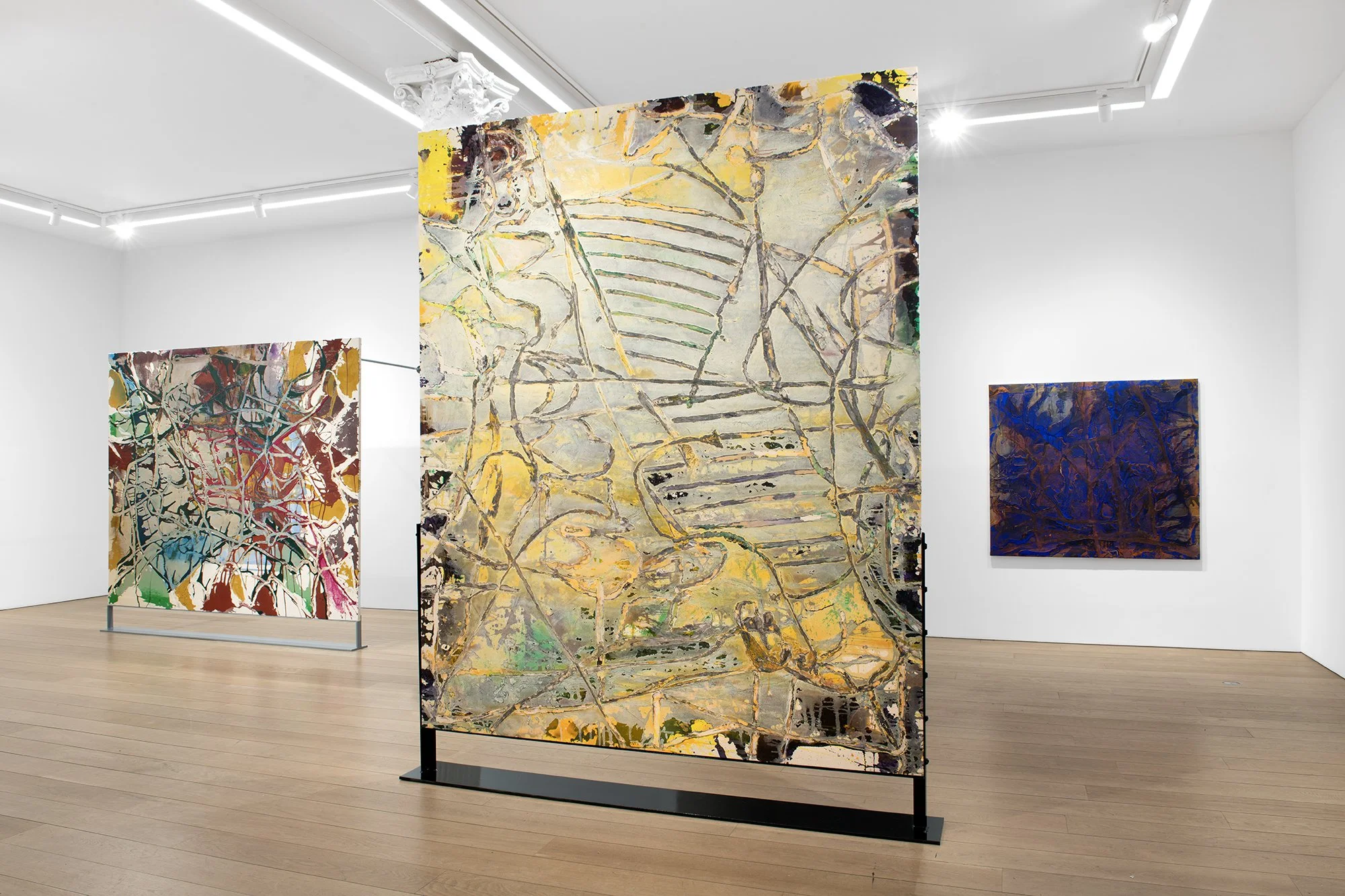
Installation view, The Individualism of Dona Nelson. Courtesy of the artist and CANADA.
Among the antecedents no longer present but, we presume, involved in their becoming is the empirical person who, we are told, made them. But what is the nature of the this person according to these paintings?—What are humans, artists and viewers, to these paintings? Not, as our biopic-loving age is wont to think, psychologies with intentions or emotions that are prior to or beyond the paintings on view. Although the lines at first appear gestural, there is no simple causal relationship between mark and maker’s body, as is characteristic of the (oversimple idea of) expression associated with (a superficial picture of) abstract expressionism. Nelson’s lines are not extensions of her body; the stains are not color-based decisions applied according to preference or preconception. Among the splatters and calcified pours, no brushstroke the scale of a human, nor their signature, is present. According to the paintings themselves, the material history they leave us to read, the human who made them is but energy, moved by and mover of matter that is always already there. The laws of Nelson’s paintings are material, the scale of action geological (erupting, flowing, shifting, flipping). Each painting is the surface of a planet, a world of its own with its own laws of coherence and material history: the artist is energy and matter formed and informed by the energy and matter of acrylic paint, canvas, strainers, and the possibility of abstraction; the viewer is energy and matter that can move around these worlds and enter into them by tracing material accidents developed into formal relations until accidents become necessity.
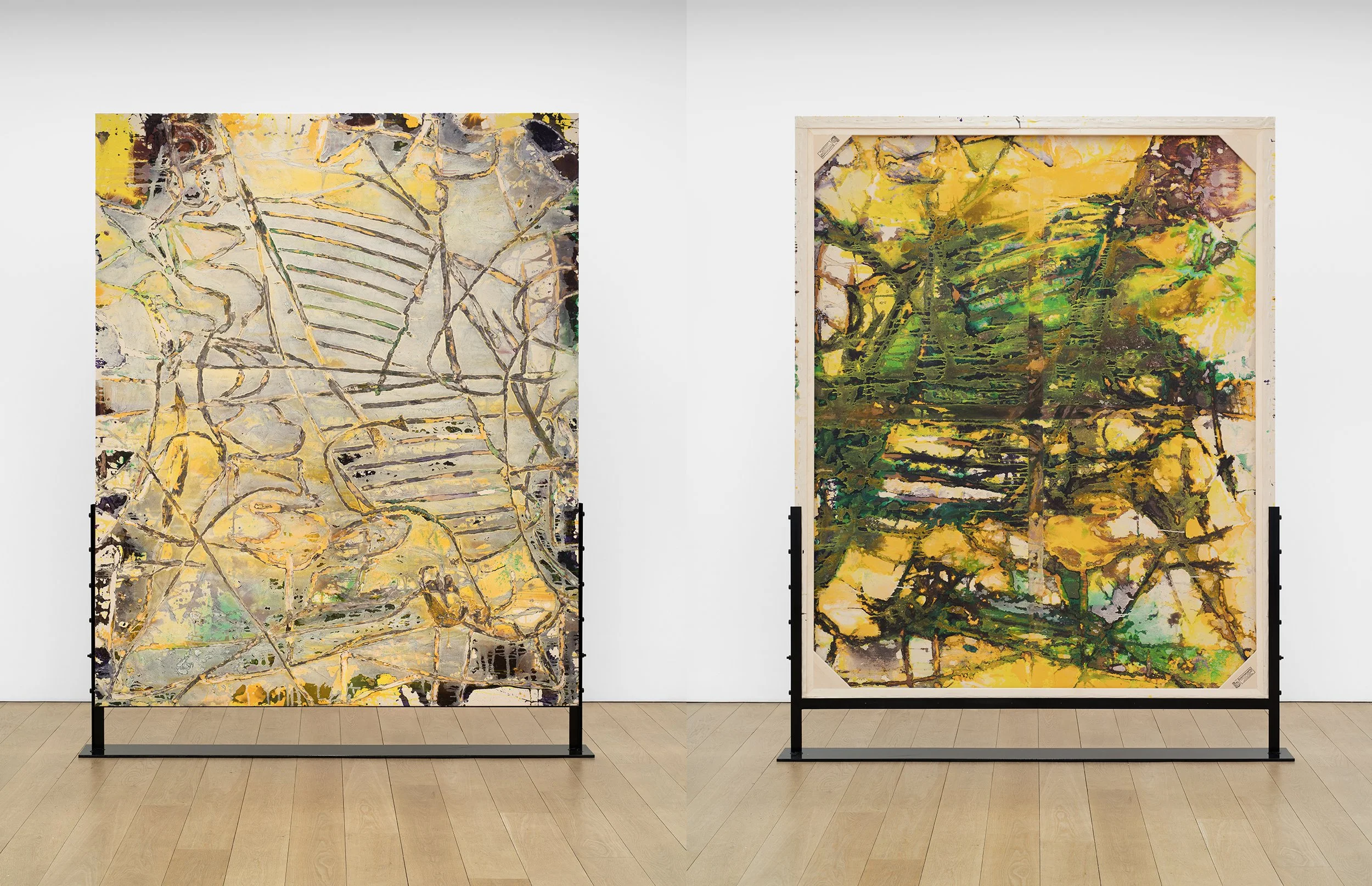
Dona Nelson, Grass, 2025. Acrylic paint on canvas, 108 x 88 inches. Courtesy of the artist and CANADA.
The worlds of the freestanding paintings encompass more than just what’s on their surface. The peculiarity of each surface, their different relations to the gallery space, the treatments of the strainers when visible, the confusion of conventional orienting terms like front and back, tell us that these paintings conceive of themselves as singular individuals, each with its proper mode of display. Nothing was taken as given in their making. Nothing should be taken as given in our understanding of them. As individuals, they—the ones that work—start within themselves and extend their logic to the space. They, in other words, create the world, are themselves the context in which the world is intelligible—not the other way around.
In Grass, the world is permeable and simultaneous. The divisions of front and back are emptied of their conventional opposition because what is applied on the recto (thick acrylic ridges and pours of liquid paint) permeates the canvas that usually separates it from the back. The very thing that divides the opposites is what unites them; the same actions produce effects that appear different from different views. This world of simultaneity must, however, be experienced through time, for a viewer, neither omniscient nor omnipresent, must move from face to face, tracking correspondences of paint and permeation, sometimes obscured by newer layers of paint. Grass’s world encompasses the other paintings in the show, exemplifying their nature as two-sided unities made through a similar treatment of surface and exisiting simultaneously in the space.
For Monday, by contrast, the world is divided into inner and outer. Two horizontal bars that prop the painting upright suggest a cuboid space between the wall they’re anchored to and the back of the free-standing painting, which is unpainted except for the stain of a blue square that has seeped through from the first layer of paint applied to the other side—the outside in opposition to the inside of the cube. The cerulean square stain seems to glow, its edges bleeding into the raw canvas, bisected by a white-painted strainer. In contrast, the outer face is built up and chipped off, a multi-colored shell that all but obscures a few traces of that original blue square that seeped through to the inside. This explicitly material, calcified outside is continuous with, but not simultaneous with, the cuboid interior. In this painting’s world, the other paintings on the wall are hiding private insides, and the gallery becomes a sanctuary (filled with rectangles), set apart from the bustle and calcified grime of Canal Street.
The paintings in the show that don’t stand on their own (figuratively) are the ones that isolate a single aspect of Nelson’s process, thereby depending on the other paintings in the show to illuminate the history of their making. Through the Day flattens into decoration without the knowledge, gained from the two-sided works in the show, that its verso may have more to offer (but doesn’t in this exhibition).
Most (so-called) artworks today (mis)take their role to be that of mere imitation of the given world and the fragmentation and absurdity that constitute contemporary life. To take the disorder of the given world, the remnants of past conventions and stories we’re told, and to reorganize it according to the new logic of an artwork (painted or otherwise)—that is the kind of subversion that art is capable of. A good painting creates a world according to the relations internal to it, one that we can only access by letting the work tell us what its world is. And that—the creation of a web of relations that constitute a coherent world—is what constitutes the individualism of Dona Nelson, or at least the individual nature of the successful works in the show.
(And, who knows —perhaps those paintings that don't stand alone, that don’t produce a world of their own in this space, might do so in a different space, off the wall or flipped around. Not all worlds are accessible to us at all times, both because the object may not be so oriented as to give us its whole self, and—the more common cause—because we are not willing to overcome our individualism to see another individual when they try to reveal themselves to us.)
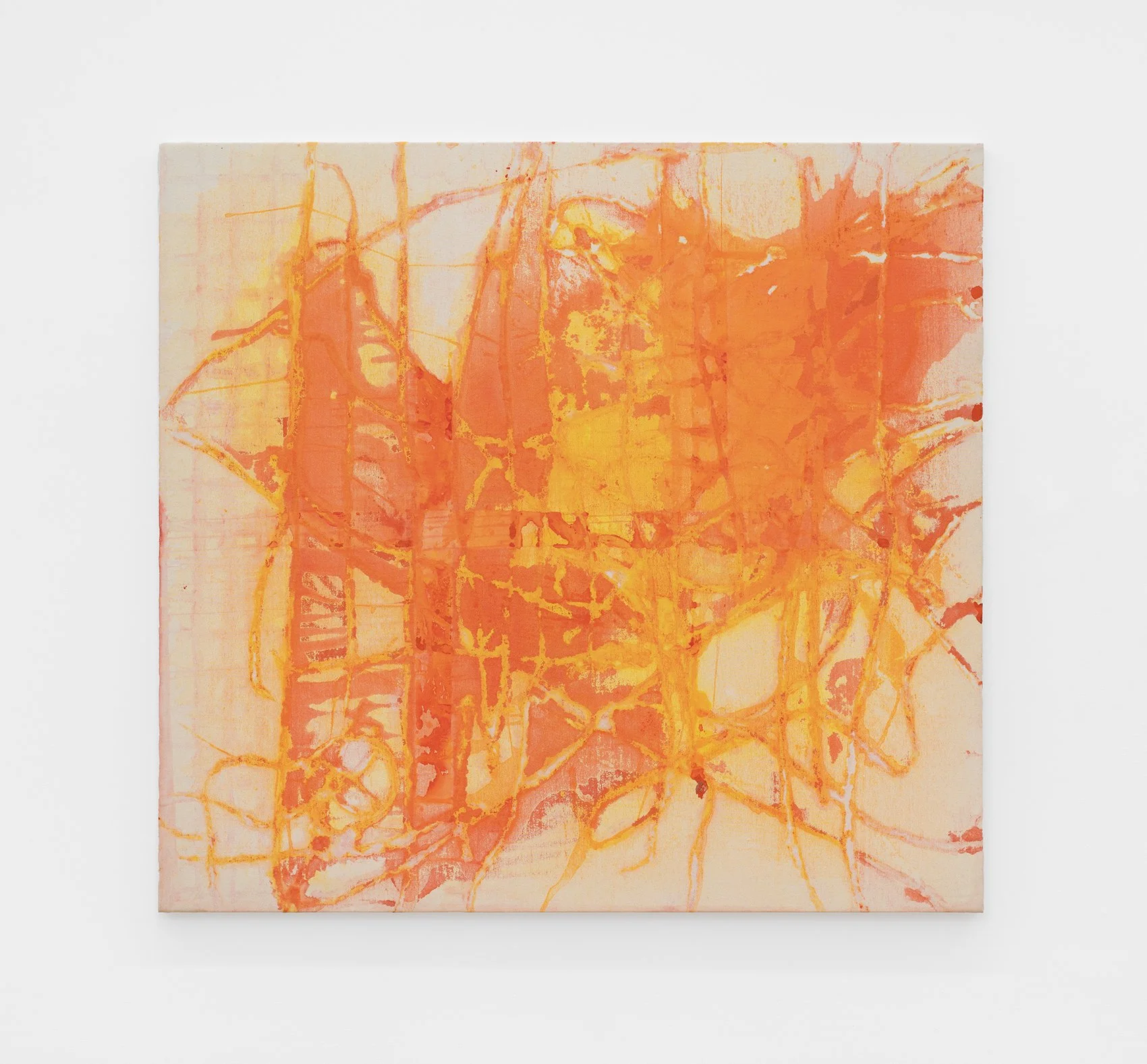
Dona Nelson, Through the Day, 2024. Acrylic paint and acrylic mediums on canvas, painted wood stretcher, powder-coated steel. 70 × 75 inches. Courtesy of the artist and CANADA.