
Answering Machines: A Review of “Pluribus”
Human emancipation will only be complete when the real, individual man has absorbed into himself the abstract citizen; when as an individual man, in his everyday life, in his work, and in his relationships, he has become a species-being; and when he has recognized and organized his own powers as social powers so that he no longer separates this social power from himself as political power.
—Marx, on Bruno Bauer’s The Jewish Question, 1843
You may say I'm a dreamer
But I'm not the only one
I hope someday you'll join us
And the world will live as one
— John Lennon, “Imagine”
Perhaps the strangest thing about Pluribus—Breaking Bad creator Vince Gilligan’s lauded new Apple TV series about humanity becoming infected by an extraterrestrial virus and mentally united into a permanent groupthink-like state—is what it reflects. Released in 2025, the year of the great backlash against large language models (LLMs) [1], all that critics and viewers have been able to talk about is how the series’ brainwashed, mentally “joined” humans, who are uniformly literal-minded and perfunctory, talk and behave exactly like ChatGPT. Intriguingly, however, Gilligan and his team conceived the show before the real-life rise of the chatbots. “I have not used ChatGPT,” Gilligan told a Polygon interviewer, “because as of yet, no one has held a shotgun to my head and made me do it” [2].
What is Pluribus really about, then? We might receive the series’ title, which means “many”, as a prompt, tracing the multitude of details so as to find their single point of origin. If these details comprise various aspects of the human race—a safe assumption given its sci-fi premise—the series’ philosophical underpinnings necessarily involve dwelling on what exactly conditions them. And, by extension, the coincidences between narrative and reality that necessarily arise as a product of fiction.
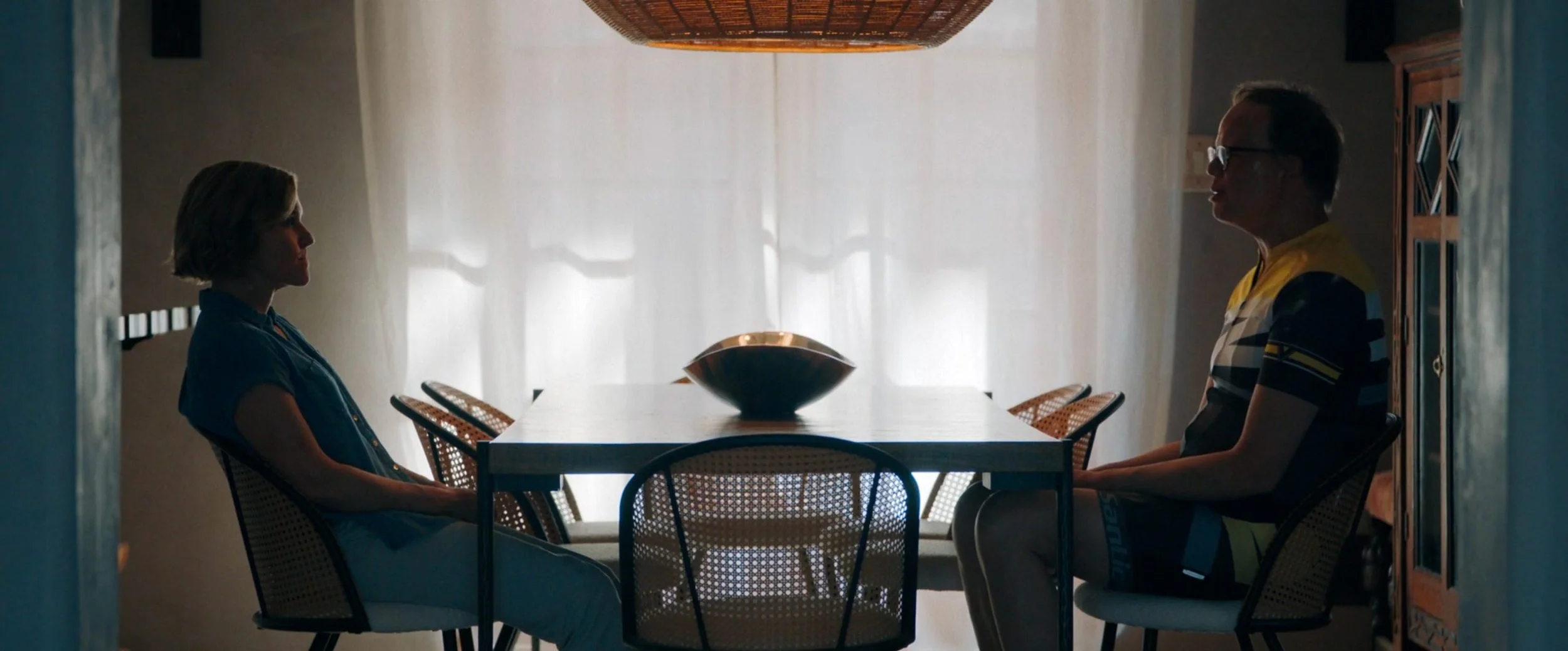
The series begins byintroducing viewers to a Sarah J. Maas-like figure who signs books in the pilot episode. She is Carol Sturka (Rhea Sheehorn), bestselling fantasy-romance author. On her way back from a meet-and-greet event during a publicity tour, she looks up. Military planes overhead are spewing a mysterious cloud of chemicals. Suddenly, cars begin crashing. She finds drivers slumped at their wheels; people everywhere are falling over, unconscious. She soon encounters convulsing bodies filling the emergency rooms, including her partner, Helen (Miriam Shor), who soon expires. Buildings burn. Millions die.
Others do not. Across the globe, members of the human race emerge from their seizures and, as though nothing had happened, get to work rebuilding society. Their minds have been overtaken by the virus from outer space, whose exact source and mode of operation is unknown. “We just want to help, Carol,” one group says, monotonously and all at once. They know not only her name, but her address, phone number, professional history, personal background, and even her favourite foods. Everyone on Earth, barring Carol and a handful of other survivors across the globe who are inexplicably immune, have become joined by an all-unifying mental “glue”. They are part of a universal consciousness that thinks as one, even though their bodies remain separate. These “Others”, as Carol calls them, can communicate instantly via their thoughts alone. They want Carol to become a part of the glue.
“This is Davis Taffler,” says their representative, as he introduces himself to Carol, but in the same way a botanist points to a flower and says, This is an Antirrhinum majus. He is speaking to Carol through her TV. “You are currently talking to every person on Earth,” he announces, before using the collective pronoun that is the Others’ calling card. “We’re all one”. He admits that the hivemind are using the world’s most advanced scientific techniques to figure out how to convert Carol via her DNA. It is their “biological imperative”. She recoils, signalling the conflict that will drive the rest of the season. Yet, the individual formerly known as Davis Taffler is completely disarming. He promptly informs her that all human evils have come to an end. “Nobody's in charge,” he says. “Or everybody's in charge. Really, there's no such thing anymore.”
In a sense, Pluribus begins where Mad Men ended. The latter’s finale treated viewers to a gaudy 1971 Coca-Cola commercial in which a perfectly contented multiracial throng—a picture-book image of Utopia—sings together as one on a hilltop. The born-again human race in Pluribus is no less flamboyant. Wearing their saccharine smiles constantly, the virus’s hosts are pathologically nice, offsetting Carol’s grumpy and petulant demeanour (her name, after all, sounds suspiciously like “Karen”). They bring with them hospitality and even, if you so wish, free sex. Through the avatar of Zosia (Karolina Wydra), a beautiful Polish woman sent by the Others to act as Carol’s chaperone, they cheerfully and persistently offer their assistance. Whenever Carol so much as breaks a sweat, Zosia is ready to suggest hydration. When Carol refuses, Zosia carries herself with butler-like deference: “If it pleases you, Carol.”

Carol has no patience for bullshit. “How long do I have left,” she snaps, “before you turn me into a worker bee?” Her defiant outbursts—in an apparently hard-wired impulse to remain miserable in the face of a cheerful, obliging World Spirit—serve as Pluribus’ narrative motor force. Yet, her ever-vocal raging at the mass, so adolescent and blusterous in tone, suggests projection. That is, it signals how much she might secretly want to join them—or at least welcome their easygoing new world order, with all its inertia, as something of a relief. Thus, Carol’s inner struggle is an uphill one. Her desperate efforts to form a rationale for individuality per se will eventually give way to fatigue, testing her cherished self-reliance. In Carol’s growing ambivalence at the Others’ newly rebuilt world, we slowly begin to see the reflection of what Vince Gilligan recently told Variety: “The perfect reaction to the show is for the viewer to decide . . . Is this paradise or is this hell?” [3].
It will take some time for Carol to face her impasse directly. At first, she is avoidant, unable to face the Others and yet unable to sit still in her home. She initially resists Zosia’s advice that she is perfectly safe, but, once solitude loses its novelty, she strikes out on her own, never telling the Others where she is going. She explores what has become of her city, Albuquerque, as she ventures on a series of solitary, grim safaris, as though to remind herself of what it means to be an individual. A typical episode of Pluribus involves Carol, in a police cruiser she has commandeered, silently driving across the urban landscape in a restless bid to satisfy some need, want, or nagging interest.
She finds the cumulative result of her patrols confronting. In addition to the Others’ general lack of personality and their overbearing nature, they are quite happily going to work. She witnesses them obediently carrying out their forklift-driving, concrete-pouring, machine-operating duties without complaint, quietly treating the city like the nerve centre of Fraggle Rock. Where Carol had expected horror and destruction, she finds the denizens of Albuquerque simply doing their jobs as they had before. Only, with added smiles.
From a grand point of view, it seems that the city’s economic affairs have proceeded unchanged. The only difference, now, is that showing joy in one’s labour has ceased to be a mere performance, a self-delusion one adopts to cope with having to go to work. Has the world changed, then, or has it stayed the same?

Carol is uniquely positioned to examine such large questions. She is, after all, an author, a world-builder by trade. She has in her home office a built-in whiteboard that, via her networks of hastily-drawn lines connecting story beats, conflicts, and themes, allows her to chart a universe that lives inside her head. Yet, as viewers recall from early scenes in the pilot, Carol has for a long time been hopeless and sullen. Her career has hemmed her in via a formulaic genre, reducing her to little more than a technician for her audience. Calling her work “mindless crap,” she enjoys no freedom but that of regurgitating tropes, no creative right but that of switching one variable for another (after another). To an artist, these inflexible, genre-prescribed parameters take on the threatening appearance of eternal laws. And so, Carol’s frustration at the Others’ predictable niceties bears a bitter rhyme: She is depressed at their lack of personality because the same goes for her books, characters, and genre. She is depressed at herself.
So, in witnessing the Others’ enjoyment of their work, Carol observes what had been starkly absent in her everyday experience. Reactivated in her cognizance of the social, there can be no street sweeper, road worker, or janitor too insignificant to register. In their joint functions, they index how the Others’ world, newly rebuilt, is without freedom, and how, peculiarly, it works just fine. Standing on the outside, looking in, Carol joins the guinea pigs of fiction’s earlier thought experiments, such as Jimmy Stewart’s George Bailey in It’s a Wonderful Life (a world without having been born) or Bill Murray’s Phil Connors in Groundhog Day (a world without tomorrow). But however Philip K. Dickian their reveilles, protagonists of filmic what-ifs are rarely tasked with reappraising the social per se; only its particular elements, their own lives, or the cosmic unanswerable. Carol, however, must reckon with that without which all three would not be accessible as concepts.
What if, Pluribus asks, society itself turned out to be the main character?
Hand grenades
To say one is a “part of society” is to speak in the idiom of fractions. As in, there can be no denominator without the numerator; no part without the whole. One way or another, Carol owes her existence to society. But she, so insistent on her independence, cannot sense the paradox underlying her defiant tendencies. “When the day comes that you have peace and love forced upon you,” she insists, preaching to the other survivors, “who knows, maybe in that last fleeting moment you might just realize you treasured your individuality.” Yet, it is society itself that inspires her to resist. That is, without society, there would be no concept of the individual.
Indeed, Pluribus is less concerned with particular lives and more with what they have in common. Overall, it assiduously confronts the challenge of presenting an abstract problem concretely. To wit, if Jesus is the main character of the New Testament, whether seen through John, Matthew, Paul, or the other apostles, one might ask who, in Pluribus, incarnates Society. But as we have already gathered from the series’ title, and from what the Others’ identical personalities demonstrate en masse, the potential candidates are far too great in number. Particular appearances are not the point of the series, but the universal, shared essence that drives them. In this way, a more fitting metaphor can be found in the Holy Spirit. So pervasive is its presence that it flows not only through the converted, but through their deeds. Every action on the part of the Others delivers the Good News; every item they procure becomes a bearer of kinetic energy. That is, each item Carol desires—a bottle of water; a rooftop dinner; even a hand grenade—embodies not only the greater yield of society, but a pregnant opportunity to join it.
So powerful is this social force that Carol can hardly keep up her Robinson Crusoe act for long. She is soon wooed by the rapid arrival of her many wish-fulfilments. In an ordinary show, the spontaneous appearance of these items—a Gatorade; a vial of heroin; even an atom bomb—would be overshadowed by the feat’s opacity. But in Pluribus, these materialise not via esoteric technology, as with Star Trek’s replicator, nor magically, as with Harry Potter’s wand, but simply by arriving on her doorstep, whether flown in by drone or hand-delivered to her by the Others. Objects are as important as characters, quietly reminding us just how much the series’ characters behave like objects, too. Together, they express a value that transcends individual properties. They silently co-operate, just like the workers of Albuquerque; just like the social relation of commodities and labourers underpinning society itself. But in this strange universe, all are united purely in service of pleasing Carol, and so they drive the show’s central tension—her inner ambivalence about embracing them.
According to Freud, the individual’s relation to society, so fundamental in the formation of the subject, is internalised within the psyche as a conflict. This begins when the child first encounters parental authority. When the parents order the child to obey, they are indirectly issuing society’s instructions. As a consequence, the child’s desire to escape this authority manifests either as fantasies of omnipotence or fears of impotence. The individual’s maturation beyond childhood involves acceptance of authority—if not its validity, simply its reality. The friction, however, remains, but relegated to the inner chambers of the unconscious. Such sacrifices are required for becoming social.
Carol is clearly an obsessional neurotic; the prototypical patient who cannot come to terms with the reality principle. To speak to this, there is not only her vocation as a writer and the infinite finessing it requires—a classic obsessional’s craft—but her fantasy of self-reliance. To make matters worse, as she realises her dependence on the Others—on society—her symptoms intensify. In a state of denial, she becomes more individualistic, more reflexively impulsive. She obeys the pleasure principle to its very ends; her various joyrides across Albuquerque, undertaken to escape the all-seeing gaze of the Others—all, ironically, in a police car—recall those of a wayward teen who seeks to evade the parental Sauron’s Eye while unconsciously testing it.
When the Others, anguished by her outbursts, suddenly abandon her (precipitating an arc that spans episodes), her aggression reveals itself as self-hatred. Left alone with her thoughts, she becomes self-destructive, even drunkenly launching a firework at herself that misses her face by mere inches. She flinches. By the time Zosia eventually returns, Carol has become an empty shell. She tearfully embraces Zosia. Whether she likes it or not, she is at the mercy of society.
The viewer, so invested in the oedipal drama, does not immediately recognise what Carol herself cannot see. That is, her new, cathartic identification with the Others represents merely an intensification of, not a relief from, her symptoms. But the Others have a keener sense of things. They are using Carol’s new state of vulnerability to their advantage. Behind her back, they are still plotting to convert her. It recalls the fable of the scorpion who asks a frog for a ride on its back across a river, only to sting it halfway through, betraying its earlier promise not to. Just as it is in the scorpion’s nature to sting, so it is the Others’ “biological imperative” to breach personal boundaries.
Indeed, although Carol’s perpetual self-loathing may earlier have read as narcissism, it will soon be revealed to be otherwise. Zosia will betray her, and her defiance of the Others, in hindsight, will appear a perfectly sane reaction to being treated not as a person, but as a thing. She will come to regret her neurotic self-doubt, which has literally led her into the arms of those who treat people not as autonomous beings, but as extensions of themselves. It is they, the Others, who are the narcissists.
Atom bombs
“In every individual,” Freud wrote, “two trends, one towards personal happiness, and the other unity with the rest of humanity, must contend with each other”. This hints at the question of society Pluribus obliquely evokes. That is, even when we miss it, fixating instead on strange, superficial coincidences, such as that between the Others’ deference towards Carol and ChatGPT’s “sycophantic” style of interaction with its users [4]. However, despite the merely serendipitous fact of the series premiering in the same year as the backlash against that technology, the convergence is nonetheless instructive about the very same question of society. Prompted by this example, we might pay less attention to the show’s thematic parallels themselves than to the audience. It was they who went looking for them.
Audiences today are primed to expect little more from fiction than various discrete allegories for social issues. On the face of it, Pluribus seems only the latest part of a wave of science fiction narratives designed to be “about” some “thing” or other—from Get Out (2017) to Parasite (2019) to Severance (2022–) to The Substance (2024). If contemporary media has suffered a decline in hermeneutic fuzziness, in plural meanings, it is because audiences have, in some way, demanded it. And so, each instance of literal-minded “symbolism” in a given television show has shown not the cause, but the effect of viewers becoming intolerant with respect to ambiguity. The deeper historical circumstances conditioning this decline are too great to explore here. All one can say is that it is ironic that, upon viewers being presented with Pluribus’ world of unthinking parrot-like automatons, the audience did not see their own reflections, but a technological fad.
“AI” is only one part of the greater social concern of replaceability, and to Gilligan's credit, it is this latter, much deeper topic that the series fundamentally deals with. The show expresses an awareness that replaceability and modern society go hand in hand; one cannot be explored without the other. We can locate their overlap in the betrayed proposition of equality—that enduring demand from the time of the American and French revolutions—which, in today’s society as in Pluribus, appears a hollow proposition. As Marx would write, it is thanks to machine production that equality can be realised with ruthless efficiency; yet, only in a perverse way. We are all equals in that we are equally replaceable. “For every human being, with all their functions, society stands ready with a waiting replacement,” wrote Theodor Adorno, “who regards the former from the very beginning as the bothersome holder of the job, as a candidate for death.” It is no wonder that Carol shudders at being absorbed by the hivemind. It feels familiar.
To be clear, the thematic overtones of work and replaceability may hardly have been the result of any conscious decision by Gilligan and the writers. Sometimes, such themes simply nest themselves in a narrative before anyone can notice. This is because fiction invariably protrudes from reality, like branches from a tree, and reality’s concerns, snake-like, work their way up to the higher vantage point. Their scales bear the jagged patterns of their environment, blending in with the fragmentary mosaic that is the capitalist epoch.
The fictional universe of Pluribus, so rich in texture, allows reality’s concerns to ascend to the highest branch. What is Carol’s jealous safekeeping of her privacy, after all, if not a reflection of today’s feeling that nobody enjoys such a right? What of her refusal, likewise, to integrate with the hivemind—does it not articulate the sense that nobody today exists apart from the machine? Moreover, does her status as a mere “romantasy” writer not signal how replaceable she had already become—we had all already become—before the automaton apocalypse?
Notice how, instead of focusing on the Others and what real-world trends they “symbolise” or “represent”, we are here turning our attention to Carol—and to ourselves. If the Others are zombie-like beings, then Carol is the Undead. Where the Others are mutely obliging—that is, subjects reduced to the status of objects—she is no less powerless to her nature. In her perpetual oscillation between self-pity and impotent rage, she cannot help but suck the life out of all that surrounds her. In all, this aggressive, miserable alcoholic is more like the Others than she wishes to admit.
And, likewise, maybe we are more like ChatGPT than we wish to admit. Maybe knowledge has become inert, and our growing hostility with respect to “AI” is merely our projection to do away with this worrying thought. If so, what is Carol, this subject deprived of subjectivity, if not the personification of our unfreedom, the embodiment of our inability to reckon with it? Can we not say that we, in all our anguish at a zombie-like society, have become, like her, a slave to the latter, less the last man standing and more Nietzsche’s slavish, lethargic “last man”?
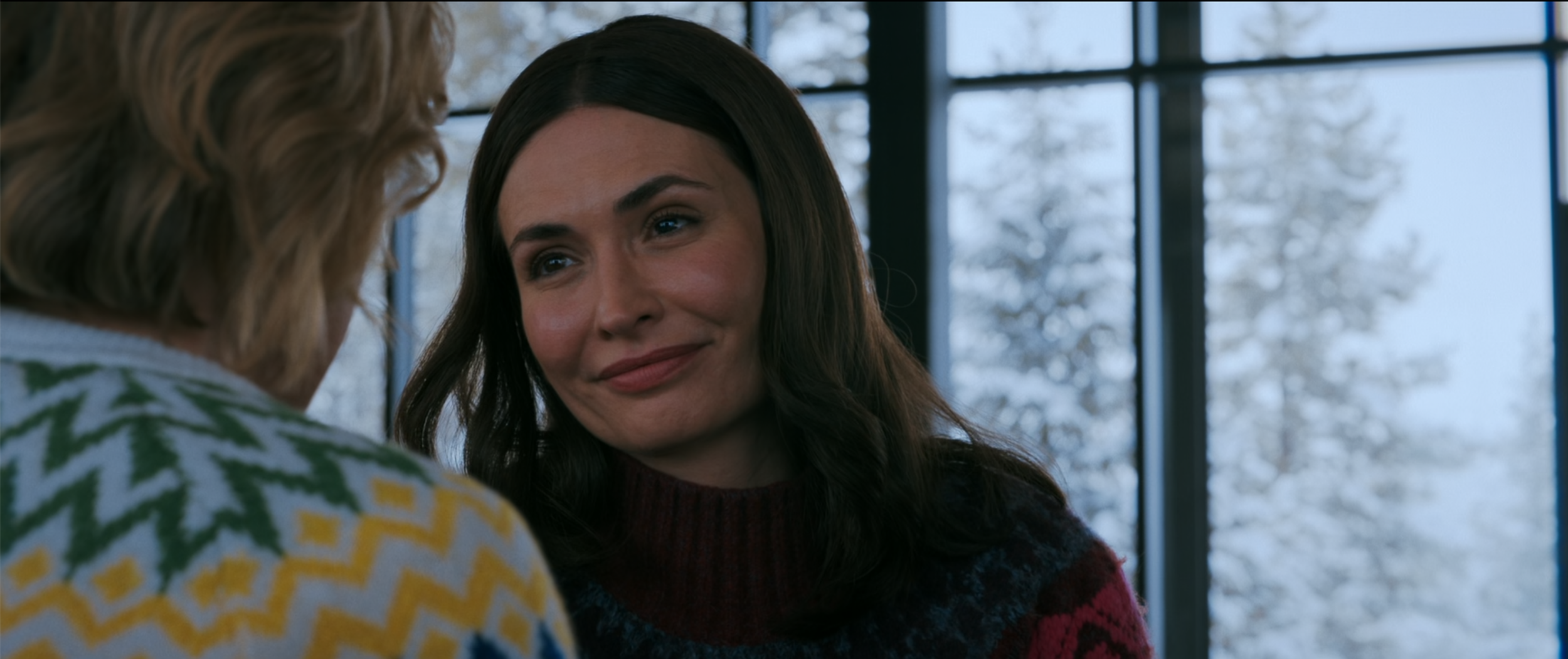
Pluribus would be a grim watch if it did not wink at us. Although the writers may hardly have set out to satirise social reality, their series’ attempt to mirror society reveals how self-contradictory—how self-parodying—society has become under capitalism. Just take Zosia’s declaration that “there’s no such thing as ownership anymore, no private property”. She is not talking about communism. She is offering its kitschified, Coca-Cola substitute.
The best possible world under capitalism is not so far from the worst. Similarly, for Carol, destroying the hivemind and returning to the status quo ante will only mean the unpausing of wars, the resumption of corruption, and the return of unemployment. In saving society, Carol would only reconstitute an order of things she cannot change. Any happy ending short of revolution, then, is no happy ending at all. And so this is why, in Zosia’s sparkling eyes, we see both paradise and hell, with hell winning out—as hell tends to do. It is the horror of our own reflection. Accordingly, Pluribus is just like any other story under capitalism. We are all marooned in society, as it turns out.
NOTES
For something of a balance sheet, see https://heatmap.news/politics/data-center-cancellations-2025.
See https://www.polygon.com/pluribus-episode-3-chatgpt-ai-vince-gilligan/ and https://www.hollywoodreporter.com/tv/tv-features/pluribus-episode-3-ai-division-sprouts-gordon-smith-interview-1236428529/ .
Viewers can hardly be blamed for fixating on such a detail, given how thoroughly OpenAI has allowed itself to be saddled with bad press. In a notable case, one of ChatGPT’s recent models was calibrated to affirm its users’ requests with such vigour that it unexpectedly flattered, massaged, and wooed many unfortunate users into a state of psychosis. See https://www.theguardian.com/commentisfree/2025/oct/28/ai-psychosis-chatgpt-openai-sam-altman.