Obsolescent Experience
It's unclear if the reconstitution of a movement to qualitatively change society's real existence — i.e. to overcome capitalism — would coincide with a reconstitution in the realm of art, despite the fact that the historical basis for both art and politics is the same. The struggle for socialism and art as a discrete field both stem from bourgeois society, they were animated by this society's subjectivity. Underlying this subjectivity was an optimism about mankind's capacity to change the world and itself. Art as art, art as we understand it, is the product of the transformation of a sphere of aristocratic and folk culture which never differentiated itself from religion or propaganda, into a vehicle for this new society's own unique realm: experience. Experience as something that one is seeking out is an idea that never occurred to the ancients. The ancients — or rather, the ancient aristocracy and clergy — were interested in reproducing tradition, rather than participating in the production of an experience that possibly no one has ever had before. Those who the French Revolution would refer to as the Third Estate — those who worked, rather than those who fought or prayed — had a tradition of their own: the tradition of slavery. An embryonic form of experience grew in utero within this caste, yet this proto-experience was synonymous with victimization: everything that happens to one as a passive recipient. The so-called experience of a peasant hardly differed from the “experience” of a prey animal. However, the dawn of bourgeois society — the society of labor — was underlied by a conscious recognition that experience had the potential to be more than what merely happens to us. Rather, what would it mean to take experience as something in which we feel ourselves as active participants, sensuously interfacing with the world and thereby transforming it? In other words, what if experience was actually the basis of our freedom, rather than the product of total unfreedom?
Experience is the conceptual plaything and abstract ideal of a modern, alienated people who can't quite grasp it. Yet it’s in this way that experience tasks us. A culture interested in experience qua experience is associated with a mankind who has been able to see for itself its own capacity to change its own world, to be the actor that makes one's world totally different from the hermetic world of one's childhood. And more importantly, this mankind is able to derive not just terror, but pleasure from this experience. Art as we know it emerged from this, and while its initial convulsions in the womb of a developing urban society mistook its own image as the perpetuation of values from the ancient world, this was a necessary misrecognition. Urban dwellers found themselves totally marooned from the realm of culture made for and dominated by the clergy and aristocracy. They identified with an equally marooned past, abandoned by Christendom. Yet art for the Greeks or Romans too was never just art per se, it was hardly art at all by our conception, and could not be differentiated from religion and propaganda. However, it was bourgeois society that was finally able to divorce this ancient art from religion, and take it as an object of autonomous aesthetic experience. This new freedom overturned the notion that art is merely one more node in a religious cosmology — a cosmology from which the ancients could not be extricated. Art became a domain in which mankind recognized its own capacity to make the world anew, and acted out this power through play. Critically however, the artwork also contained the reminder that the relationship between mankind and the world had not yet been mastered.
As the crisis of capitalism magnified in the late 19th century, art came to appear more free than ourselves, while actually becoming more and more curtailed in its capacity for free expression. The disintegration of the struggle for socialism in the 20th century coincided historically with a disintegration of art as a field with special formal concerns, and this was no coincidence. The origin of art and politics’s crises were one and the same — the crisis of freedom — yet the political sphere was the only potential means to overcome this crisis. The political failure meant that both spheres “persisted” while losing their vital centers. In the 19th century, art's self-exile into Bohemia was a protest against society that nevertheless emerged from society itself. This gave art the appearance of being both more and less free — more free to explore its own formal problems, less free to pierce into society’s workings which were becoming more of a black box everyday. Yet art’s greatly limited freedom nevertheless was a cryptogram for society's own unrealized freedom. Every great work of art always seems to contain an “if only…” After the potential to remake the world disappeared, modern art's antisocial sociability transformed into mere specialization — art became one “field” like any other. Without a society with real potential to qualitatively transform itself, a supposedly antisocial art actually lost its secret ratio essendi. Art experienced a radical inner decay. Today what counts for art has returned to the zone of pure “culture.” Popular art and music inherit the democratic core of Modernism without any of the antipathy towards this democratization. An important inner tension has been lost. Art in bourgeois society relied on an inner antagonism towards the so-called culture of which it was part, a tension which blocked it from becoming totally affirmative, propagandistic. Modern popular art and music, through its conformability to culture, would have us believe that it is a naive continuation of the art of antiquity — an authentic global folk culture. Yet this “authentic global folk culture” is produced by specialized technicians with schoolish knowledge of the whole of art history. So too in the fine arts where every artist today is a mannerist who scrounges through the past for inspiration. We are now contemporary instead of Modern (are we even contemporary?), the fact of our living in the present has become coincidental rather than historical.
The reconstitution of a project for socialism wouldn't necessarily mean a reinvigoration of art with that most vital component — optimism. Art’s declaration of independence from society in the 19th century transformed into a quarantine in the 20th. This quarantine was so successful (despite all attempts to create a "social" art which was neither social nor art), that a re-entry by art into society may in fact be impossible. The existence of art would perhaps have to find a new social basis to justify itself, an internal need found within the subjectivity of society's own individuals. But the destruction of the movement to overcome society's impasse also coincided with a deterioration of that society's subjective integrity, a breakdown in that subjectivity which was originally interested in experience at all. Reconstituting a movement for socialism would not simply mean the refounding of this subjectivity, which had a specific historical basis that allowed it to develop as it did. Actually it could be through the completion of the total denigration of our subjective faculties that a political movement to overcome capitalism might be founded. In other words, it might be the barbarians, those overcultured creatures who have grown tired of experience, that offer the real opportunity for revolutionary politics. It doesn't arise from this however, that an artistic impulse would follow. An experience-oriented subjectivity will not so easily be reclaimed after the 20th century pawned it away. Perhaps too, the piled up wreckage of art's formal impasses would not suddenly be answered for in the realm of freedom. It might be the case that all of our aesthetic hang-ups would suddenly dissolve, much like how centuries long ecclesiastical disputes seemed to suddenly terminate following the end of Catholicism's dominion over the Western world. The aesthetic realm could be free to move on.
For us however in the realm of unfreedom, art remains trapped in the bombed out ruins of Bohemia along with the lepers who loiter there. Yet they say these strange characters possess some remains of an ancient knowledge spoken in broken pidgin tongues... yet nobody quite remembers from whence it came.
On the outskirts of these ruins a hermit cries: “Woe to ye anthropologists who make camp here! Some knowledge truly is lost for all time.”
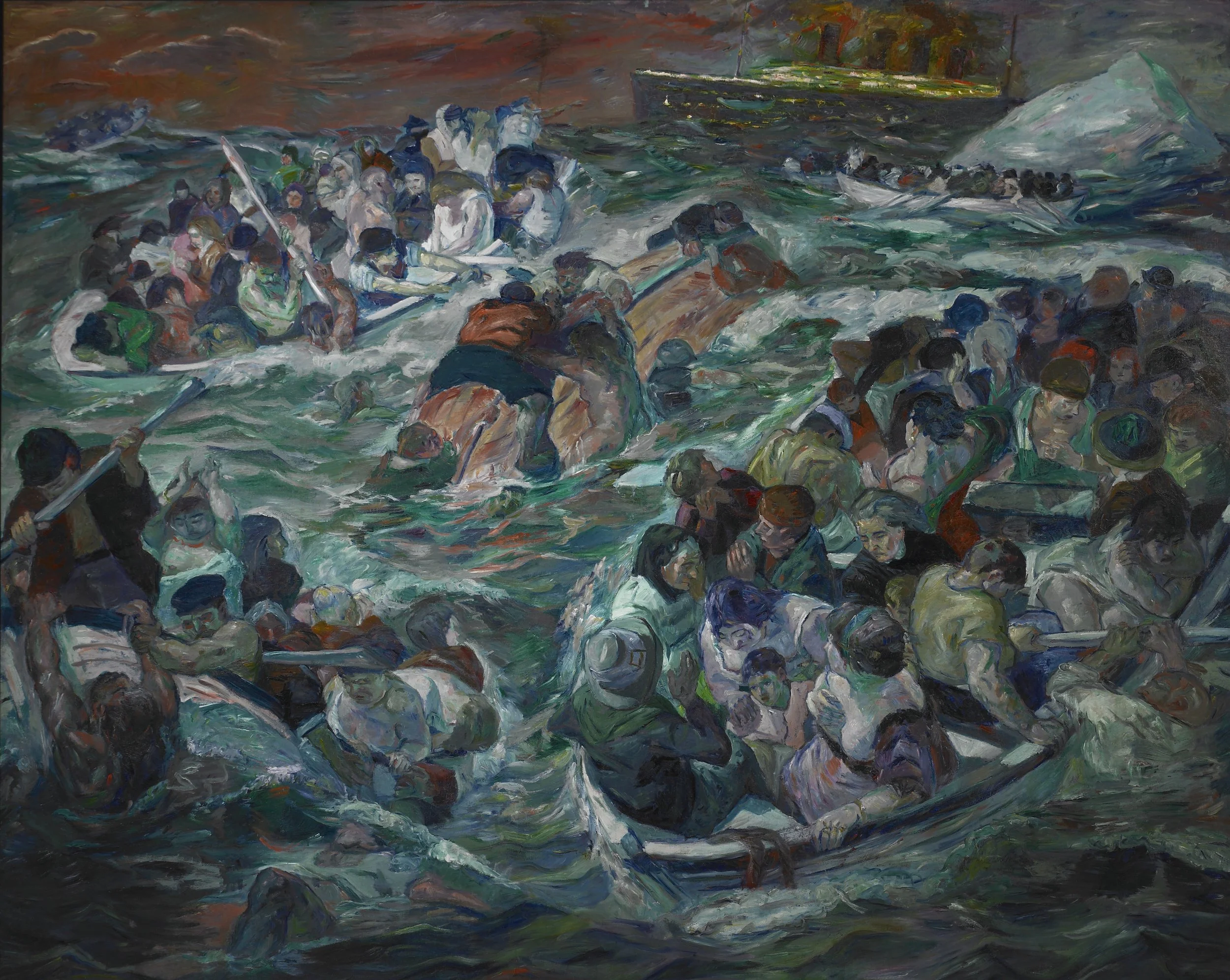
Max Beckmann, Sinking of the Titanic, 1912-1913. St. Louis Art Museum

Thomas Couture,The Fugitive, Study for Timon of Athens, 1857. Brooklyn Museum

Hubert Robert, An Artist Seated in the Ruins of the Colosseum, 1759. Art Institute of Chicago