The Whitney Biennial Will See Contemporary Art To Its End
“Approach an artwork. Imagine Yourself being transformed by it, emotionally and physically, Imagine yourself walking away changed.” This is one of Maia Chao’s Scores for the Museum Visitor in black vinyl wall text next to a rectangular outline delineating the absent artwork. At the 2026 Whitney Biennial one really has to fucking imagine being transformed by anything. Kitty-corner from Chao’s artless rectangle are some two dozen more artless rectangles: rule signs taken from New York City’s Privately Owned Public Spaces (POPS) that constitute David L. Johnson’s Rule, a comment on the many rules imposed in such spaces. I have never understood why POPS inspire so much ire in post-DSA urban planning types, but I suspect it has to do with a confused belief that unlike corporate-run POPS, proper public parks are indeed public. This is not true. They are owned and operated by the state, which has little to do with the public. But I digress. The point is that Johnson’s work doesn’t expect to be looked at in full, or really at all. Like most contemporary art, it is closer to a trade fair display, to be met with “huh” and “mm hmm.”
Chao’s empty rectangle, like the blank sections of new plaster in restorations of 12th century frescoes, is a relic of an irretrievable and poorly understood past. Viewers are instructed to pantomime what the ancients called “aesthetic experience.” The whole Biennial, in fact, feels like the work of a future civilization that has discovered the wreckage of 21st Century “contemporary art,” and did their best, based on extensive archeological and archival research, to stage a faithful reproduction. Like Colonial Williamsburg.
It all looks very much like art. The set pieces are convincing. But the synthetic feeling is inescapable. The invective to look like art is even carried out at the expense of touching the anarchic possibility of art. The script has been given. Johanna Unzueta’s drawings are quite charming. Dark and evasive like late Picabia. But they’re stood upright, smushed between pieces of plexiglass so that viewers can see both sides. The versos are indeed nice but not nice enough to justify this ridiculous display, and yet something tells me the ridiculous display was Unzueta’s ticket to the show. There was a time that a painting or drawing by virtue of its medium would, good or bad, resemble art. But now the look of art is supplied by Home Depot, ULine and Canal Plastics.
Kamrooz Aram is compelled to take his pleasant, elegantly composed and executed (if not terribly original) paintings on a self-effacing adventure through home decor such that their final appearance in the Biennial looks like one of the stronger booths at Design Miami. Both Aram and Unzueta produce the type of work that might have existed in Chao’s empty art rectangle, but appears in 2026 only in self-undermined form.
The problem worsens in a tendency across several works towards the fucked up, the disconcerting, and the abject — a tendency that consistently fall short of the mark. Weirdly the closest the Biennial came to this was in the unticketed first floor gallery by Zach Blas dressed up like a Disney World Berghain with an AI generated digital face and script that, when I entered, was going on about taking a tiny cock and licking cum (call me a prude, but nothing in the wall text indicates X rated content, I do hope no one brings their child in there). There’s a real desire to grasp the messiness of the world but it gets tidied up into memes.
Precious Okoyomon has filled the entire large 8th floor gallery with a forest of strange fruit: hundreds of plush toys hung by the neck in twine nooses, some low enough to be met at eye level. It’s disturbing, and the contradiction between a history of racial violence and an amnesiac present of mass market toys ought to be more productive than it is. But the sheer force of ice cream pastels and big plastic eyes overwhelms and the moment of contradiction is not sustained. The fact that viewers can walk among the hanging plushies does not help: it prohibits abrupt confrontation, the very approach that Chao imagined might produce transformation. It feels like an episode of Care Bears teaching children in gentle high pitched tones about the history of Jim Crowe and ending the episode in a resolution designed to head off any awkward dinner table conversations. For the grown ironic-Care-Bear millennial, the swing at abjection lands in lolz.
Andrea Fraser’s plaid grey sleeping toddlers rendered in wax gave me a start when I walked into the gallery. They might have been the tiny dust covered corpses seen so often in images from Gaza. But placed on white pedestals, sealed in glass vitrines and given expressions that suggest vitality, the dead babies quickly become boring sculptures and the terror they briefly inspired is shooed away. Apparently this is the point. According to the wall text Fraser created them as “allegorical figures of art objects representing the primary emotional needs for attention value and care that artworks often hold.” Why evoke a dead kid, with all the requisite sincerity and horror, when you can whine over a dead concept? The one work in the show that actually really needed to be about something other than itself to succeed failed on its insistence that it isn’t.
Isabelle Frances McGuire does not have the same problem. Her trio of slouched waxen figures joisted up on poles in the groin has something of Charles Ray’s uncanny base human ambiguity but… she puts them in Spirit Halloween costumes. Ray’s sculptures disturb because they might be — probably are — you. But these three are definitely characters, safely someone else. Once again the moment of confrontation fails to be sustained. I learn from the wall text it’s to do with the Salem Witch Trials and maybe also Abraham Lincoln and something about the video game Doom.
I don’t want to harp on wall text art — the type of “art” that becomes legible only after a minimum 250 words — not because wall text art isn’t bad, or isn’t ubiquitous in this show. It is both. Wall text art is kind of a given at this point. Wall text art is not the thing that’s uniquely bad about this Biennial.
After I posted a shorter snarkier version of the McGuire/Ray comparison to my Instagram stories, a friend of the artist’s reached out to let me know that McGuire and Ray had in fact been in constant conversation since McGuire’s selection for the Biennial. And here I think we have a hint at the problem. This mutual friend sent me examples of the artist’s earlier work, which I found funny and promising, even if the video game references evaded me. It had to do with particular historical figures and their rasterisation — through memory, through history, through digitization — into contemporary consciousness. It had less to do with Ray’s unsettled humanity in uncanny human bodies. McGuire’s Biennial piece takes the shape of Ray’s sculptures in form with little to do with them in content. Ray’s slouching catastrophe is McGuire’s clipart. What was once “contemporary art” is now a formal lexicon.
Hal Foster wrote in 2002 that “‘form’ is nothing but ‘content’ that has become historically sedimentented.” Back then he identified film as “the medium of the future” that had sedimented into “a privileged index of the recent-past.” [1] Today, all the forms of the 21st century, which tried so desperately not to look like art but could not help themselves, have ossified into that sedimentary stone from which “contemporary art” today takes its forms. One might hear an echo of Thom Yorke wailing in the quarry that “it looks like the real thing.”
What I want to propose here is that “contemporary art” has become a thing of the past, a phenomenon no doubt helped along by the 21st century’s biennial industrial complex.
The very notion that such a thing as “contemporary art” existed was a product of end-of-history capitalist triumphalism. In 1948 the Boston Museum of Modern Art remade itself into the Institute of Contemporary Art in a move to distance itself from the accrued political implications (communist) of modern art. “Contemporary art” suggested an endless present that is both eternal and ever so “now.” An art for which the past is material and the future is fantasy. Fifteen years ago a group of e-flux writers understood that “contemporary” is essentially institutional: “a de facto standard by museums, which denote their currency through an apparently modest temporal signifier: to be contemporary is to be savvy, reactive, aware, timely, in constant motion, aware of fashion.” [2] A contributor locates "Contemporary culture as the deja vu of a revolution that never entirely took place." [3] One wonders just how long this deja vu can last.
Nowhere is this symptomology more evident than in the “contribution” of Joshua Citarella, a figure recently proposed by the New York Times as the “Joe Rogan of the art world.” “Contribution” is in scare quotes here, as it is limited to a wall text in a corner with no accompanying art (who needs that anyway) with instructions to listen to Citarella’s ongoing podcast, Doomscroll. Citarella has also taped new episodes at the museum over the course of the show. The podcast is ur-contemporary in two sense, the passive podcast medium and the evocation of the eternal doomscroll, Citarella’s project interviews a hodge-podge of pseudo-intellectuals generally living quite comfortably in the deja vu of a revolution that never entirely took place. If this was the curators’ attempt to locate the Biennial in the present it is an affirmation that the present is a non-entity.
In 2023 critic and J. Crew model Dean Kissick began hosting a series of talks, mostly with other critics, at downtown tavern T.J. Byrnes. They were wildly popular, appealing to many young men (among others) alienated from institutional art’s turn to identitarianism and sub-political agitprop. The resulting milieu followed Kissick in groping towards a return to l’art pour l’art. Which made it ironic that when Kissick gathered a collection of short essays from speakers and participants he titled it What is Contemporary Art For Today? And what should it be for if anything? The question negates itself: if art is for anything it is nothing at all. By the time of its publication in 2025 Kissick had already absconded to London after riling up the discourse with a programmatic call to return to the great aesthetic halcyon of…Hans Ulrich Obrist, leaving Citarella to host the launch.
In his contribution, Citarella wrote that “art is the permissioned space within which we may break society’s rules in an attempt to generate new ideas.” This may explain Doomscroll’s inclusion in the Biennial: Doomscroll is not really anything else so why not call it art? Art has long been the receptacle of bastard theories that don’t quite hold in their own university departments (think: Object Oriented Ontology). But, writes Citarella, “recently, art has become a depoliticized form of activism.” [4]
The “depoliticization” has been the defining issue for many reviewers. “Would you be able to tell from the show that the country is teetering on the precipice of fascism?” shrieks Hyperallergic’s Hakim Bishara. One wonders if anything less than 2016 era hysteric caricatures of Trump would have been a satisfactory alternative. It’s true that this Biennial is less “political” than past iterations but the explicit agitproppy mode of artmaking was always more effective at liquidating rather than advancing the politics du jour.
The real problem with this Biennial is its falseness, its use of so many recognizable shapes and settings of what we recognize as 21st century contemporary art as purely formal signifiers. Everything is relentlessly about something: POPS, video games, a great variety of identities, internet intellectuals, and so on.
The Whitney Biennial, forced to go on in what was once the world’s cultural metropolis, can hardly be held at fault for its feverish reproductions of the forms of 21st century contemporary art. Here’s a plywood box filled with dirt. Here’s a bunch of 1990s radio boxes lined up on pedestals. Here’s a corrugated plexi and 2x4 construction with plaster, mirrors and plushies. Curiously the things that looked least like art were the half dozen or so paintings. Akira Ikzoe and Taina H. Cruz are owed apologies for the belittling of their otherwise very compelling paintings in this setting.
These things can only hold for so long. The 2011 e-flux writers understood that in “contemporary art” they were dealing in a particular and unstable field. That fleeting moment of recognition of contemporary art’s specificity has passed. Now “contemporary art” is simply assumed to exist and questions are posed on what it is for or about. Contemporary art has become a reenactment of art. Or simply a way to pass the time in the institutions, regulated by haggard management staffs of underpaid downwardly mobile children of the haute middle managers of the 20th century. The end of “contemporary art” may signal the return of history, but the art found in Whitney Biennials seems determined not to come along.
Hal Foster, “This Funeral Is for the Wrong Corpse,” in Design and Crime: And Other Diatribes (Verso, 2003), 137, 139.
Julieta Aranda et al., eds., E-Flux Journal: What Is Contemporary Art? (Sternberg Pr, 2010), 6.
Cuauhtémoc Medina, “Contemp(t)Orary: Eleven Theses,” in E-Flux Journal: What Is Contemporary Art?, ed. Julieta Aranda et al. (Sternberg Pr, 2010), 19.
Joshua Citarella in Eleanore Hugendubel et al., What Is Contemporary Art for Today? And What Should It Be for If Anything? (Péric Collection, 2025), 24–26.
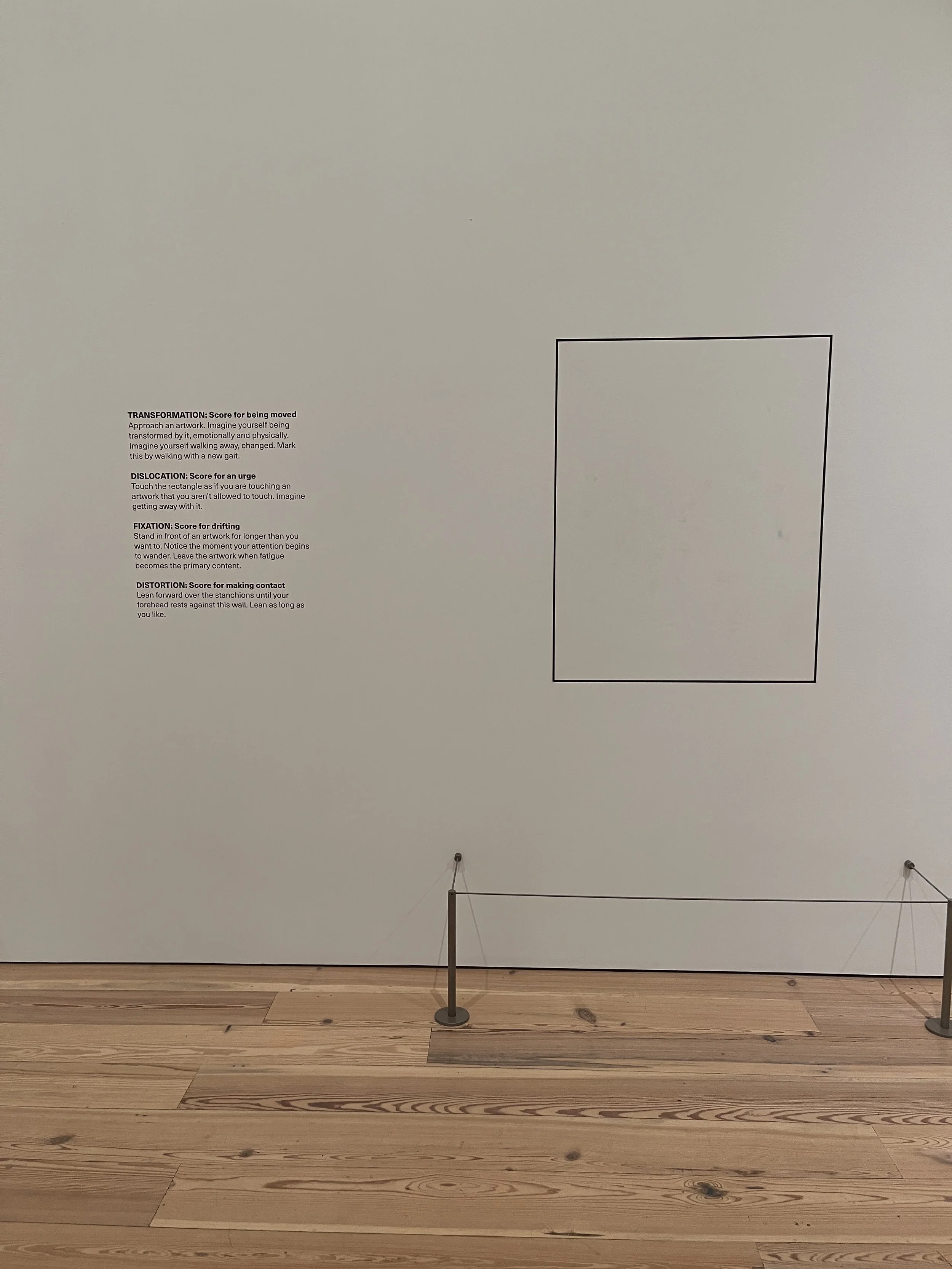
Maia Chao, Scores for the Museum Visitor, 2026
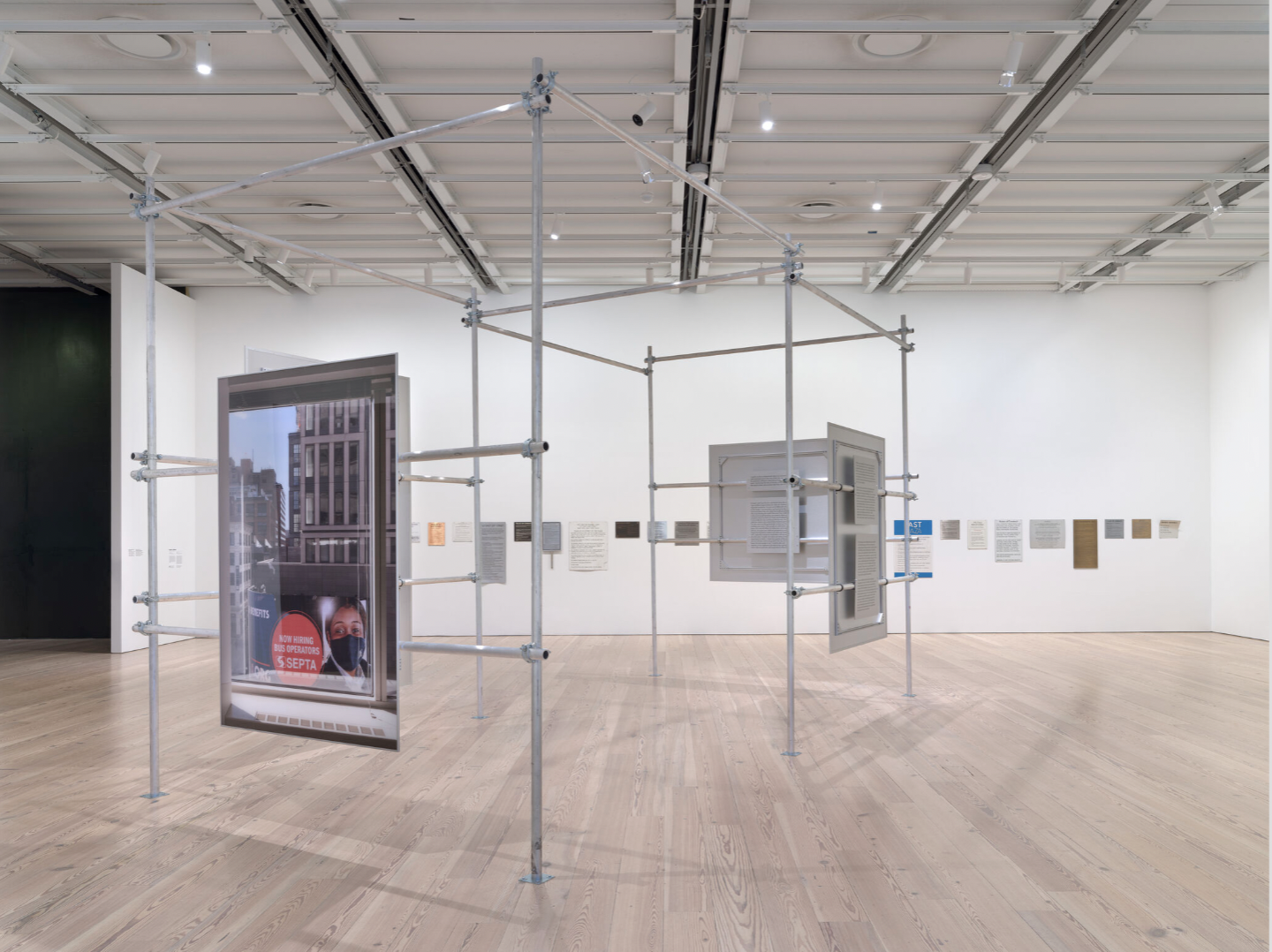
Installation view of Whitney Biennial 2026 (Whitney Museum of American Art, New York, March 8–August 23, 2026). Center: Emilio Martínez Poppe, Philadelphia Housing Authority, South, 2024; Emilio Martínez Poppe, Philadelphia Department of Sanitation, North, 2024; Emilio Martínez Poppe, Philadelphia Department of Public Property, West, 2024; Emilio Martínez Poppe, Philadelphia Water Department, South, 2022; Back wall: David L. Johnson, Rule, 2024-ongoing. Photograph by Ron Amstutz
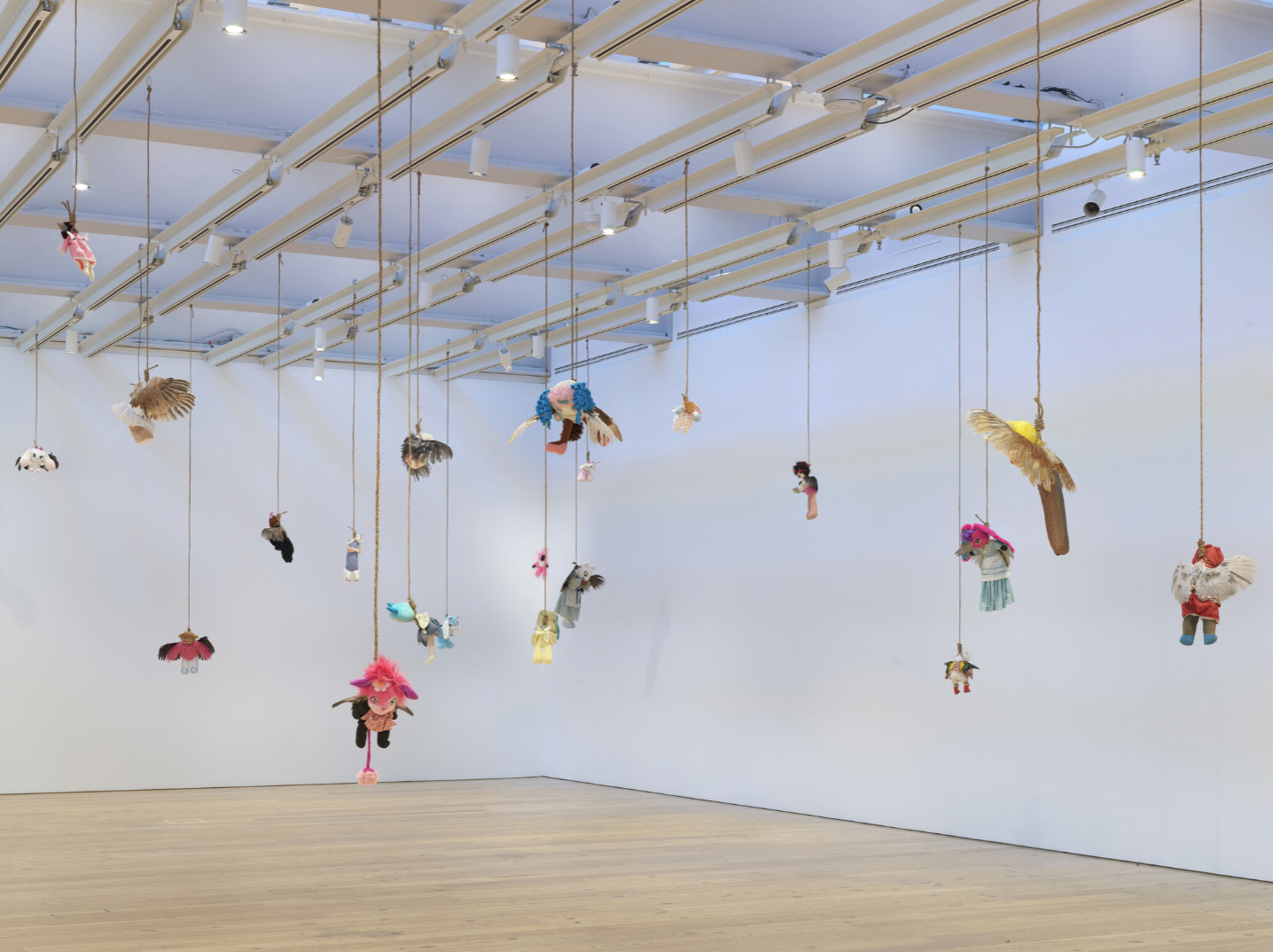
Installation view of Whitney Biennial 2026 (Whitney Museum of American Art, New York, March 8–August 23, 2026). Precious Okoyomon, Everything wants to kill you and you should be afraid, 2026. Photograph by Ron Amstutz
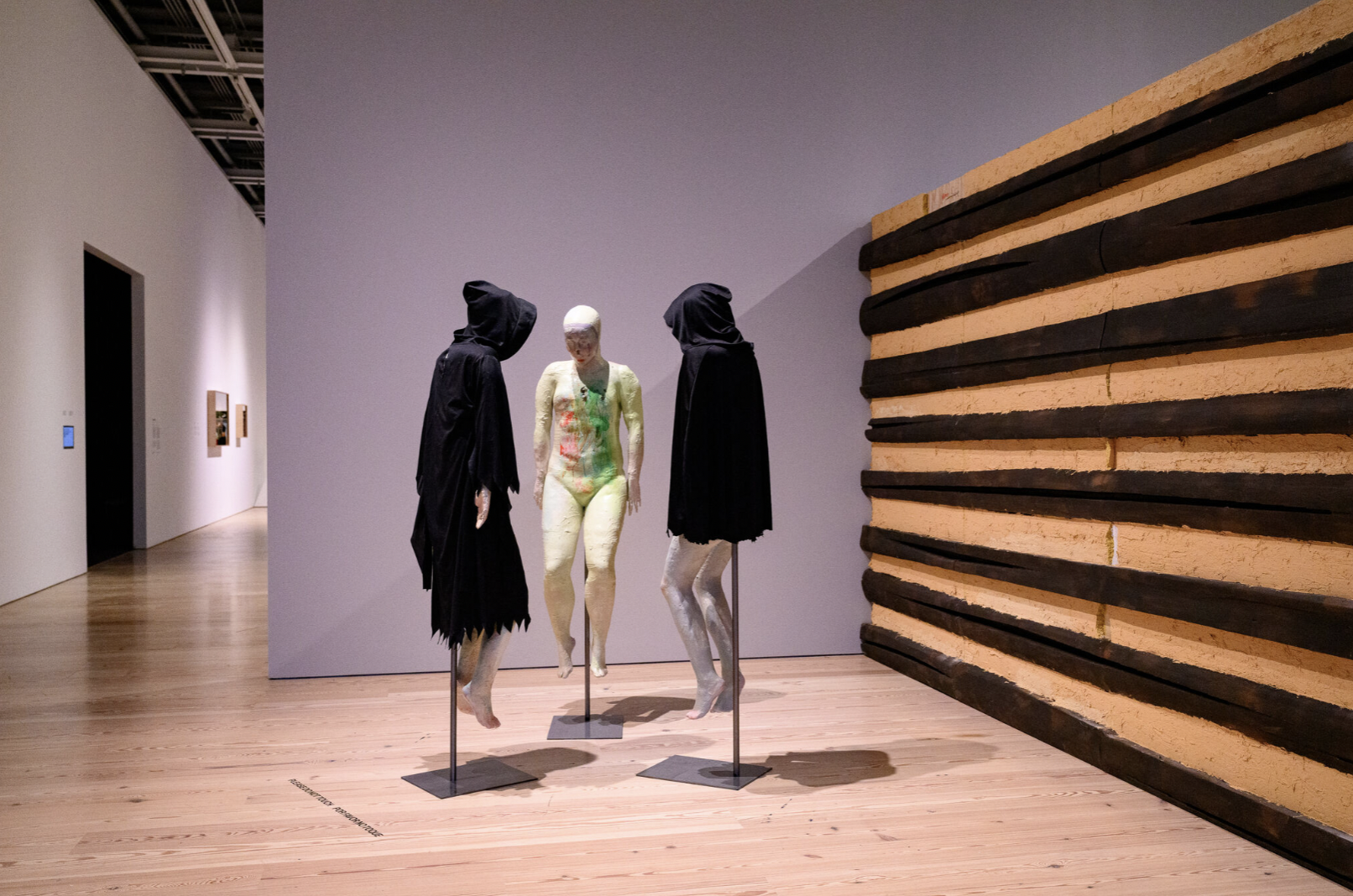
Isabelle Frances McGuire, Satan in America and Other Invisible Evils: Experiments in Public Sculpture, 2026. Photograph by Darian DiCanno/BFA.com. © BFA 2026