
End of the End of Painting?
What happened to discussions addressing the avant-garde in the contemporary art world? When I was an undergraduate at SAIC in the late 2000’s, it was assumed that what was valued in contemporary art was related to its ambition to be avant-garde. This was how phenomena like relational aesthetics and art as social practice were understood, as continuations of the radical experimentation and self-conscious problematization of art embodied by the avant-garde tradition. But in today’s art world, where what counts theoretically is meaning or identity, that tradition seems to be ignored, or forgotten.
The present moment is marked by the return of painting. The postmodern theorist Douglas Crimp made his indictment of painting in a historical moment that was actually marked by the return of painting after its demise at the hands of the avant-garde in the 60’s and 70’s. Crimp wrote “The End of Painting” in 1981. But rather than confirming Crimp’s speculation of an end of painting, we seem to be living in a moment that would suggest the end of the avant-garde.
Crimp, in “The End of Painting”, offers a response to his historical moment that should make us think about our own. He perceives the return of painting in the early 80’s, and especially its theoretical framing — exemplified by Barbara Rose’s 1979 catalogue text for the exhibition “American Painting: The Eighties” — as reactionary in its avowals to eternal and unchanging artistic and painterly values, counterposed by Crimp to the avant-garde’s historicization of art and its values. Crimp writes: “Within this conception of art, painting is understood ontologically: it has an essence and an origin. Its historical development can be plotted in one long uninterrupted sweep from Altamira to Pollock and beyond, into the eighties. Within this great development, painting's essence never changes…”
The Art Institute of Chicago recently acquired a Norman Rockwell painting, The Dugout (1948). This is pertinent to questions about the status of the avant-garde in the present moment, if for no other reason than the fact that Clement Greenberg offers up Rockwell as an example of a (quality) kitsch painter in his seminal 1939 essay “Avant-Garde and Kitsch”. Rockwell is esteemed, the way all kitsch is, for the eternal and unchanging values of painting and art that it supposedly embodies, the same unhistorical criteria Crimp rejected in the return of painting in the 80’s and in Barbara Roses’s writing. If the point of the avant-garde is to historicize art, to show how it is bound to specific historical conditions that are changeable, kitsch eternalizes art and makes art a matter of an unchanging essence. In Adorno’s language, kitsch is perennial fashion. Perhaps this is how we experience all art in a moment that seems marked by the end of the avant-garde.
Greenberg writes in “Avant-Garde and Kitsch”: “In seeking to go beyond Alexandrianism, a part of Western bourgeois society has produced something unheard of heretofore:— avant-garde culture. A superior consciousness of history—more precisely, the appearance of a new kind of criticism of society, an historical criticism—made this possible.” Greenberg accords to the avant-garde a superior historical consciousness as its defining feature, the same historical consciousness Crimp thinks is being liquidated by the theoretical framework surrounding the return of painting in the 80’s in its espousal of eternal values. But is painting fated to be what it was for Crimp in the 80’s, a conservative force basking in unchanging values, betraying the need for an art that is historically self-conscious?
Much of the avant-garde of the 60’s defined itself against painting. Crimp’s “The End of Painting” theoretically summarizes a dynamic that began to acquire force at least 20 years prior to its publication. Since the 60’s, we associate the ambition to be avant-garde with the rejection of painting. But the return of painting in the present might be an opportunity to rethink the relationship between painting and the avant-garde. What would it mean for contemporary painting to be historically self-aware, to situate itself in relationship to both art history and the historical specificity of our own present moment? What would it mean for contemporary painting to reject the logic of static and eternal values of art and painting, to not succumb to a notion of an unchanging essence of painting and art? What would it mean for contemporary painting to objectify in form the particularity of this historical moment aesthetically? If the avant-garde has ended, it is possible that thinking about these questions is no longer relevant. Or it may only be relevant to those who want painting to be more than a part of the perennial fashion of the status quo.
Crimp recognized in the return to painting in the early 80’s a potential liquidation of art into eternal fashion, a potential threat to art’s role as a historical index. He understood the return to painting and its justification according to timeless values as a reaction against the rejection of painting in the 60’s and 70’s by avant-garde artists. For Crimp, this earlier and more radical moment was about problematizing a notion of an eternal and unchanging meaning of art and painting. By coming to reject painting in their own moment, these artists were testifying to the historical specificity of the meaning of art and painting. Painting as we understand it didn’t always exist, and perhaps it won’t exist forever. Thus the call to recognize the end of painting. For Crimp, the return of painting in the 80’s was a backsliding away from the higher historical ambitions of the avant-garde of the 60’s and 70’s.
Similarly, the return to painting in the present seems to be motivated, consciously or unconsciously, by a discontent with the proliferation of avant-garde strategies in the early 2000’s, perhaps best exemplified by relational aesthetics and art as social practice. The return to painting was motivated by a discontent with a prevalent dogma in the contemporary art world that unconsciously assumed that painting was obsolete, dead, inherently conservative and reactionary, as opposed to avant-garde strategies that tried to problematize the relationship between art and life. The counterposing of painting to the avant-garde has a long and pervasive influence in contemporary art.
Painting’s return is the return of the repressed. As a function of the success and influence of Crimp’s position, avant-garde strategies in contemporary art proliferated and at a certain point began to seem routine, conventional, and even academic. In this context, the taboo on painting seemed to lose its grip, and painting appeared as a convincing alternative to endlessly repeating rote and prescribed avant-garde gestures that began to appear more and more hollow and unconvincing.
Greenberg grounded the possibility of an avant-garde in a social-historical circumstance: “... the appearance of a new kind of criticism of society, an historical criticism-made this possible.” The emergence of the avant-garde was conditioned by a historical critique of society, a critique that recognized capitalist society as not an eternal, natural, and unchanging invariant, but as historically specific and able to be changed. The avant-garde historicized art because it was bound up with a political project that historicized all of social reality, that aimed to show how all of society’s forms were historically transformable.
Crimp accurately recognizes that the return of eternal values of painting is antithetical to the historical consciousness of the avant-garde. But he fails to provide an account of why in certain historical moments, let’s say both in the early 80’s and in the present, the attempt to be avant-garde appears unappealing or even futile, and why painting, understood to be about unchanging and timeless values, returns with a vengeance. Despite Crimp's critique of Greenberg that aesthetic autonomy ignores the social, it is Greenberg in fact who might allow us to get a grip on the social meaning of why the historical consciousness characterizing the avant-garde might seem untenable in certain moments. If the avant-garde for Greenberg was conditioned by a consciousness of the historically transformable character of society as a whole, then perhaps the avant-garde might be absent in historical moments when society as a whole appears less and less able to be historically transformed.
But does this consign painting to being nothing but the ghost of the death of the avant-garde? Is Crimp correct in identifying painting as inherently reactionary and chained to notions of timeless and eternal values? Is painting necessarily antithetical to a historical consciousness of art? Does the acquisition of Norman Rockwell by the Art Institute of Chicago embody the fate of painting as perennial kitsch? Perhaps Crimp’s “The End of Painting” is actually expressing a task for painting. Crimp thought painting was being rendered obsolete by a radical social transformation that was affecting the very nature of artistic production. He saw the return of painting in the 80’s as reactionary specifically in relation to that earlier notion of radical social transformation. But what if the return of painting was really an indication that the radical social transformation Crimp rested his speculations on never came to fruition? Painting persists because a total social transformation that might overcome the need for painting didn’t happen. Painting’s return should be treated as a reminder of a historical task that has yet to be fulfilled. To provoke recognition of this historical task was what it once meant to be avant-garde.
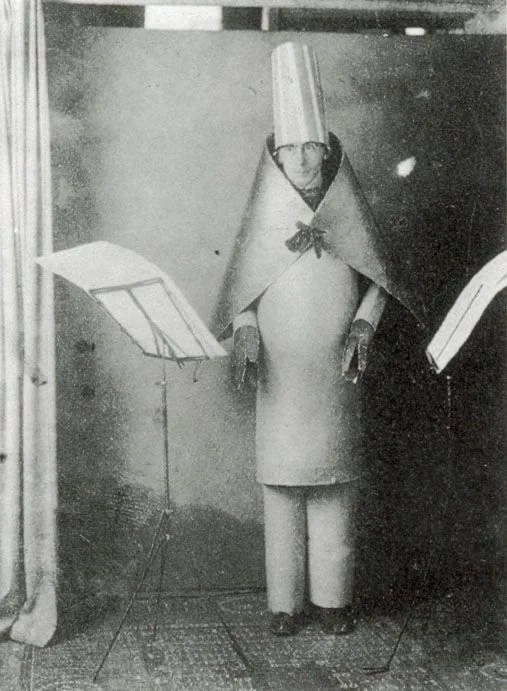
Hugo Ball reading "Karawane" at Club Voltaire, 1916
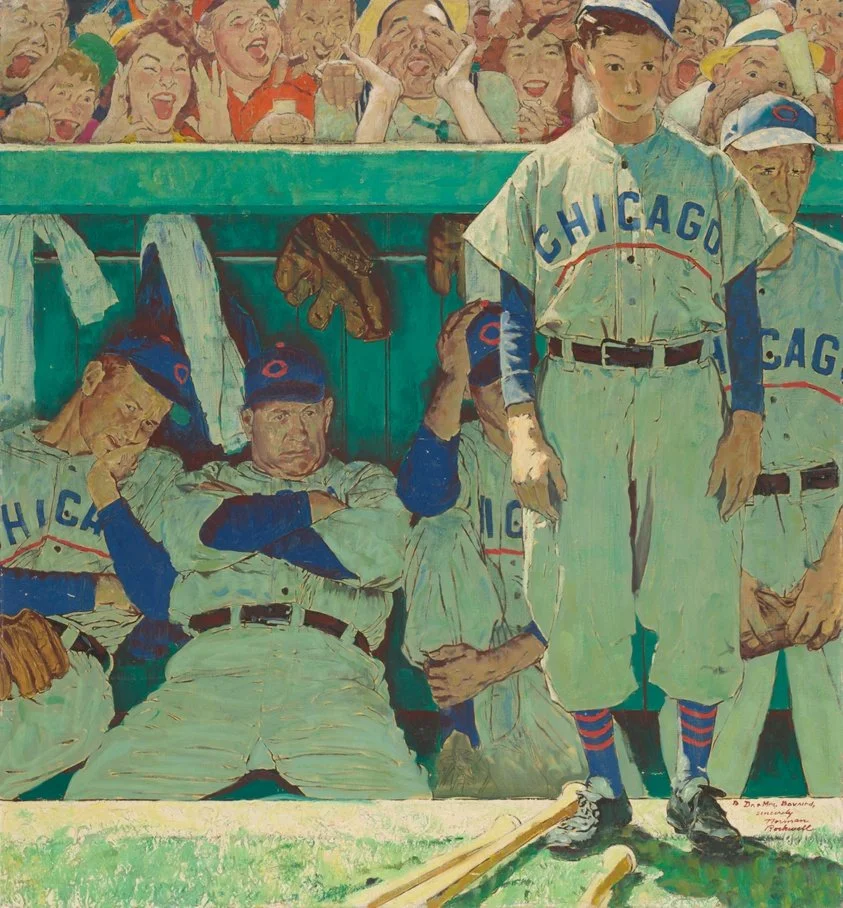
Norman Rockwell, The Dugout, 1948. Art Institute of Chicago
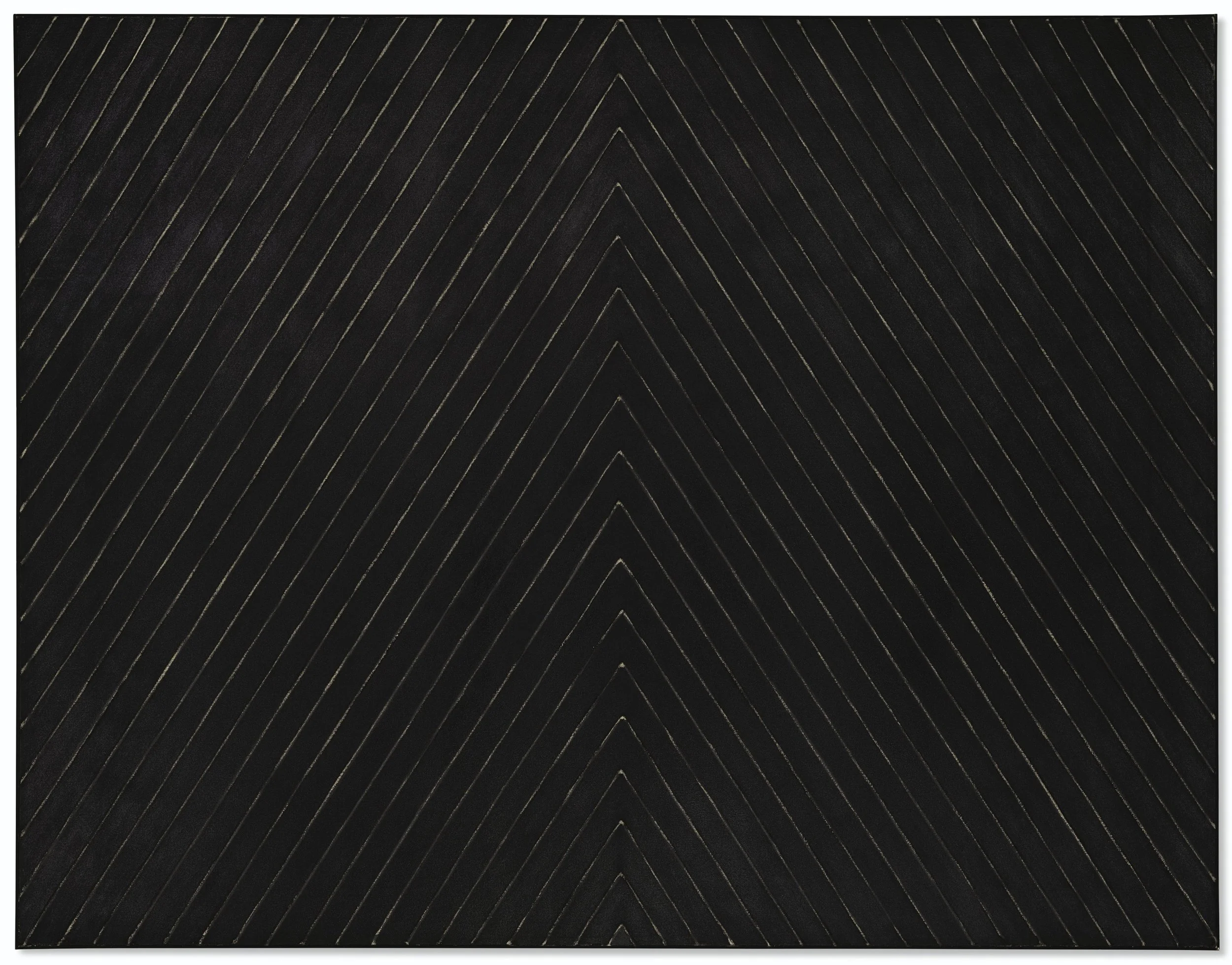
Frank Stella, Point of Pines, 1959. Courtesy of Christie’s