
American Painting
“The problem of American painting had been a problem of subject matter. Painting kept getting entangled in contradictions of America itself. We made portraits of ourselves when we had no idea who we were. We tried to find God in landscapes that we were destroying as fast as we could paint them. We painted Indians as fast as we could kill them. And during the greatest technological jump in history, we painted ourselves as a bunch of fiddling rustics. By the time we became social realists, we knew that American themes were not going to lead to a great national art. Not only because the themes themselves were hopelessly duplicitous but because the forms we used to embody them had become hopelessly obsolete. Against the consistent attack of Mondrian and Picasso, we only had an art of half truth, lacking all conviction. The best artists began to yield rather than kick against the pricks. And it is exactly at this moment, when we finally abandon the hopeless constraint to create a national art, that we succeed for the first time in doing just that. By resolving the problem forced on painting by the history of French art we create for the first time a national art of genuine magnitude. And if one finally had to say what it was that made American art great, that was that American painters took hold of the issue of abstract art with a freedom they can get from no other subject matter. And finally, made high art of it.”
Philip Leider in the documentary Painter’s Painting made by Emile de Antonio in 1972
In the context of an art world that prides itself on its efforts to be international in scope, perhaps a discussion of “American Painting” seems out of touch with the times and even reactionary. Hasn’t decolonization educated us to not accept such Western-centric narratives? Isn’t an explicit anti-Americanism a default position of contemporary cultural radicalism? On the occasion of the 250th anniversary of the American Revolution, it seems that only the Right is taking up its celebration. But often, conservatives understand their apologia of America as the defense of a concrete set of specific cultural traditions that need to be preserved.
Yet the self-understanding behind Abstract Expressionism and its offshoots as “American Painting,” is precisely opposite of the conservative defense of America. Rather than a set of concrete cultural traditions that must be preserved, America to the “American Painters” meant an absence or lack of a concrete set of cultural traditions inherited from the past, which allowed for these painters to think of their work as a radical break from the whole history of art, which they designated “European.” They were able to reject cultural tradition because, as Americans, they had no real cultural tradition.
In “The Plasmic Image” from 1945, Barnett Newman writes:
“We are reasserting man’s natural desire for the exalted, for a concern with our relationship to the absolute emotions. We do not need the obsolete props of an outmoded and antiquated legend. We are creating images whose reality is self-evident and which are devoid of the props and crutches that evoke associations with outmoded images, both sublime and beautiful. We are freeing ourselves of the impediments of memory, association, nostalgia, legend, myth, or what have you, that have been the devices of Western European painting. Instead of making cathedrals out of Christ, man, or “life,” we are making it out of ourselves, out of our own feelings. The image we produce is the self-evident one of revelation, real and concrete, that can be understood by anyone who will look at it without the nostalgic glasses of history.”
Donald Judd cites this Newman quotation in his essay on Newman from 1964. There’s a similar self-understanding behind Judd’s move away from modernist painting to his “Specific Objects.” Judd wanted to escape part-to-part relationships in composition and to assert the unity of the form. He identified part-to-part relationships in composition as a conservative holdover of “European painting.” He also rejected illusionistic space and anthropomorphism as relics of “European painting,” propelling him to abandon painting and embrace three-dimensional work, which to him was not traditional sculpture (which would be too European) but was no longer painting either. In his writings, Judd often wrote about how his attempts at aesthetic innovation were in large-part an attempt to leave behind “European painting.”
What did Newman and Judd mean when referring to “European painting”? They meant the entire history of art. Their critique of “European painting” was a challenge to the whole history of art as it had been practiced to that point. Of course, American painters understood themselves as inheriting the legacy of European painting. It was the tradition they had learned from and knew well. But the dialectic of American painting was a recognition that to adequately inherit the history of European art might require breaking from it. In their practice, they sought to transcend the tradition inherited from the history of art which, in Marx’s language, “…weighs like a nightmare on the brains of the living.” Their indictment of “European painting” was an attempt to move beyond the weight of the entire past of art.
What American art meant to Newman and Judd was not a specific style or subject matter, but a recognition that America’s cultural insignificance historically could be turned into an asset for breaking with the past. Because America was not carrying the historical luggage of centuries of cultural development, it could lead the world in leaving the past behind. Because it had no concrete set of traditions to preserve, it could take the greatest aesthetic risks. If the modernist dictum was “Make it New,” perhaps American painting could make it new because it had nothing old of real cultural significance to hold onto. If modernism sought to reject the dead weight of tradition in order to grasp the potential of one’s own historical moment, what was “American” about the modernism of the “American Painters” was that their efforts were aided by a sense of freedom from the weight of the cultural past.
In a 1967 artists’ symposium on Jackson Pollock, Barnett Newman said “In 1940, some of us woke up to find ourselves without hope – to find that painting did not really exist. Or to coin a modern phrase, painting.. ..was dead. The awakening had an exaltation of a revolution. It was that awakening that inspired the aspiration – the high purpose – quite a different thing from ambition – to start from scratch, to paint as if painting never existed before. It was that naked revolutionary moment that made painters out of painters.”
In his 1933 essay “Experience and Poverty,” Marxist literary critic Walter Benjamin diagnosed the horrors of the 20th century as giving rise to a new poverty in regard to the meaning of experience. Yet he attempted to avoid simply recoiling romantically from this new reality. Benjamin writes “Indeed (let's admit it), our poverty of experience is not merely poverty on the personal level, but poverty of human experience in general. Hence, a new kind of barbarism. Barbarism? Yes, indeed. We say this in order to introduce a new, positive concept of barbarism. For what does poverty of experience do for the barbarian? It forces him to start from scratch; to make a new start; to make a little go a long way; to begin with a little and build up further, looking neither left nor right. Among the great creative spirits, there have always been the inexorable ones who begin by clearing a tabula rasa.”
Both Newman and Benjamin’s modernism consists in recognizing that modernity is a condition in which the artist is forced to start from scratch, to paint as if painting never existed, to clear a tabula rasa. Because the conventions of tradition no longer hold the same power of conviction they once did, the painter is forced to attempt to break from the past and begin anew.
What America meant to the “American Painters” was an opportunity to clear a cultural tabula rasa and begin anew by overcoming the inertia of art historical tradition that came to be recognized as fetters on artistic possibilities. To be an “American Painter” meant to challenge the authority of that tradition. To be an “American Painter” was not a concrete cultural identity defined by a particular way of life. Rather, it meant the attempt to overcome the weight of all past cultural traditions, to leave behind culture as it had been practiced historically. Benjamin writes at the end of “Experience and Poverty,” that “In its buildings, pictures, and stories, mankind is preparing to outlive culture, if need be.”
In a moment when the Right claims that America is a cultural identity, a tradition, a way of life, “American Painting” raises the question of America not as a particular cultural identity, but as the embodiment of a perpetual critique of cultural tradition as a force of domination. On the 250th anniversary of the American Revolution, the need for that perpetual critique seems as relevant as ever.
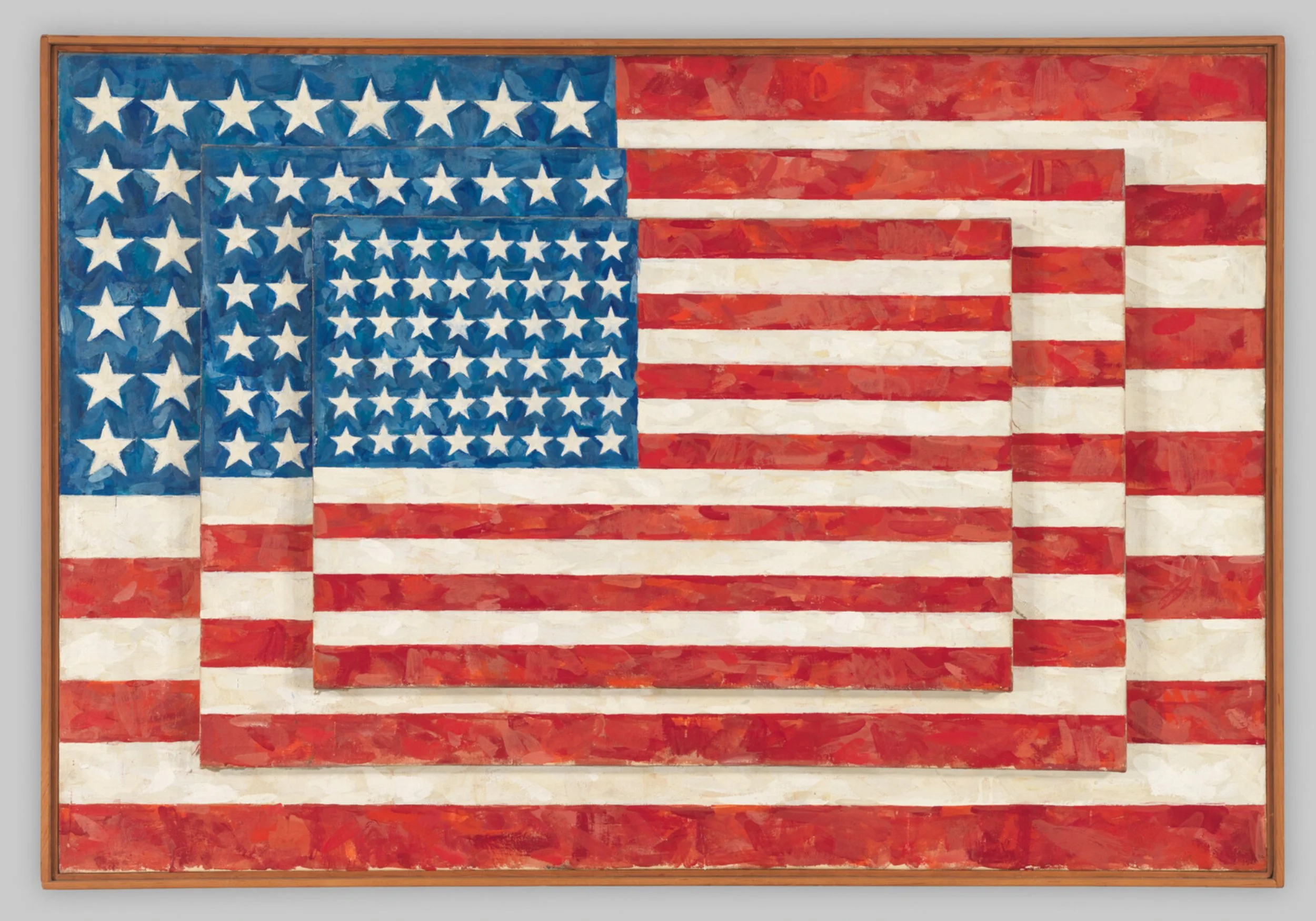
Jasper Johns, Three Flags, 1958. Whitney Museum of American Art
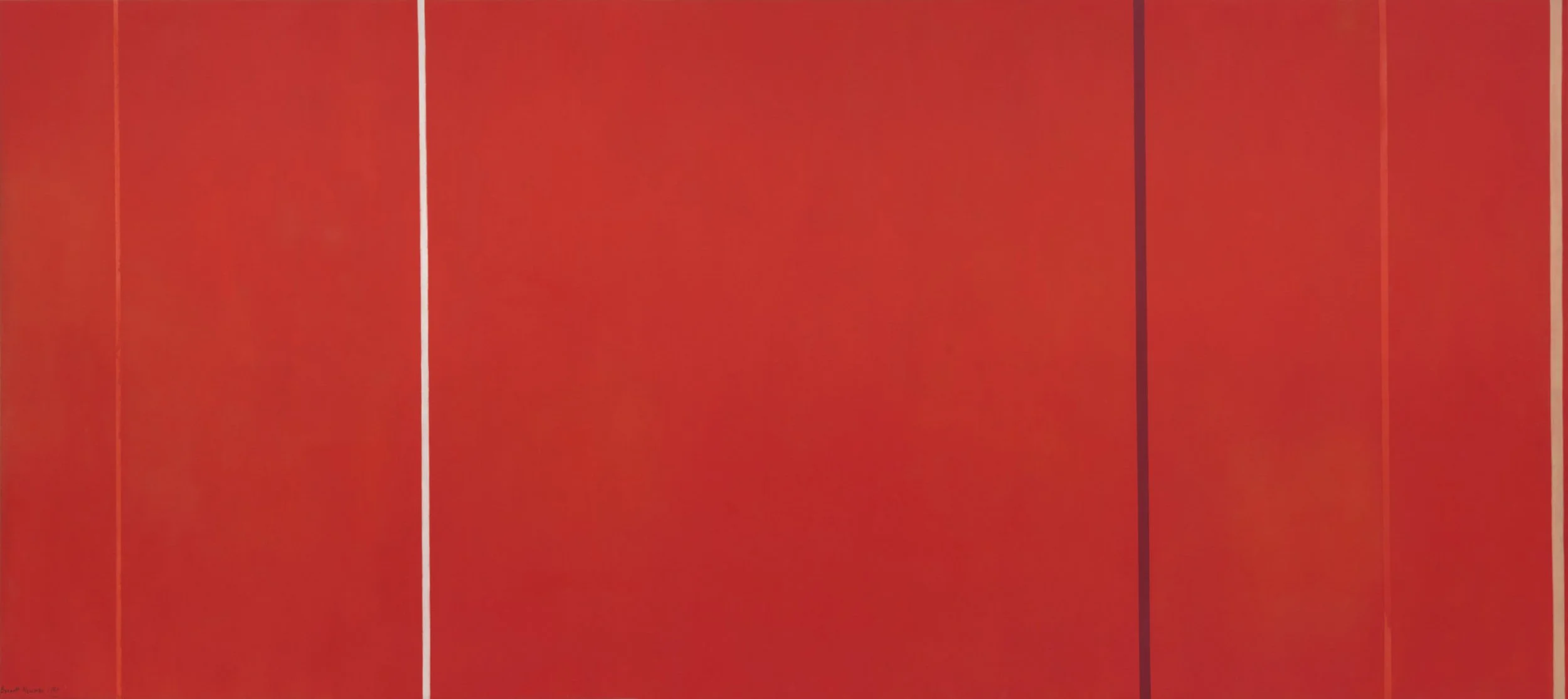
Barnett Newman, Vir Heroicus Sublimis, 1950-1951. The Museum of Modern Art
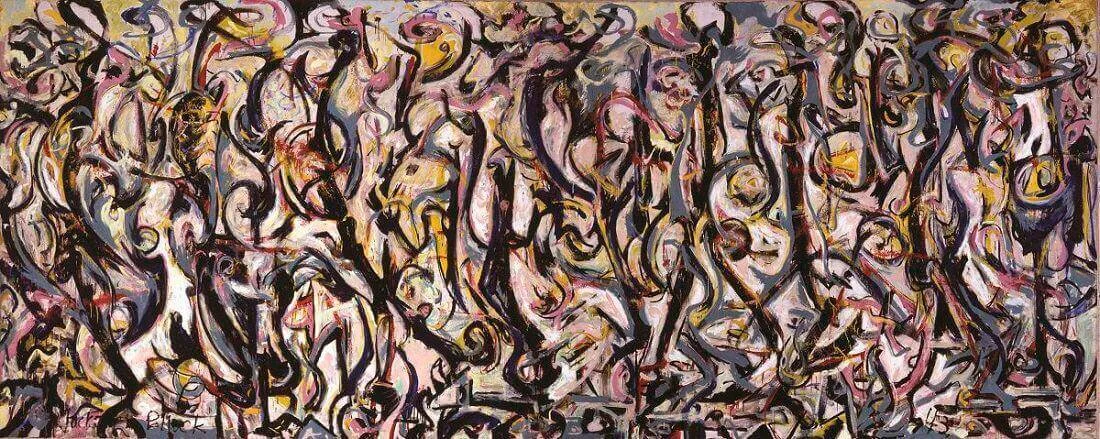
Jackson Pollock, Mural, 1943. University of Iowa Stanley Museum of Art