
Disjecta Membra: Baudelaire’s Salon of 1846
If art criticism has a founding document, it may well be Baudelaire’s Salon of 1846 — not because it was the first of its kind, but because it was the first to grasp the contradiction that would define Art from that moment on. It was the first to express the social condition of criticism itself within capitalism — or modernity, Baudelaire's cultural term for it — as a crisis.
The twenty-four-year-old Baudelaire addresses his dedication “To the Bourgeoisie,” at once a flattery and an indictment, serving art criticism’s first great exercise in ambivalence. The bourgeoisie as the majority “in number and intelligence,” collapsing scholars and owners into a single class whose power “is justice.” The irony is palpable but never total. At certain moments, when he speaks of museums as a “communion” or of the multiplicity of truth, Baudelaire appears to mean what he says. He holds irony and sincerity in tension.
Baudelaire’s core complaint — that art had become “an infinitely precious good,” an object of connoisseurship stripped of genuine feeling, a science of enjoyment rather than an experience of truth — describes the situation of contemporary art as much as it did the Paris Salon. Yet somehow people believe in an idealized past of art, where it mattered in a different way, instead of asking what art ought to be. And his challenge to the “aristocrats of thought” who monopolize aesthetic judgment, those “Pharisees” of culture, speaks directly to an art world in which the language of critique has become indistinguishable from the language of promotion. Baudelaire’s “irony” was a weapon aimed at a complacency that has only deepened since his time: the complacency of a culture that insists art matters while treating it as if it doesn't. Our 21st century Pharisees reject judgement, wear the language of postmodernism as a second skin; they are industrious, ambitious, and anti-art without even knowing it, ceaselessly overproducing culture while lacking the historical consciousness of what art has been or what it ought to become.
Long before anyone spoke of the “death of art,” Baudelaire had already identified the contradiction at its core: that the bourgeoisie, the very class that had created the conditions for modern art — its collections, its galleries, its museums, its public — was also the class most inclined to reduce art to a commodity among commodities, a pleasant diversion to be consumed in “those hours separated for leisure.” Yet this commodification is not simply art’s degradation. Art’s emancipation from religious ritual, court patronage, and inherited tradition was inseparable from bourgeois social relations. The same society that transformed artworks into commodities also liberated art into a distinct sphere of experience, reflection, and freedom within an unfree world.
To grasp what is at stake, consider the historical moment. The bourgeoisie represented more than a new ruling class; it represented a new form of social life. The word itself simply meant town dweller, city person, a class emerging outside the old feudal order of land and inherited rank — the third estate. Workers belong to this class because they have their own property — their labor — to sell, and that’s labor power. Through the commodity form of labor, capitalism unleashed entirely new social relations. Modernity brought new rhythms of life, new forms of loneliness and excitement, new values, new desires, new pleasures, new crowds. New Art. This is the potential inherent in art’s commodity status under capitalism. Art’s emancipation from religion, aristocratic patronage, and ritual tradition was inseparable from this transformation. The same bourgeois society that threatened to reduce art to a commodity among commodities also created the conditions for art’s unprecedented autonomy — for art to appear as something more than utility, propaganda, or ornament. Modern criticism emerges alongside this contradiction because art could now appear simultaneously as commodity and as something more than commodity: an object through which society reflects on itself. This is the historical horizon from which Baudelaire writes: not against modernity, but from deep within its contradictions. Meanwhile, the “Hungry ‘40s,” Europe's first global economic depression at the end of the first industrial revolution, with its massive unemployment presenting itself as a social problem for the first time, culminated in the continent-wide Revolutions of 1848. Baudelaire is one of the central figures of this 1848 consciousness: a poet-critic who, alongside Marx and Engels's Communist Manifesto, anticipated the upheaval coming out of the crisis of the 1840s. We have a historical inflection point where a cultural and artistic modernity was announced by Baudelaire, and political modernity represented by Marx and Engels.
Baudelaire addresses the bourgeoisie as if they were his natural audience while making clear that they cannot be, at least not the audience the work needs. The tension between the real public and the ideal public — a tension that Arnold Hauser and Walter Benjamin would later theorize — is already operative here, in 1846, before the barricades of 1848 had even gone up. Yet it would be a mistake to read “To the Bourgeoisie” as mere negation of art’s commodification. Baudelaire not only diagnoses art; he diagnoses society and the contradictory nature of the bourgeoisie's role as patrons of the arts. And from this diagnosis he forges a new artistic mission.
What makes “To the Bourgeoisie” more than a historical curiosity is what it reveals about the condition of art in modernity: the commodity relation is not simply what destroys art, it is also what historically produces art as modern art. There is a serious, almost desperate appeal underneath the irony — a call for the bourgeoisie to live up to what it made possible, to become worthy of the art it patronizes. That Baudelaire follows this dedication immediately with the question “What is the good of criticism?” only raises the stakes.
Criticism emerges because art itself has become a problem. Once art loses its self-evident place in social life, criticism becomes necessary to mediate between artwork and public, appearance and meaning, culture and society. Yet criticism inherits the same contradiction as art. The critic may preserve the possibility that art means more than a commodity; but criticism can also become one more specialized discourse of cultural administration, reducing art to information, expertise, promotion, or taste. Baudelaire’s attack on the “Pharisees” therefore cuts deeper than a complaint about bad critics. It is an anxiety about criticism itself.
The crisis of art and the crisis of criticism are ultimately one and the same. Art requires criticism because its social meaning is no longer secure. Yet criticism threatens to annihilate the very object it seeks to save, explaining art away, using art to illustrate “new” theories, liquidating its contradictions, or substituting judgment for content.
The question posed by “To the Bourgeoisie” is therefore not simply whether art can survive the society that produced it. It is whether the critic may preserve the possibility that art represents more than a commodity: a sphere of reflection and freedom within an unfree society. But this raises the question: whether criticism can survive its dependence on the very class it must critique. Nearly two centuries later, that question remains unresolved.
—Laurie Rojas
Alexandre-Gabriel Decamps, The Experts, 1837
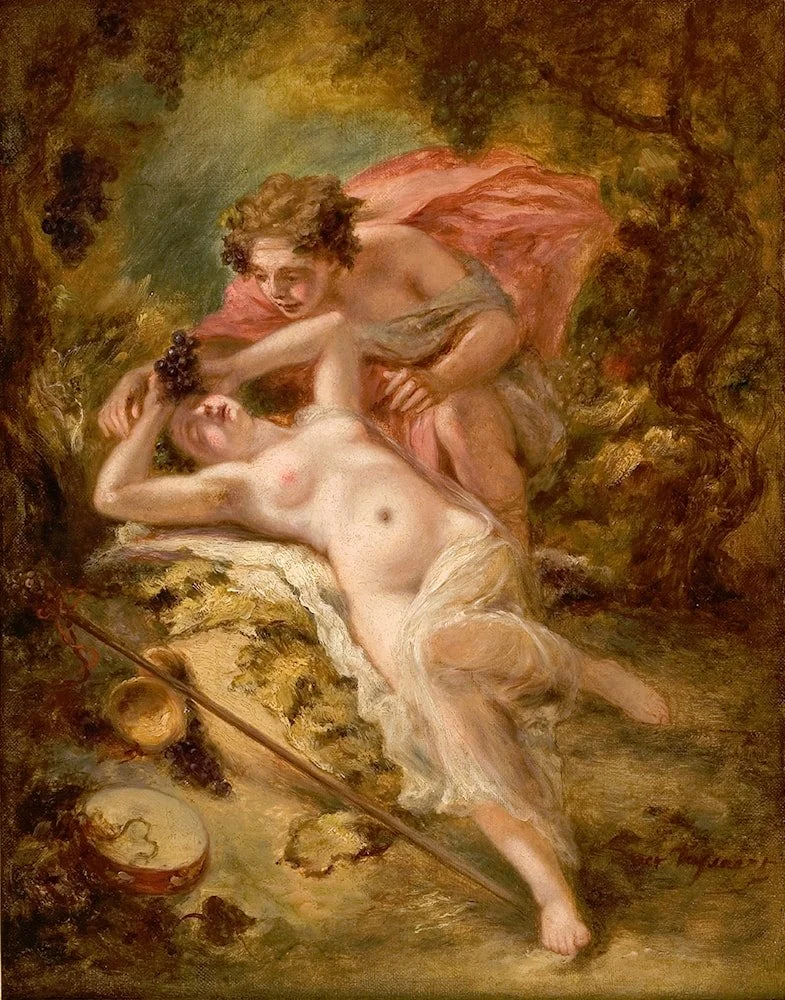
Octave Tassaert, Bacchus and Erigone, 1846
To the Bourgeoisie
You are the majority—in number and intelligence; therefore you are the force—which is justice.
Some are scholars, others are owners; a glorious day will come when the scholars shall be owners and the owners scholars. Then your power will be complete, and no man will protest against it.
Until that supreme harmony is achieved, it is just that those who are but owners should aspire to become scholars; for knowledge is no less of an enjoyment than ownership.
The government of the city is in your hands, and that is just, for you are the force. But you must also be capable of feeling beauty; for as not one of you today can do without power, so not one of you has the right to do without poetry.
You can live three days without bread—without poetry, never; and those of you who can say the contrary are mistaken; they are out of their minds.
The aristocrats of thought, the distributors of praise and blame, the monopolists of the things of the mind, have told you that you have no right to feel and to enjoy—they are Pharisees.
For you have in your hands the government of a city whose public is the public of the universe, and it is necessary that you should be worthy of that task.
Enjoyment is a science, and the exercise of the five senses calls for a particular initiation which only comes about through goodwill and need.
Very well, you need art.
Art is an infinitely precious good, a draft both refreshing and cheering which restores the stomach and the mind to the natural equilibrium of the ideal.
You understand its function, you gentlemen of the bourgeoisie—whether lawgivers or businessmen—when the seventh or the eighth hour strikes and you bend your tired head toward the embers of your hearth or the cushions of your armchair:
That is the time when a keener desire and more active reverie would refresh you after your daily labors.
But the monopolists have decided to keep the forbidden fruit of knowledge from you, because knowledge is their counter and their shop, and they are infinitely jealous of it. If they had merely denied you the power to create works of art or to understand the processes by which they are cre-ated, they would have asserted a truth at which you could not take offense, because public business and trade take up three quarters of your day. And as for your leisure hours, they should be used for enjoyment and pleasure.
But the monopolists have forbidden you even to enjoy, because you do not understand the technique of the arts, as you do those of the law and of business.
And yet it is just that if two-thirds of your time are devoted to knowledge, then the remaining third should be occupied by feeling-and it is by feeling alone that art is to be understood; and it is in this way that the equilibrium of your soul's force will be established.
Truth, for all its multiplicity, is not two-faced; and just as in your politics you have increased both rights and benefits, so in the arts you have set up a greater and more abundant communion.
You, the bourgeois—be you king, law-giver, or businessman-—have founded collections, museums, and galleries.
Some of those, which sixteen years ago were only open to the monopolists, have thrown wide their doors to the multitude.
You have combined together, you have formed companies and raised loans in order to realize the idea of the future in all its varied forms-political, industrial, and artistic. In no noble enterprise have you ever left the initiative to the protesting and suffering minority, which anyway is the natural enemy of art.
For to allow oneself to be outstripped in art and in politics is to commit suicide; and for a majority to commit suicide is impossible.
And what you have done for France, you have done for other countries too. The Spanish Museum is there to increase the volume of general ideas that you ought to possess about art; for you know perfectly well that just as a national museum is a kind of communion by whose gentle influence men's hearts are softened and their wills unbent, so a foreign museum is an international communion where two peoples, observing and studying one another more at their ease, can penetrate one another's mind and fraternize without discussion.
You are the natural friends of the arts, because you are some of you rich men and the other scholars.
When you have given to society your knowledge, your industry, your labor, and your money, you claim back your payment in enjoyments of the body, the reason, and the imagination. If you recover the amount of enjoyments which is needed to establish the equilibrium of all parts of your being, then you are happy, satisfied, and well-disposed, as society will be satisfied, happy, and well-disposed when it has found its own general and absolute equilibrium.
And so it is to you, the bourgeois, that this book is naturally dedicated; for any book which is not addressed to the majority—in number and intelligence—is a stupid book.
1st May 1846
Baudelaire, Charles. The Salon of 1846. Introduction by Michael Fried. Ekphrasis Series. New York: David Zwirner Books, 2021.