
"Could you", wrote Mr. Jefferson,
"Find me a gardener
Who can play the french horn?
The bounds of American fortune
Will not admit the indulgence of a domestic band of
Musicians, yet I have thought that a passion for music
Might be reconciled with that economy which we are
Obliged to observe.
I retain among my domestic servants
A gardener, a weaver, a cabinet-maker, and a stone-cutter,
To which I would add a vigneron. In a country like yours
(id est Burgundy) where music is cultivated and
Practised by every class of men, I suppose there might
Be found persons of these trades who could perform on
The french horn, clarionet, or hautboy and bassoon, so
That one might have a band of two french horns, two
Clarionets, two hautboys and a bassoon, without enlarging
Their domestic expenses. A certainty of employment for
Half a dozen years
(affatigandose per suo piacer o non)
And at the end of that time, to find them, if they
Choose, a conveyance to their own country, might induce
Them to come here on reasonable wages. Without meaning to
Give you trouble, perhaps it might be practicable for you
In your ordinary intercourse with your people to find out
Such men disposed to come to America. Sobriety and good
Nature would be desirable parts of their characters "
June 1778 Monticello
Ezra Pound, Canto XXI
//
Bret Schneider: Maybe the American dream was more ambitious than our current obsession over Art, a vestige from the old world. Today, we recognize that art (as we know it) is bound up in a specific form of suffering in capitalism. Maybe the original imagination of America didn't foreground art because they hoped the new world would be free enough to not have need of it? And yet Jefferson felt the urge to include it in some capacity. It's also interesting that the musician would also serve as a gardener — art not as a profession, but an activity.
C. Philip Mills: That America eventually found a need for art as art seems to express to me a kind of freedom in distress. I imagine Jefferson’s concept of art-experience wouldn’t be so different from Kant’s, ultimately classicist. In his letters he speaks a lot about architecture but little about art as a discrete field (in one letter I did find he gives deference to France: “were I to proceed to tell you how much I enjoy [French] architecture, sculpture, painting, music, I should want words. It is in these arts they shine. [T]he last of them particularly is an enjoyment, the deprivation of which with us cannot be calculated.”) Art as we understand it seems to come later in America — in the mid-19th century, with writers like Mark Twain. Prior to that, the perennial question regarding American art seems to be “where is the great American novel? Where is American painting? Where is American music?” In the meantime, American artists seemed to merely be trying on European forms, one of the last iterations of this was the “American impressionist” who traveled to Europe to get an education in painting, e.g. Mary Cassatt and John Singer Sargent. It’s only really in the 20th century that American art not only comes into its own, but becomes the world capital of art, arguably after art as a phenomenon has collapsed. Along with the American political hegemony achieved after 1945, contemporary art itself is an undeniably American phenomenon (this will inevitably ring alarm bells for the army of half-educated Stalinoid radlibs who don’t waste any opportunity to claim that the CIA was the benefactor of contemporary art). It’s interesting to note how a great deal of AbEx painters and mid-century American composers went out of their way to declare a break (or rather, a lack of any influence at all) from their European predecessors, despite the fact that many of them spent their early careers studying under early 20th century European artists. Contemporary art coincides with the declaration that an American art had finally been found.
Itsï Ramirez: I think you’re raising some core points here. America lacks tradition in the way that Europe does not. What if this leaves America to give shape to what the Europeans take for granted? This has a double edged quality I think. If we are to take up the category of American Art seriously then we would have to deal with the pragmatic and immediate quality of it. America's freedom is freedom from tradition as well. This is seen as a fault to the European philistine but I see it as an awkward openness — kind of like a child wobbling through the vast open space except in this case it's the child also carving it out and not just being born into it!
Laurie Rojas: I’d add that this “passing of the torch” was not simply America coming into its own—it was produced by the historical crisis of World War I, the conflict at the “highest stage of imperialism,” which shattered the old European order and wiped out the aristocratic authority that had patronized centuries of artistic and intellectual tradition. The resulting exodus transformed New York: Max Weber teaching Rothko at the Art Students League in the 1920s, Hans Hofmann's school shaping Krasner, Pollock, and Frankenthaler in the 1930s and 40s. The collapse of Europe's old world was also an important prerequisite for the “freedom from tradition” that flourishes in mid-century American art.
BS: Re:American Art — I agree of course that contemporary art is synonymous with America, but this just means an opportunity for cosmopolitanism, right?To be an American artist is just to be an artist, to be free from making art about America per se. Analogously, to be an artist in NYC is to be free from regional thinking and the need to make art about NYC. A freedom from provincialism. Of course authors like Mark Twain or Whitman wrote about America, but by the early 20th century, America became a kind of lens for (art) history in a much broader sense. For example, Pound's Cantos range from everyday American conversation, to records of the Medicis and other renaissance characters, Chinese history, and Ancient Greece, etc. I don't think this was uncommon, to be an American meant to be cosmopolitan, and even the many authors who pilgrimaged to Paris, like Henry Miller and Anaïs Nin, ultimately just deepened an American kind of sensibility that's hard to define. I think Morton Feldman clarified it well when he criticized the 'professional' European artist as a kind of small-minded village character, as opposed to the American artist who does many things and isn't specialized as an artist, perhaps even more interesting due to the day jobs they work. Of course, the professionalism of Millennial artists idealizes that specialization, so something may be lost there, and perhaps there's a retreat to provincialism that coincides with the death of contemporary art. Yet contemporary art is by far not the only art America produces, and American culture is just fine in many other industries. It should also be noted that Europe's best thinkers were inspired by American artists and thinkers — Baudelaire idolized Poe; Nietzsche loved Emerson; Adorno wrote an opera on Tom Sawyer. If Europe created 'culture', American authors were also already a cornerstone even before modernism. But these were also thinkers seeking to overcome or fulfill European tradition, not romanticize it or take it for granted.
CPM: I think the Feldman line is just a late recognition of bourgeois society — Jefferson already recognized the character of art in bourgeois society as an activity rather than a profession. Art as a profession actually meant art per se had not yet developed — guildcraft. That it seemed to continue into the 19th century is really a result of artists’ retreat into bohemia — and not even all of them, e.g. Honoré Daumier. But bohemé artists were hardly making a living as “professionals” at all, most died in destitution — the Third Republic’s sentence against Courbet was essentially an execution by other means for anti-social behavior. Feldman’s line is hardly aspirational, it’s just a fact. Not to say however, that most artists working day-jobs is a bad thing. Though I think you say it well that the millennials (really Gen X too) problematized this by their “professionalism.” I think of contemporary artists talking with utter seriousness about their “research.”
Regarding the contemporary, one would think it would mean the fulfillment of a kind of cosmopolitanism, but in fact it ended up just becoming a kind of in-house style of an ersatz cosmopolitanism that could be mentioned in the same breath as the World Economic Foundation and the EU — contemporary art despite being an American phenomenon was quickly Europeanized, meaning ghettoized in the fascist-holdout villages the second World War failed to destroy: Venice, Berlin, etc. The regionalist turn in the collapse of contemporary art that was first noticed with the proliferation of regionalist magazines during the Biden admin (and perhaps already irrelevant now under Trump?) is even worse. Despite New York being the capital of the world, its art writers parochialize themselves (why a Manhattan Art Review?). One might have the impulse to recover the memory as you mention, of American culture as a true cosmopolitan culture. This would be working against the grain of just about everyone, from the anti-Americanists on the Left, to the Right who insist upon the specificity of an American culture. Yet taking up culture in this way could be just as obfuscatory — isn’t culture precisely what art is meant to overcome, despite being its product?
LR: As the only participant in this roundtable who was raised outside of the United States, it falls to me to double down: American culture is world culture. I grew up with American pop culture; I understood way before I could have articulated it that black culture is American culture, that Jewish culture is American culture, that even My Big Fat Greek Wedding is American culture, that America’s culture, precisely in its cosmopolitanism (and not, as the standard dismissal would have it, as cultural imperialism), is the only one that has truly projected itself upon the world. Empires impose a particularity; what arrived in my childhood was received as it was received precisely because it was already universal — cosmopolitan, worldly, addressed to anyone. The proof is comparative: Paris was the capital of the nineteenth century; New York was the capital of the twentieth.
Hollywood, the film industry of a nation of a third of a billion, gave the world its common cinematic language: Hitchcock (who only became Hitchcock in Hollywood), Kubrick (who never stopped making American films from his exile in England), Scorsese, Coppola and Coppola, Spielberg, Lucas, Spike Lee, Tarantino, Paul Thomas Anderson — these are the filmmakers of the world, or at least of my generation everywhere. Bollywood, the industry of a nation of nearly a billion and a half, produces no world-influential cinema in this way. The asymmetry is not merely a matter of marketing budgets.
The explanation, I think, is the one this roundtable has been circling since the Jefferson letter at the top: the American Revolution produced the first fully secular national culture, because it came at the tail of the Enlightenment as its political realization. Every other nation’s culture rests on what precedes the nation — blood, soil, confession, the accumulated sediment Europe calls tradition. America rests on an experiment: a culture founded on a proposition rather than a patrimony has no insiders by birth; it can only be joined, which is to say it was universal from the start, available to the Greek wedding and jazz alike, and this is why its export never required conversion. Jefferson’s gardener who plays the french horn is the emblem of this secularity: music detached from court and church, art as an activity reconciled with economy rather than a profession sanctified by tradition — culture, in other words, already desacralized at the founding, already half-dissolved into life. CPM is right that this looked to the European philistine like the absence of culture. It was actually culture’s first appearance in its secular, which is to say its modern, form. When modernism arrived, America did not have to clear away an ancien régime of taste to receive it. The awkward openness IR described earlier, the child carving out the space it wobbles through, is the same condition seen from inside. Baudelaire was Edgar Allan Poe’s greatest inheritor in Europe, dedicating decades to translating him, transmuting him into his own writing, not only transforming French literature but establishing Poe as a global literary figure.
Then there is the silence around the 250th anniversary, which is so telling. One would expect the semiquincentennial of the Revolution to be the occasion for exactly this reflection — what the Revolution meant for culture, what it might still mean. Instead the critics and the gatekeepers will not touch it, or if they do it’s via repudiation and satire. The reasons are not mysterious: the culture wars have made any affirmation of America sound like an affirmation of Trump, and a nation at war with itself makes the discomfort acute. So the anniversary is ceded in advance — the Right claims 1776 as ethnic patrimony, which is precisely what it was a revolt against, and the Left abandons it the way it abandoned the flag, as if Jefferson belongs to the people who quote him worst. What goes unclaimed in this standoff is the actual inheritance: the classical liberalism of the revolutionaries, radical enlightenment as politics, which neither camp can use. To take it up now is not nationalism. It is the opposite of nationalism: the recognition that the one national culture worth defending is the one that dissolves the very category of national culture.
Which brings me to CPM’s closing question — isn’t culture precisely what art is meant to overcome, despite being its product? Yes. But this is exactly why the American case matters dialectically rather than patriotically. If culture is what art must overcome, then America is the place where the overcoming began as a founding condition rather than an artistic achievement — a culture born secular, born without sanctity, in which art could appear as Jefferson imagined it, an activity of free people, and in which it instead appeared as what CPM rightly called freedom in distress. American culture is world culture not because America succeeded but because it posed the world’s task first: what becomes of art when culture no longer carries it? Contemporary art was one answer, and it collapsed — Europeanized, ghettoized in Venice and Berlin, then parochialized at home. The 250th anniversary would be the moment to ask whether the question is still open. That no one in the art world wants to ask it tells us less about America than about criticism — that it has traded the universalism it inherited from the Revolution for the provincialism of its own political moment. The revolutionaries thought a gardener could play the french horn. We can no longer imagine that the same person might love America and think.
BS: Yes, NYC was the capital of the 20th century, and it continued to hobble on until around 2016 — but only as a lingering afterimage, when it became obvious that NYC was no longer an avant-garde of industry or art, but actually a potential rearguard — behind the times. Today it persists only via its tenuous associations with the last century, its legacy, and a legacy that is often rejected by younger artists anyway (e.g. AbEx). I don't think it makes much sense to speculate about the new cosmopolis either, that seems besides the point when artists should be reflecting the present in its most open and indeterminate forms. Do American artists do this today though? Or are they just pathologically repeating the 20th century? I guess I'm wondering what the universal appeal of American art will consist of going forward in this century, when so many American artists are anti-American, which really just means anti-cosmopolitan. We live in a paradoxical situation where American culture is undoubtedly world culture (and vice versa), while the Left, which has a stranglehold on culture, is anti-American. e.g. "Left" pop stars will condemn the US, while still being a global export. So will American art be unconsciously American, or consciously American? Those seem to be the only options.
I'll never forget many years ago when I went to Bali to study Gamelan, and the local musicians just wanted me to tell them about Rock ‘n’ Roll! Likewise we're watching Europeans here for the World Cup discover the deliciousness of American food. The world looks to American art or no art at all. An American musician from the midwest, Michael Jackson, remains the most famous person in the history of the world. No one really cares about post-Viennese Actionism beyond a silly spectacle, but American music is still profoundly inspiring — Kanye is currently selling out massive stadiums of unprecedented scale internationally, even having to build stadiums to house the huge audiences, while he's apparently cancelled. Isn't it interesting that the biggest (American) artist since MJ has to work outside the US, in a kind of exile? Maybe American culture will be more successful overseas going forward? It's only 'imperialism' in the negative sense if you can somehow ignore the subjectivity of the listeners who are passionately inspired by the music. Maybe in this transitional era artists will need to face exile to succeed, to be properly understood and supported. Exile actually turns out to be imperialist?
But the point is that people overseas are inspired by the music, formally, the art itself, which does indeed trump all the faux-political stuff around it. Art works its magic, regardless of ideological attempts to tear it down, because it operates on a completely different facet of our minds. We should seriously consider, as Laurie did, Why? Why is American art so appealing? What is it, formally, that makes it so compelling? I think American artists have a specific form they must adhere to, which has to be abbreviated, concentrated, compelling in a distracted glance. In my opinion, it's the resulting simplicity, the energy of clarity that American artists tend towards, whether that be Feldman or Kanye or whatever. Poe succeeded in large part because he was one of the first to argue that a poem should be read in a single sitting, and not some neoclassical epic; Pop music is formulaic in a dialectical sense — it is reductive because it is after something eternal; Hemingway's concision. Underlying this, is a drive to get to the bottom of things and not dabble in inessential details, the American aesthetic sensibility might bring art closer to its subliminal relationship to reason, discovery, which also means jettisoning historical baggage. Art is still an enlightenment phenomenon, even in its most irrational and unconscious forms. America is the battleground for the enlightenment and counter-enlightenment. Poe was successful because he mixed the mysterious with reason.
CPM: Worth earmarking Omair Hussain’s recent essay in Caesura “American Painting,” where he tries to recover that most essential element from the Abstract Expressionists, optimism. Their optimism consisted in knowing the world had already ended, so all bets were off. As Americans, perhaps the world had only ended in the other hemisphere, the Western hemisphere could live on. Maybe this has been the condition of the New World from the beginning. There’s a moment in the utopian socialist Victor Considerant’s memoir The Road to Texas where he remarks that one might see a similar vista in Texas as one sees in the French countryside, yet on a French horizon one would inevitably notice a medieval castle, and suddenly the landscape is ruined. In Texas there are no castles — really, the experience is the lack of historical fetters. The Old World had a kind of suffocating history — Hubert Robert’s paintings of peasants and bourgeois wandering the ruins of Rome — these images can really crack open your imagination, and similar sentiments seem to resonate in our cultural detritus today, e.g. Ancient Aliens, mudflood. Reading someone like Considerant, one can easily see how the open space of America was so quickly identified with its freedom — American landscape painting of the 19th century which was apparently imitative of English and then French painting had a different meaning by virtue of being American, the identification of open space with freedom was more complete.
Hussain was trying to recover the early optimism and energy of American painting. Reading his essay I was also reminded of a quote from Cage: “I think that what is most invigorating for me is the music that has not yet been written. I want something I don’t yet know… We don’t have to have tradition if we somehow free ourselves from our memories.”
BS: Yea, Omair's tabula rasa point is really important. It's about the freedom of leaving things behind and the excitement of the blank canvas. There's a line in A Streetcar Named Desire where the new world, working class Kowalski reminds the old world aristocratic Stella that she "loved him tearing her down from the old columns." One of the things about doomsday-ism and 21st century jadedness (often anti-American) is that it's just not true: the modern world is pretty young and still clearing the slate, which can be a tumultuous, but exciting endeavor, and in some ways the real work has yet to begin. I often think about this kind of violent clearing away work the artist must do today. There's a myth about eagles that in middle age, they have the option of going to a mountain and bashing their beak out on a rock, a new one then grows, with which they tear out their old talons and feathers, undergoing a violent transformation and rebirth. This is how I think of America, and art today.
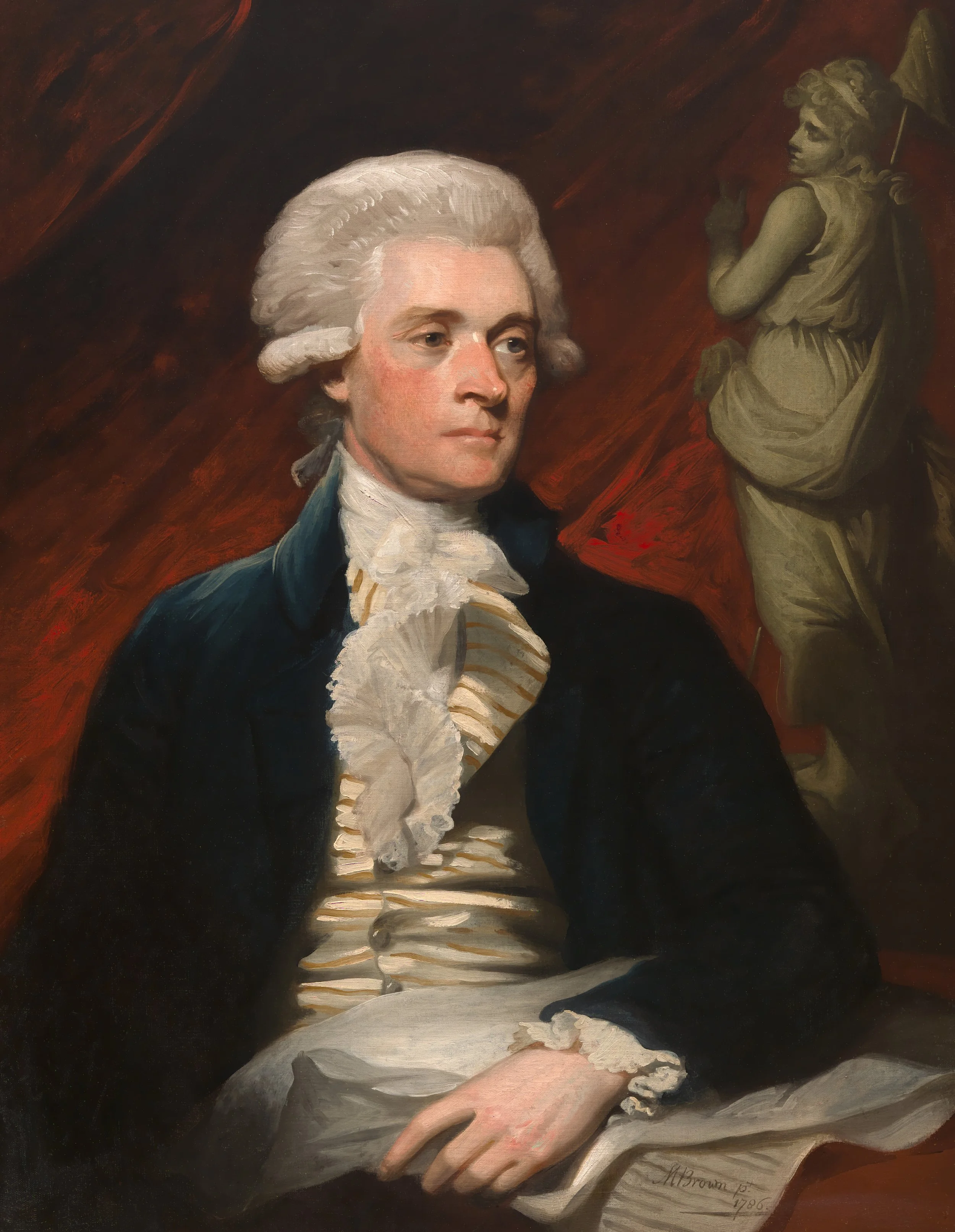
Mather Brown, Thomas Jefferson, 1786. National Portrait Gallery
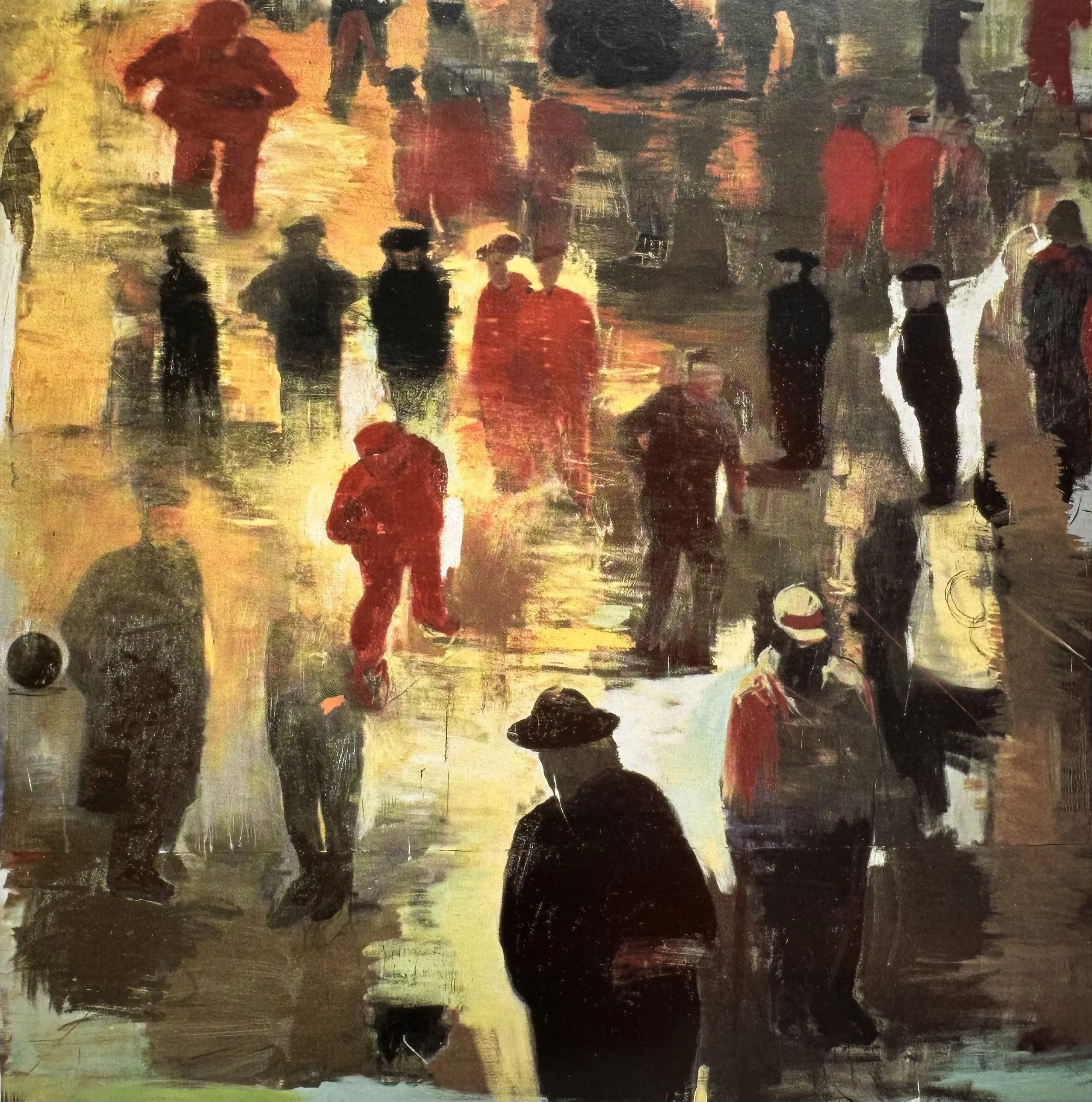
Christopher Brown, November 19, 1863, 1989. Modern Art Museum of Fort Worth
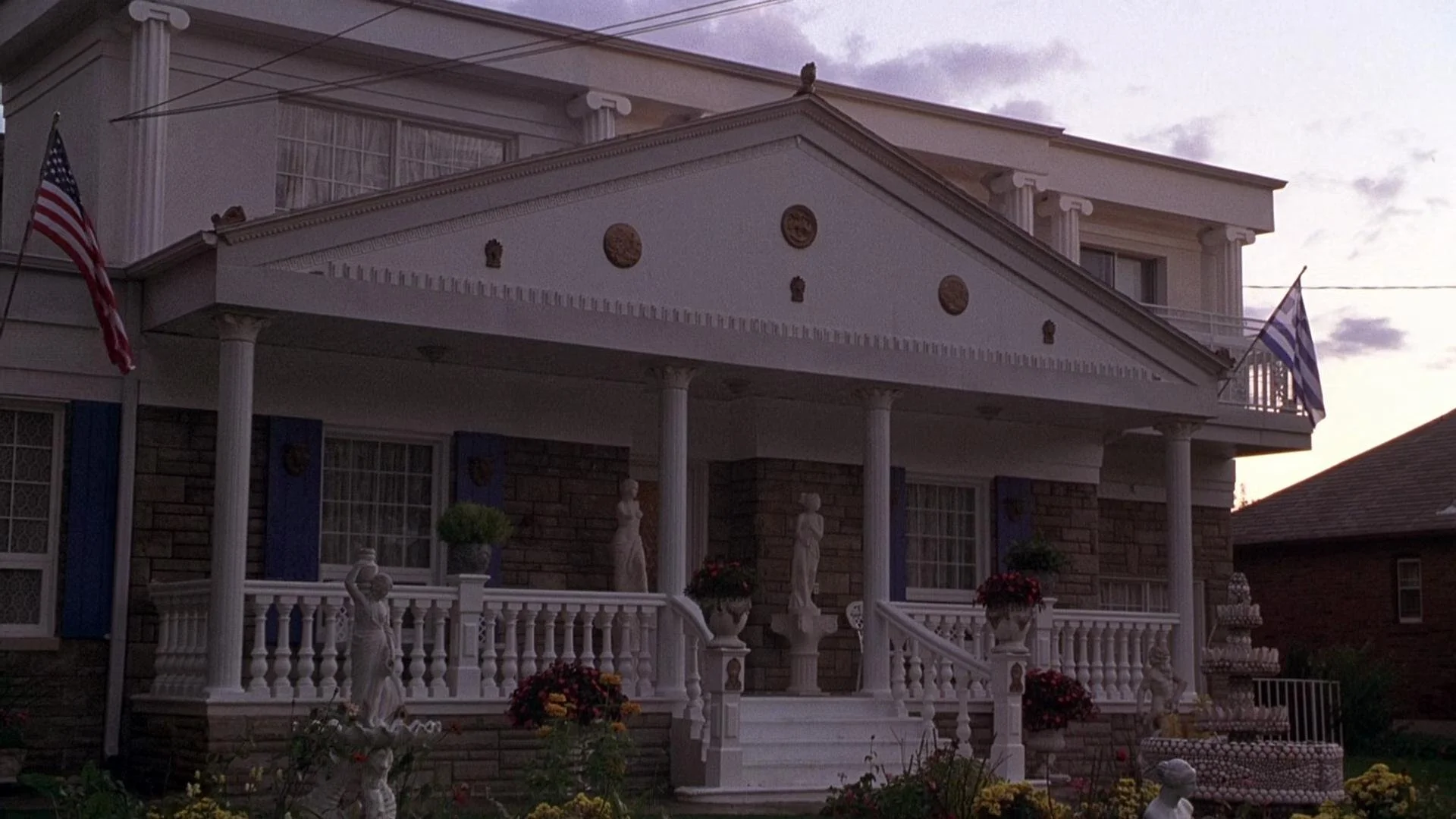
Still from My Big Fat Greek Wedding, 2002.
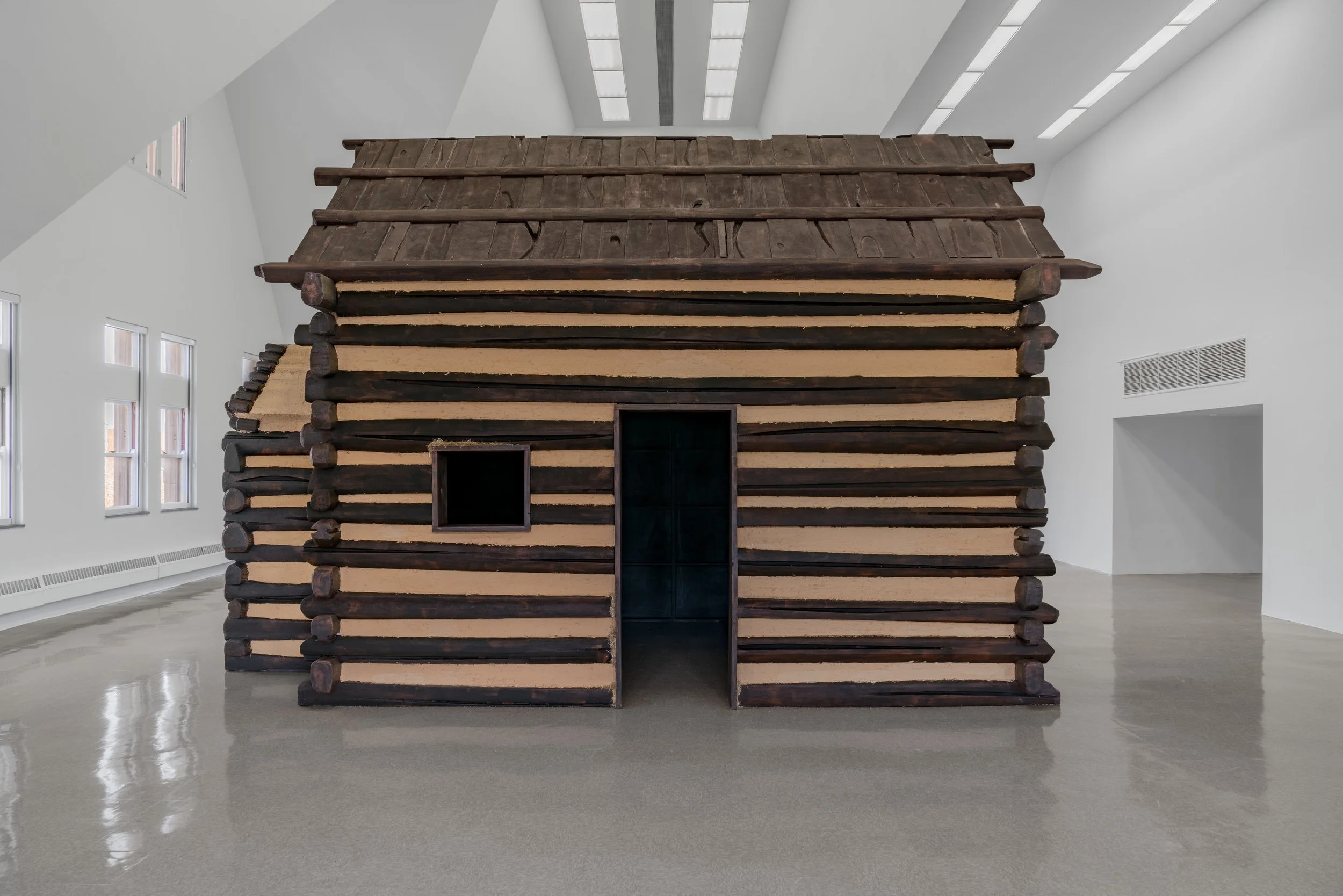
Isabelle Frances McGuire, Symbolic Birth Cabin Unit, 2025. The Renaissance Society