"All Art is Political" is a Meaningless Phrase
Politics does not exist; has never existed.
Politics is the surest way of avoiding freedom.
“Everything is political” and “All art is political” are prison-phrases. They cause in me an immediate jolting reaction, I want to rebel against them. They sound to me like attempts to shackle art, like the words of someone quaking in their boots for fear that they can’t control the world. The world is not political — we are not political. Or at the very least, we are not only that, which is what those deadly phrases imply by definition. To insist that everything is political is necessarily to say nothing can ever be more than political. Politics becomes the end of all things, the limit of our world; it replaces wisdom, meaning, love, beauty, or God as the unifying substance of our lives. It requires an incredibly unfree consciousness to say it, which is why you hear the phrase most from people who have staked a large portion of their identity on being more moral than other people. Since anyone who has done that is secretly very afraid they’re the exact opposite: deep down, they’re the victim of their own anxiety, the suspicion that these convictions might not even be their own, natural convictions.
But in the end we should have no political convictions whatsoever.
The right, the left, the center, the fringe, collectivism, capitalism, communism, socialism, anarchism, fascism — any and all ideologies, allegiances, parties, or beliefs are incapable of addressing the actual human world (only art can do this). There is no politics whatsoever that can ever actually address our lives. There is no “Fixing things.” There is no “Getting things right.” Each and every attempt to navigate the complexities and conflicts that bloom between people living together can only ever be “Good enough.” What self-respecting person ever loved a politician? Who could ever love the kind of person who would put themselves in control of others? The wisdom of every wise tradition, the insight behind every insightful religion — the truth through which every sage has ever engaged with the world — comes from the same understanding, that every human action is a deadly illusion, carried out under shadows, whose consequences lie beyond our ability to predict or understand. It’s a peculiar time we live in, that slogans and clichés like “The time is now,” or “The world is ours,” or “Everything is political,” or “The personal is political,” are still chanted like apotropaic charms. Since that’s what they are: a cliché is a charm against thought, a substitute for individual hesitation. And any real history — of art, of politics, of human consciousness — will show that there is no proper “history” at all, only a long line of individual hesitations, moments of thought, clichés not chosen.
What a dull thing it is, to be political, to act, to “Do the right thing”! All right things are empty things. The only way to be truly alive is to be creatively wrong. But the whole history of political thought is a list of painful, mortifying, stultifying ways of being morbidly correct.
Marxism is obviously completely correct — which is why it’s boring, useless, and stupid. Ethnonationalism obviously makes a correct survey of the hearts and minds of every people who have ever considered themselves a people, only to find themselves hemmed in by the borders of some invented thing called a “nation” — which is why it always ends in the mass-murder of somebody else, in ritual sacrifice to ancient gods of tribal mistrust. To be a people is to be the only people. All tribes are named “the people.”
Neither capitalism nor socialism actually exist, or have ever existed, thank god. Who could want perfect competition, who could want perfect redistribution?
“Community!” “Community!” people cry. “We are dying because we have no community!” “Everything I do is for the community.” But why would anyone ever want community?
The same people who talk the most about community also claim to care the most about giving people the freedom to be themselves — but to be in community is to give up the right to define yourself. You cannot say “This is who I am” while remaining in community because to be in community is necessarily to let a group decide for you who you are. You cannot dictate the way people see you. Only hermits have self-expression.
Most therapy, most contemporary psychology, all of our psychiatric obsessions and fixations, are a replacement for the old religion (whatever religion, they’re all the same, now: dead, until they aren’t). Salvation is no longer for souls but minds; bodies, too (only step one foot inside your local gymnasium, a word that in many happier places still means school). Health and above all Mental Health is our salvation, and we worry over it exactly as men and women used to fret over the fires of hell lapping their unredeemed souls.
So no — community is not a comfort. It doesn’t fix these things. It doesn’t heal the unsaved mind and body. We’ve given ourselves the curse/blessing of the Individual, and we will have to see it through. No hope here but for a sect of one.
And yet there has yet to be a true individual. The best are artists, geniuses of the singular. Even these have only been glimmers.
We live in the most conformist time that has ever been, because our version of conformity is subtlest. It convinces us we’re each owed attention and validation as unique individuals; it has us believing that what we desire is really our own desire. When in reality we’ve outsourced all desire to platforms, to avatars, to the rich and famous and fuckable; we go to the Mirror to ask the Other that is Not Us to desire for us, and what it desires for us is that we would be obedient in our individually desiring it. We declare what we want, not understanding that this is what we were mindlessly instructed to want; we don’t even know what we actually desire anymore; desire itself has become a foreign concept, an un-idea; desire is no longer a sensual dream of a sensual self. This time of ostensible “individuality” in the horrors of neoliberal modernity, nightmares of lives lived by statistics, is not truly individualist, not in the least. We aren’t drowning in individuality: we’re drowning because we can’t actually be individual, we don’t have the strength, or will, or final responsibility to be authentically individual. We are terrified of what freedom means (freedom means living artfully).
We live in a profoundly judgmental time, as punishingly prudish and moralistic as the Victorians or the Puritans. That this is true simultaneous to an historically unparalleled hedonism and greed should not really be a surprise. The richest among us — aliens, essentially — live grotesquely immoral lives, feeding off the misery of billions of people. But the rest of us get endless prudery, vicious hypocritical judgment, moralizing each other into the grave. Open Instagram, Twitter, BlueSky, TikTok, Substack Notes; every other post is a lecture. Every other post is some version of, “These other people are terrible creatures, and as moral arbiter of this moment in human consciousness, I feel certain deciding who is and who is not saved.” This is the real substance of our twenty-first century “individualism” — not individualism but solipsism. Give people the perfect engine for “self-expression” and they will end up using it to silo themselves and surveil others. The way any good community used to.
We really are religious creatures. Apes who keep insisting that the divine intervene on our behalf and punish the right people for us, forgetting our animal beauty and natural, physical pleasure. Forgetting we are our senses (data — “things given”). We feel that to believe rightly is to be saved, while people who show any evidence of believing wrongly are damned. It doesn’t matter what our politics are. Left or right or anything, this is how we go around behaving. Nothing has changed in a thousand years. We say we want freedom, but we’re terrified that we might not actually know what’s right or wrong; that these are just inheritances; that other people frequently believe the opposite of what we believe, but with the same passion and certainty. (Though, again, being “right” or “wrong” are far from the most important qualities or categories of our lives — in fact they’re very far down the list, much closer to “good at racquetball" than to something like “capable of love” or “a good father” or “serious about cooking”).
Only secretly cynical idealists would say that a potential counter-culture, to this reigning faux-individualist and hypocritically moralist/conformist culture would be communitarian and “unselfish.” Love and freedom exist despite community, and are impossible without a strong and cultivated self (a strong self is one that isn’t threatened by the fact that it doesn’t exist). A true creative and artistic counter-culture for our time (the emptiest, saddest world anyone has ever grown fat in) wouldn’t involve us running around saying, “We aren’t at all unique, what we want as individuals doesn’t matter, we’d all be much happier in a kommunalka somewhere.” An authentic counter-culture would be the opposite: a culture of genuine idiosyncrasy, strangeness, irascibility. A truly oppositional culture would tolerate and give free reign to the complete irrationality and peculiarity of people, would celebrate their rascality, would give them freedom to be themselves, and nothing but themselves, for good or bad, in ways the governing culture simply cannot do. It would allow genuine weirdness and risk, even a bit of deviancy. Yet as it stands today, most young social groups — already under threat of dissolution into the gray, abstract soup of our age of disconsolate loneliness — are suspicious and timid, afraid of being tainted by true idiosyncrasy, freedom, or love (any community must be incredibly strong to survive these things: human bonds melt quickly in the brightness of human divinity).
It would, in other words, be a culture that finally does run counter to the more grotesque culture that rules us — not blindly submissive to the same fixations, not just pretending to perform some quirky, individual style or self, while inside remaining enchanted by unoriginal desires or intolerance of real individuality. Every time we comment emptily on someone’s internet photo, every selfie posted online, every bit of recycled slang, every AI-generated word, every moment we beg the great Mirror for attention — we acquiesce just a little bit more to a regime that wants to obliterate us and our originality. A real counter-culture would have no selfies.
In the end “All art is political” is a statement that obscures a much sadder statement beneath it: “I wish for art to be on my terms.” It’s a fear of the freedom of art and artists. That’s all it is. A fear — the central fear of so many people right now — that art and artists are unruly, and if left unchecked (by politics, by community, by politesse) these artists might just wander off into destructive, even immoral, places. Because they possess a dangerous desire to comprehend and intuit the whole of human experience, much of which is quite immoral and ugly. A free art would be free to consider this immorality and ugliness as surely as it would beauty and gracefulness. But this is something many people can’t really stand. Though they say otherwise, the reason many people engage with art isn’t from a spirit of exploration, or a love of beauty, or a need for connection with the world: it’s for want of something to explain to them that they are alright as they are. They desire advertisement.
An artist is all history, memory, sensuality, and nature. An artist should be any of these things before being too much society or too much culture. Certainly an artist should never be political. The artist is the only person who can comprehend what Henry James called the “Tone of the Time” because the artist is the only one who understands other times, recognizing and appreciating other forms, determining what the difference is between then and now. Only people who know another time as they know themselves can recognize their own period. When we say something’s “dated” what we mean is it contains the body of its own time, and nothing else: it brings us the texture of its era, but imprisoned within that era’s unconscious fixations and assumptions. It knows nothing else, and offers the future only the values of its own common denominator. It can serve as a diversion, a picture, a warning. But it cannot stand for (or up to) time itself.
Anyone who thinks art and artists shouldn’t be free to risk the “wrong thing” has only ever thought so because they were terrified. Just beyond the edge of their consciousness, they dimly saw that what they believe to be right isn’t immediately obvious to some people, and this scares them. So for them art becomes an education in the right way of thinking. Art to these people is a propagandistic buffer, they dream of a world in which each book or film or painting functions only to protect them from encountering anything besides their own convictions. The idea that a work of art which causes (or risks causing) offense should be stamped out, or shut up, is born from minds who, like children, take each work of art to be essentially a bible, or worse, a devotional manual — that each work of art ought to reflect nothing but perfect instructional clarity in the values of a particular class.
To condemn an artist for having risked the wrong morality is to believe that the point of the art is to brainwash its audience into accepting whatever’s stated there, as simple fact. It presupposes that the audience isn’t capable of encountering something transgressive, or immoral, without being swept along by it, converted to its statements as if to a malevolent political program. It’s the most backward kind of religious thinking imaginable (a belief in magic, basically), which comes from an anxious terror that at any moment the current ruling aristocracy of opinion could be all-too-easily overturned, replaced by another: that what we consider true and good today might quickly turn into something else entirely. Normal people, anxious people, who believe they’re on the side of good, don’t realize they’ve put themselves on the side of every punishing, censorious authority that ever took up the flag of the false reactionary “protection” of its people’s minds and souls. This is how a cliché like “The personal is political” becomes — as most modern sentiments do — another prison. “All art is political” is the opposite of freedom. Any proper counter-culture ought to do away with it.
Originally published in Via Contemplativa
//
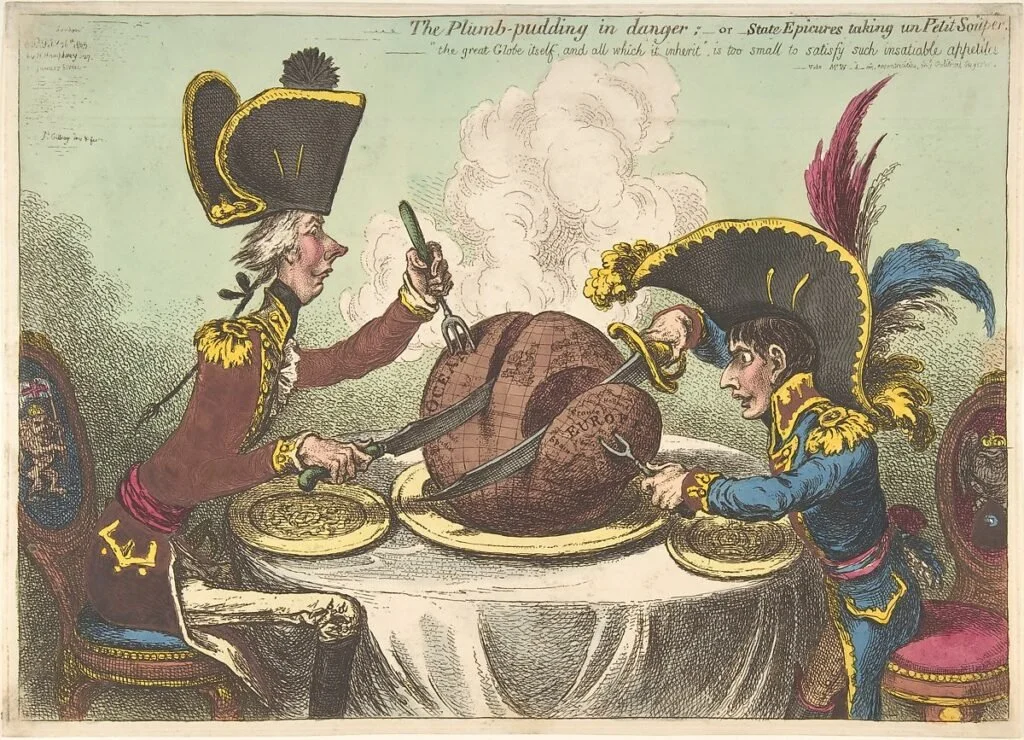
The Plumb-Pudding in Danger;–or–State Epicures Taking un Petit Souper James Gillray February 26, 1805
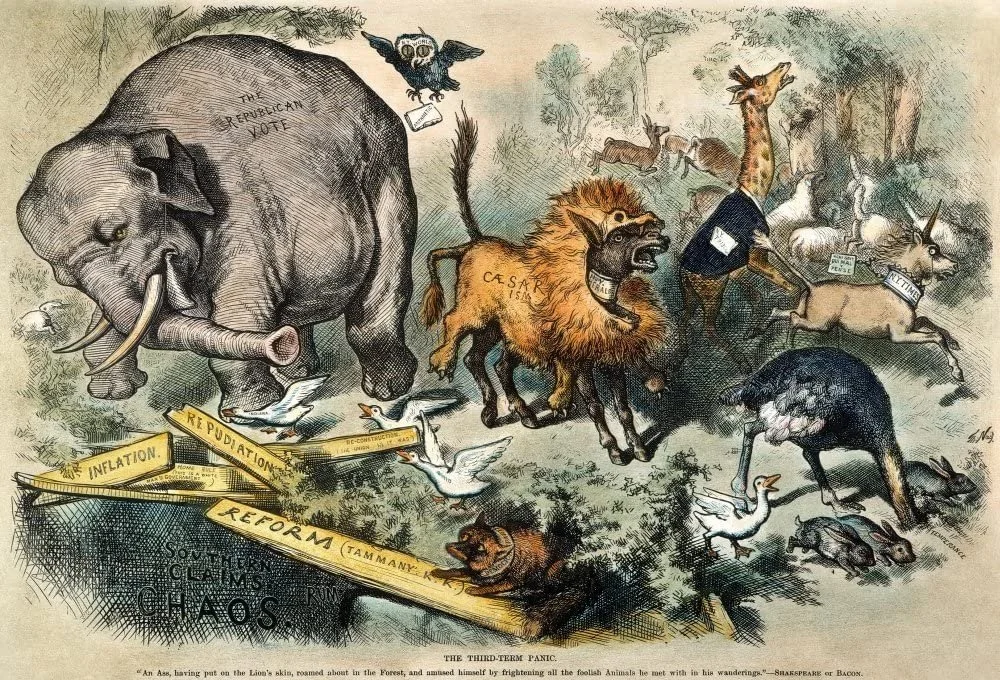
Third Term Panic Thomas Nast, 1874, for Harper’s Weekly, New York, New York
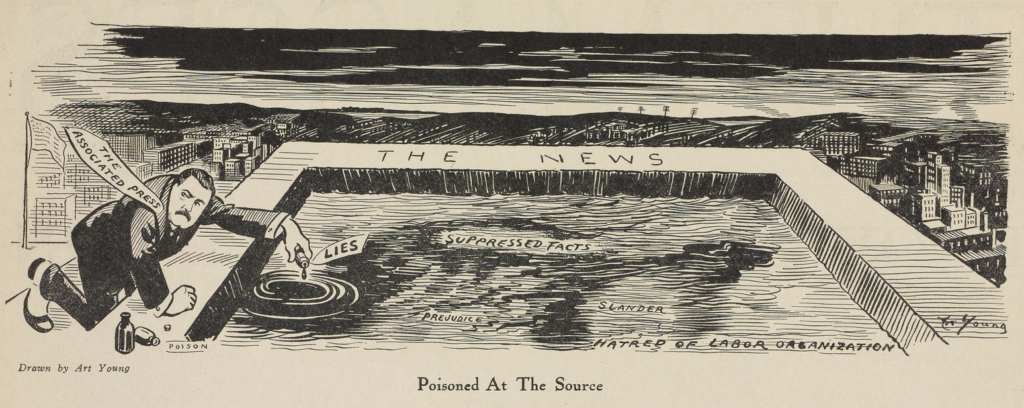
Poisoned at the Source, Art Young, July 1913 issue of The Masses.