Imagination cannot be administered. Committee heads cannot dictate what productive [art] should do... [Art] can no longer be determined from the outside by committees, public institutions, and interest groups.
— “Hamburg Declaration” (1979) by German filmmakers
To make good art, that’s all.
—Clement Greenberg, 1969, upon being asked what the artist’s role should be in society
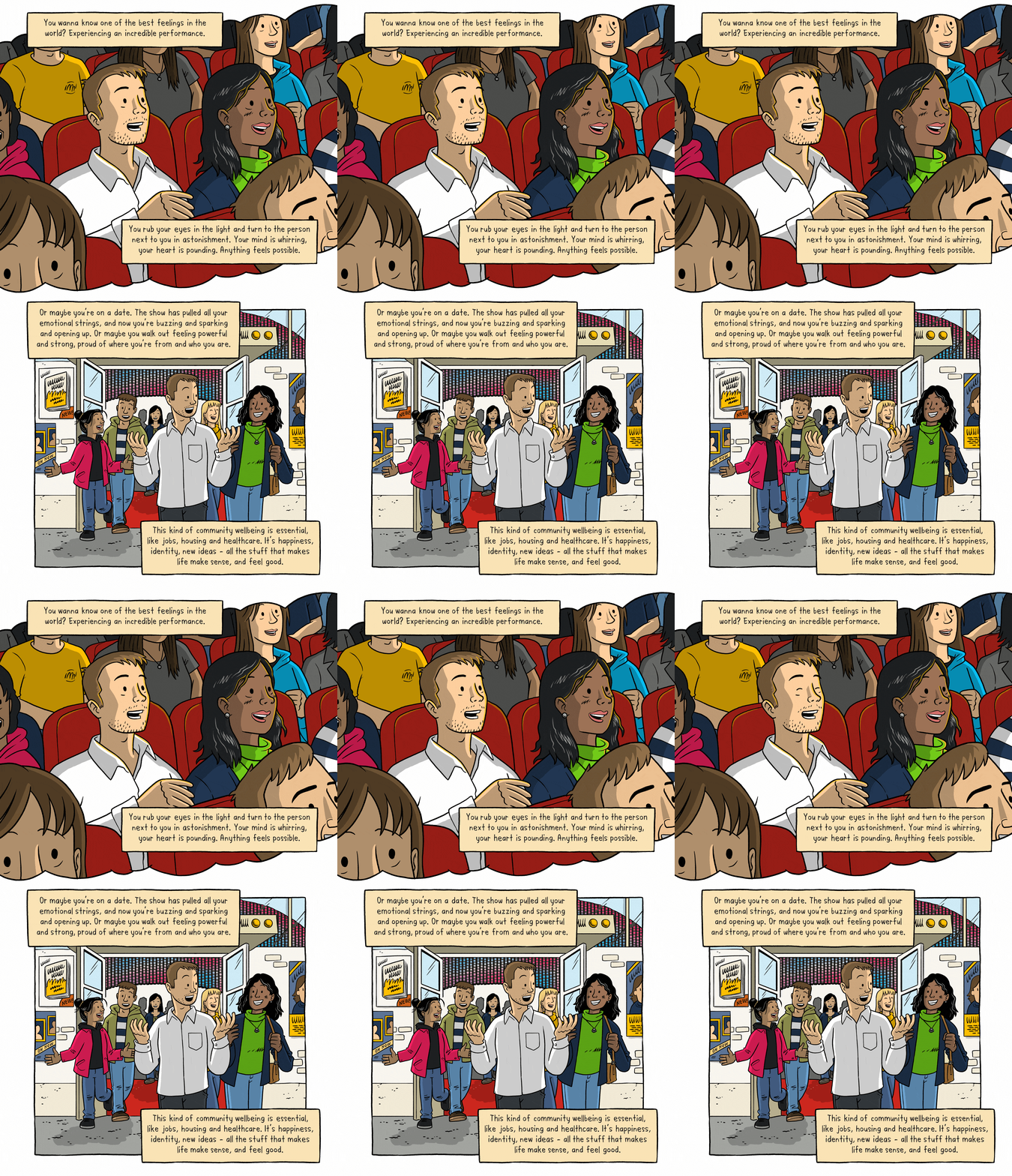
“Sponsored” is the word. In 2024, single panels of a brightly-illustrated comic strip appeared on the social media feeds of young New Zealand artists and their peers, tagged with the words “sponsored post”. It was part of a marketing campaign commissioned by Creative New Zealand (CNZ), the country’s largest state-mandated arts patron. Following the ad to its host website revealed the full comic by Toby Morris, an Auckland cartoonist whose “explainer” comics, generally aligned with the progressive wing of parliamentary politics and its policies, are popular among urban “creatives”. This campaign, targeting the same audience, was a 14-page defense of public arts funding in New Zealand. Although its scope was narrow and provincial, its message crystallised the statist horizons of a generation of political activists around the world, whose vision of the administration of society via the state has soared to the heights of Zohran Mamdani’s mayoralty and rise of the DSA in the US, Die Linke and KPÖ’s successes in Germany and Austria, and the resurgence of parties like the Greens in Australia and New Zealand.
But Morris’ comic does not transmit as overtly political. Launched on local journalism website The Spinoff in November 2024, Arts Funding 101: We Feed the Garden, The Garden Feeds Us lays it out in the simplest terms for the reader: Local art is like an ecosystem. It survives when producers, backers, and audiences work together in tending to it. When they don’t, the “garden” dies. [1]
Morris’ conservation analogy is persuasive insofar as it reflects a cautious and provisional argument: rather than relying on absolutes, Morris frames the arts as a system of cause and effect predicated on an underlying infrastructure. More official, institutional support yields growth, he contends; less means decay. Hence, Morris does not depict funding sources like CNZ as monoliths looming over the arts, but as nodes in a subterranean network of support; each a part of a community that works to send nourishing minerals to the above-ground “plants” — that is, artworks and their producers.
It is literally a grassroots metaphor.
Morris’ core claim that the arts “ecosystem” will “wither and die” without patronage of some form, has some basic plausibility. Art is a commodity, and most art needs financial support of some sort in order to exist. But the cartoon’s real concern lies at a deeper level — for Morris’ backers who commissioned the cartoon, it matters which funding sources provide that patronage.
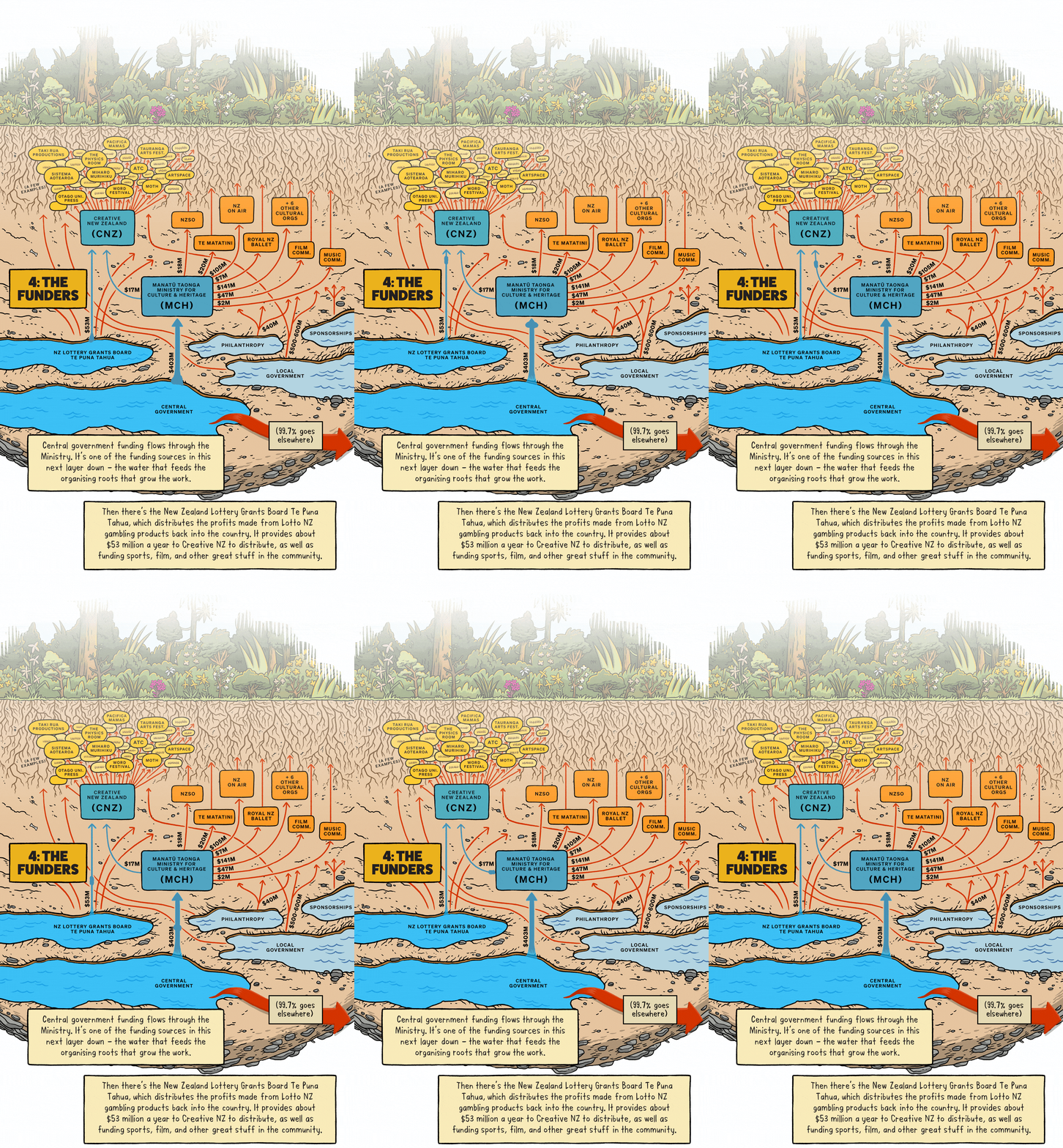
Morris completely omits commercial sponsorship from his metaphor. By leaving out the market, all forms of private patronage — from individual backers to commercial advertisers to small businesses to private museums to dealers to mega-corporate sponsors — are conflated and treated as functionally the same: not-the-state. This intimation courts the reader’s skepticism, quite healthy in many contexts, that private profiteers may not always have l’art pour l’art at heart.
But the state, too, has vested interests. Do political parties, left and right of centre, not cynically track public opinion, and so, public taste in order to craft their policies and campaigns? Has the administration of art, from Stalinist “socialist realism” to Nazi censorship of “degenerate art” to the Democratic Party establishment’s ties with Hollywood never served a political purpose? And did Bill Clinton get out his saxophone on the campaign trail because he just so happened to have it with him on that particular day?
Morris tells a different story. “Politicians and decision makers act on the national mood,” he notes optimistically. “If the mood says we want better arts funding, then that means they can strengthen the whole ecosystem. And that, in turns, means more shows, better books, more films, bigger festivals, stronger galleries, new ideas, new voices — at every level.” Focusing again on the grassroots, Morris reframes an old pro-state spending argument: No reasonable person would complain about paying a cover charge to see their favourite live act, he writes. The arts-loving public, therefore, should have even less of a problem with their taxes going to support artists on a national level. Morris’ is a point of view that equates the arts with a public service; a means of nourishing a population no less vital than public parks, museums, libraries, and clean waterways. The self-evident utility of these conveniences, explains Morris, assures informed citizens to “feed” the cultural garden by electing representatives who allocate public funds wisely. The growth cycle continues.
To be clear, CNZ is not the state, but a semi-autonomous agency that is separate from but also reliant on the state. Although its independence is upheld by policy safeguards, it must regularly reassert its legitimacy in the face of opponents whose political capital rests on undermining it. (For instance, in 2022 CNZ came under fire by the Right after one of their appointed external assessors criticised a theatre festival for high schoolers on the basis of Shakespeare belonging to a “canon of imperialism.” [2]) As a product of the state, therefore, it functions according to a similar self-perpetuating logic as the state. Morris’ comic, likewise, is defensive in form and content — not, it must be said, a defence of the art it claims to support, but of itself, via the funding channels and institutional machinery that sustain the agency.
It is difficult not to interpret Morris’ comic as anything but a tacit appeal to vote Labour. Taking the form of a worn-out “crisis of art” cliché, CNZ’s comic amounts to an ultimatum so common in capitalist politics. In spite of its chirpy narrative voice, the comic, in order to add pressure upon the reader, rests on a series of conflations: public agencies with the “national mood”, the national mood with national identity, national identity with culture, and culture with art per se. This chain of equivocations allows lofty appeals to civil society to become merged with CNZ in the mind of the reader. The audience is left to infer that artistic progress hinges not on artworks or artists, but on bureaucratic stewardship over culture; that without the state, the “garden” of art — of Eden? — is inconceivable.
Less concerned with art for art’s sake than national-profile-boosters like Lord of the Rings and Lorde (whom the comic names as beacons of our age), Morris’ various appeals to “community wellbeing” and “the national mood” invite evaluation of the comic’s success on exactly those terms. But critical judgment is of no concern for CNZ. It has little regard for art’s intrinsic value beyond leveraging it as rhetorical justification for the administration of creativity — merely one element in the agency’s mandate to invent new ways of mandating itself.
Such is the official idiom of ‘culture’ trumpeted by CNZ and its overseas cousins (Creative Australia, National Endowment for the Arts, Arts Council England, etc.). These organisations are not concerned with the capacity of art to serve the free play of imagination and understanding — only drill exercises in which market-tested social critique tropes are reproduced on command.
In sum, students of “culture,” those favoured clients of CNZ, become so conditioned to the inevitability of such agencies that they reproduce the interests of progressive capital without even requiring government support. So much energy in the art world is spent sculpting obedient personalities, so averse to thought taboos, that it is little wonder that the truest converts who emerge from this process know nothing of the revolutionary import of art, nor the artists who starved themselves in garrets in its name. Having mouthed the words “take the money and run” for so long, the most successful converts to statist doxa are those who have forgotten the phrase’s meaning. In significance, their artistic ‘work’ amounts to less than their ideological work, performed pro bono for the state and ultimately unable to be rationalised other than in CNZ’s mercenary terms: that “in 2023, the creative sector contributed $16.3 billion to NZ’s GDP.”
Yet, those who truly care about art need only look at the results. Not political supporters re-elected or value added to the national economy, but the state-sanctioned “culture” created in its pursuit — and the individuals whose entire personalities, peer groups, and CVs are crafted around knowing which grants to begin applying for at least a year in advance. Those who truly care about art already understand that this situation cannot amount for truly transformative art; only its pale imitation. Or, on a bad day, propaganda like Morris’ — that which clunkily concludes that the benefits of state sponsorship of the arts include “inspiration and identity” and “mental wellbeing on a national scale”. (One only need to attempt to form a mental picture from Morris’ phraseology to realise how hollow are its terms.)
Historical proofs abound of the state’s definite interest in leveraging an official “culture”, whether the aforementioned example of the Soviet Union’s 1934 adoption of “socialist realism” as its official aesthetic doctrine or the CIA’s funding of Abstract Expression. But none are so relevant, as far as the sensible artist is concerned, as an immediate recognition of what becomes plainly evident from examining Morris’ cartoon. That is, state sponsorship makes for bad art.
All an artist requires is one’s faculty of judgment — the impulse that allows one to detect emerging potentialities within the realm of feeling. This inspiration can be negative as much as positive, as when an audience member, trusting their gut, intuitively senses that an artwork ‘sucks.’ Yet, this quiet capacity should not be taken for granted; it can easily be drowned out by popular opinion and the loud imposition of thought taboos. By trusting one’s faculty of judgment, one refuses the opportunistic self-rationalisations that comprise the narrow vision of “culture” the state has concocted. Just as one might sensibly ignore an overly wordy press release or artist blurb at an art gallery, one learns not to waste one’s time reading the explainers, infographics, and statistics CNZ has summoned to justify its own existence. Instead, one figures out how to trust the artwork to tell a truth about itself — good or bad — via the aesthetic experience it produces. One, too, rejects propagandistic phrases like “mental wellbeing on a national scale,” instead opting to throw their lot in with art’s necessary but never sufficient modus operandi — that which Leon Trotsky called a “protest against reality.”
If state sponsorship becomes the normal state of affairs, art per se is thrown into question. On the other hand, if art’s essential quality — its autonomy — is upheld as an ideal for and by artists, sponsorship cannot exist but as a scandal.
Yet, state sponsorship is not, at present, scandalous.
Instead, artists relegate themselves to the status of an ungrateful child, bound up in a Freudian deadlock with their parent who foots the bill for their rebellious outfits. Seeking better terms in this arrangement, they turn from one parent to the other, refusing “corporate backing,” which is associated with private interests — i.e., profit — and instead courting state funding, which supposedly represents the “public good.” They oppose the corporate sector on the fraught and clichéd terms of ‘art versus commerce,’ reasoning that governments can at least be lobbied or pressured to favour “collectivistic” interests, as though the state somehow has less to do with capitalism, not more. Such is the fraught ideology produced to rationalise a situation wherein artists identify with the terms of the patronage-or-perish paradigm.
Describing state patronage’s effect on young artists as a “soup-kitchen mentality”, New Zealand critic A.R.D. Fairburn wrote in 1956:
The manager or impresario with a will to power comes into this situation under false pretences. He finds it easy to pose as the modern equivalent of the old-style patron, the representative of society. In doing so, he confuses the issue. For he is not really helping towards a renewal of the contract between the artist and society: he is merely building his own private empire. . . . The dealer-rackets, and similar parasitic growths on the arts, that have been so troublesome in the past are now beginning to get mixed up with public managerial rackets. . . . [Yet,] the artist, if he values his soul, can never afford to make the eunuch’s bargain: ‘Give me a hand-out for Art, and I’ll agree to keep off politics, economics and religion.’ It must not even be remotely implied.
Decades later, recognising that this condition was showing no signs of improving, the philosopher Susan Buck-Morss wrote: “Artists as a social class demand sponsors: the state, private patrons, corporations. Their products enter the market through a dealer-critic system that manipulates value and is mediated by galleries, museums, and private collections. Tomorrow’s artists may opt to go underground, much like the freemasons of the eighteenth century. They may choose to do their work esoterically, while employed as producers of visual culture.” [Emphasis added.]
Toby Morris’ grassroots metaphor blends poetically with Buck-Morss’: the “underground”, here, is not the romantic refuge of rebels and misfits the term often connotes, but the dark, emotionless space devoid of all but hidden networks of fungi. For artists to go “underground” in Buck-Morss’ sense does not imply retreating from the “mainstream” world of commercial art, but rather sinking into it, discarding one’s critical self-consciousness as an artist so it may break down and become absorbed like compost. This does not mean that critical moments of aesthetic experience will not flare up. It is rather that these will be more or less circumstantial, and will remain unrecognised.
It was the traditional role of critics to remind artists of their task. But criticism, like art, has been liquidated. Sponsors now occupy the place of the critic, since whoever holds the purse now appears to be the only voice capable of meaningfully altering a work’s direction. And then, actual professional critics today, insofar as they exist, effectively function as pseudo-sponsors, regarding their task as that merely of “reviewing”, i.e., affirming or denying the content of the artworks — and thus encouraging or discouraging its patronage. The resulting discourse is usually literal-minded, referential, and philistine.
However, if the present conditions continue to feel intolerable, some artists might be compelled to take the issue above ground, forcing it out into the open. Art might begin to invoke its right to exist out in the free air. There, artists, too, have the freedom to choose a side on issues where the fate of art as a critical practice hangs in the balance. And where they cannot choose, other artists have a right to remind them of that right. This insistence might even lead to controversy. Which, in turn, may be amplified — especially if, by going against the grain, these artists alienate the media on whom they have so often depended as a conduit to the wider public.
A recent article was published on Australian news website The Conversation — in concert with New Zealand’s state broadcaster, Radio New Zealand — titled “Art for art’s sake? How NZ’s cultural organisations can maintain integrity and still make money.” In it, the authors, a research team, unknowingly echo Morris in concluding that “arts and culture are neither luxuries nor commodities, but integral parts of a thriving society.” [3] They are fundamentally wrong. Art is both a luxury and a commodity, and not merely so. It is because of this commodity character that art cannot exist but as a scandal. It is implied in the very structure of the commodity which — like all of the society build upon commodity relations — is in crisis. At least, Marx thought so. As C. Philip Mills explains:
Art was able to become art by becoming a commodity, which actually meant becoming more than mere culture. But in capitalism its social existence as a commodity comes more and more in contradiction with its existence as art qua art, as an object of aesthetic experience. Nevertheless, the latter sustains itself within the lacerated subjectivity of those still willing to see. The artwork that is simply conformable to culture seems to lack that really creative energy which seems to give great works of art a life of their own, spontaneous and constructed at the same time. It’s in this internal contradiction of art as a commodity, and art as experience that art rails against homogenized culture from within it. . . . Art's protest is a formal one, [giving] form to an integrality that so-called culture in fact lacks.
If artists do not recognise the stakes of a controversial reality — a reality turning against itself — and fail to task themselves with delivering the necessary reminders of it, controversies will nevertheless occur. But there will only be incompetent defence attorneys, who will hedge, stammer, and equivocate, leading to debates strained and insubstantial. Pseudo-intellectual, pre-digested talking points like “art versus commerce” and “individualism versus collectivism” will mark the start and end of every conversation. This will be the future of art without artists, and in this barbarous state, the autonomy of art, like the words “freedom” and “utopia”, will continue to be placed in scare quotes, along with their history, in a summary dismissal of the rational plausibility such high notions ever had to those who lived and died for them. And their memory will only become available in fragments and shards, as fleeting, ephemeral visions that evade our recognition as they pass.
And yet, so long as art, in its very form, poses the question of its autonomy — i.e., cannot be reduced to Morris’ insipid appeal to “national wellbeing”, or might even provoke division — it resists heteronomous ends and defies subordination to both public and private interests.
The problem, we might conclude, is a deep one. It can be resolved no more by championing particular artworks than by cheerleading funding channels deemed more “ethical” than others. Likewise, to insist that artists refuse sponsorship or use it “subversively” would be to escape the problem, and childishly. Contra Morris’ suggestion that art vivifies culture (or the alternative view, that art offers a means of “critiquing society”, which effectively amounts to the same conservative defence of the given and the same, since it is presupposes the ultimate aim of wellbeing, not transformation), art functions to expose society’s contradictory character. Art intimately expresses this pathology; one of arrested transition, requiring — but lacking realisation of — decisive action. The question is whether we will recognise the illness, along with the deeper conditions it reflects.
Until artworks emerge that apprehend their contradictory character, we must settle for less. We must seek comfort in works that unwittingly reveal conditions of degradation. Insofar as we submit to the dubious opposition of “public” and “private” art, we can ascertain that the commercial sector’s influence on art is, at least, nakedly corrupting. A commercial artwork might be received like a blunt object, severe in its force as it delivers a truth that Morris’ equivocations never will: Art is not intrinsically about “wellbeing,” the “national mood,” “pride,” “connection,” or “joy.” We can take relief in a commercially-funded artwork since it is so often loudly stupid, unlike Morris’ cartoon, which possesses a more insidious stupidity that expects the viewer to be thankful for its tone. Which is, in a word, patronising.