
Krasner and Pollock: Past Continuous
Metropolitan Museum of Art | October 4 - January 31
Like many millennials I entered adulthood believing that gender simply would not matter very much in my life outside my selection of romantic partners. Workplaces were integrated, sex was free, the liberation of woman from womanhood if not complete was all but guaranteed. Instead, the past ten years have seen a dizzying reentrenchment of gender norms on both left and right and the reassertion of sex as the central factor of private and public lives. The personal has never been political, but it is politicized.
The Metropolitan’s Krasner and Pollock show is difficult to untangle from our sex-obsessed moment. This is not two artists who were contemporaries, it is a husband, a wife, a man whose towering career dramatically overshadowed hers. Outside of the fact of their marriage the pairing is a bit tendentious. One gets the feeling that either the Met wanted to do a Pollock show and needed a contemporary hook, or the Met wanted to do a Krasner show and needed Pollock’s star power. In any case it salaciously stirs the gender wars.
The implicit assertion is that Krasner is just as good as her more famous husband. But just as does not go far enough, one must proclaim that Krasner was better, a sentiment broadcast by some critics and repeated (as I overheard it) by several exhibition visitors. The museum gift shop is selling a Krasner tote bag but not one featuring Pollock. They know their audience. Cultured published an exchange on the exhibition with critics Julia Bryan-Wilson, Jarrett Earnest, David Rimanelli and Johana Fatemen.
JBW: I resent the space he’s taken up institutionally. I mean, maybe it’s deserved, maybe it’s not.
DR: He was better than her. I hate to say that. I’m going to be the evil person here…
JBW: Strong disagree
JBW: Pollock’s straight white male cowboy persona fit into a certain American idea. So it’s not as if he floated to the top purely because he was quote unquote great. Sorry, that’s not how talent works, and we all know that.”
JE: I think there’s no chance that people who walk into that show will walk out not thinking that Krasner’s as great an artist as Pollock.
DR: I think you’re wrong. That would be nice, but she was not a great artist. She was an excellent artist who…did not change the course of art history in the same way.
JBW: Does it even matter anymore?
It doesn’t matter, really, according to a popular and lazy form of thought in which Krasner is great because she is not Pollock, not a “straight white male cowboy persona.” It doesn’t matter who made the better pictures what matters is the narrative, even more importantly the prospect of turning one outdated narrative on its head. Rimanelli makes a strong showing in a hostile room. He’s right.
Pollock is the great artist, this is obvious looking at the work. The exhibition (possibly in spite of itself) argues this. We learn early on that Krasner comes from an east coast academic form of art making—intensely formal, in the tradition of the European masters. Pollock on the other hand is from the American west from which he pulls eclectic, figurative influence. When the two artists unite they merge briefly in similar abstractions. Two pictures hung kitty corner from one another perfectly illustrate the trap both painters set for themselves. Their canvases are obsessive, overworked, both artists anxiously applying paint toward some impossible end. The excess of movement produces total rigidity. Detailed repetition contracts totally.
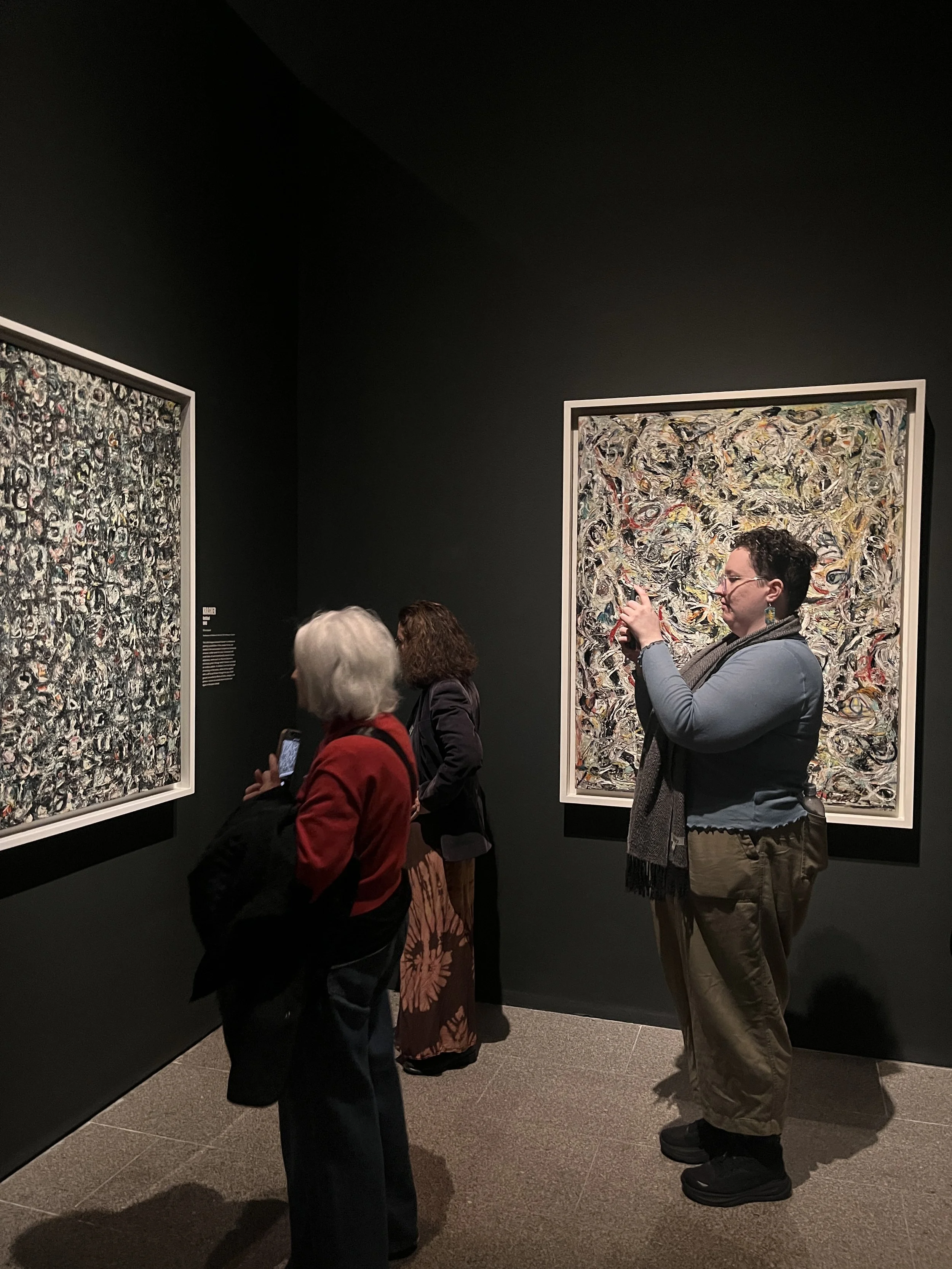
Krasner left, Pollock right,
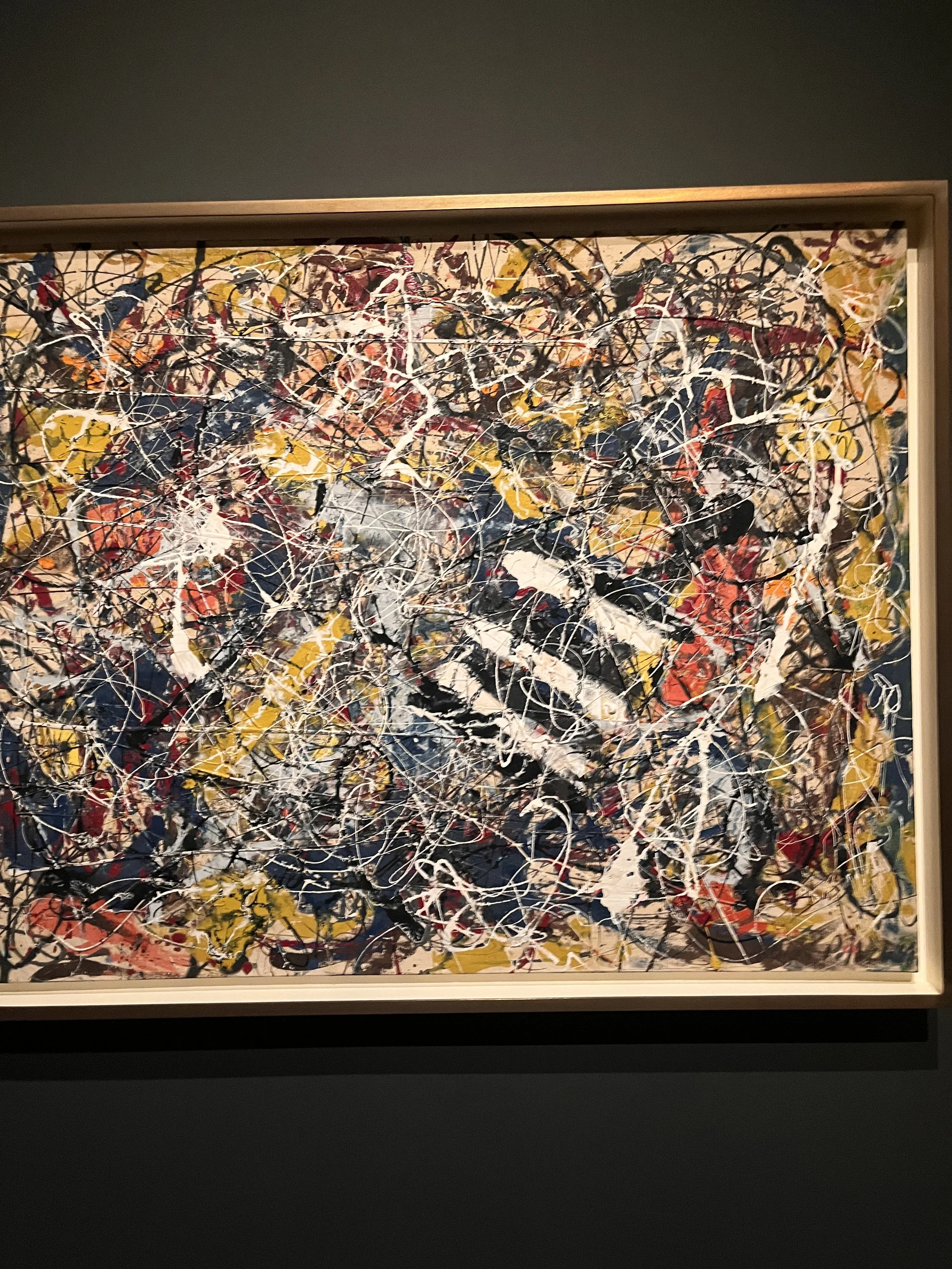
Pollock
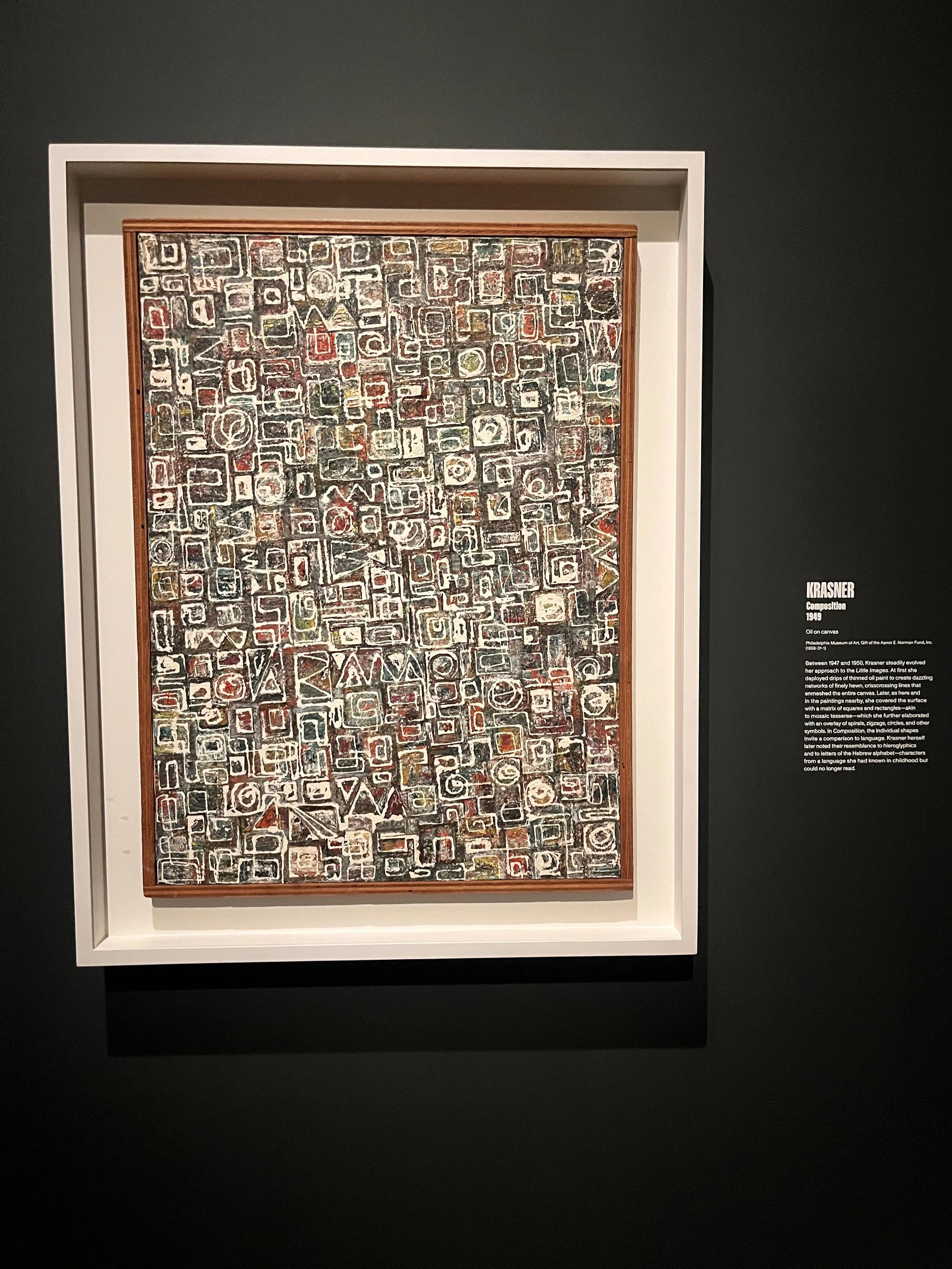
Krasner
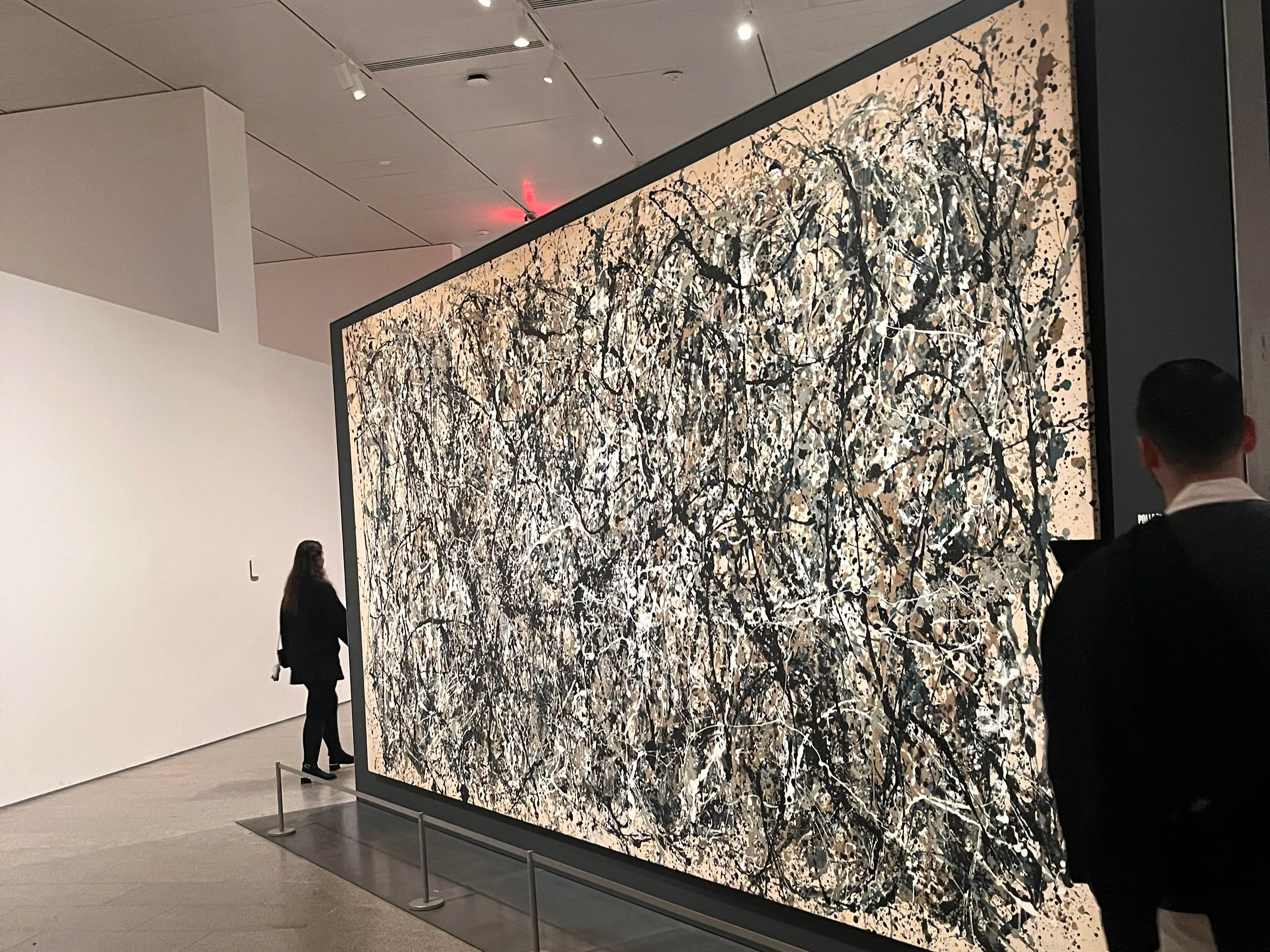
Pollock escapes the trap. Krasner does not. Pollock smashes the trap on the studio floor, jettisons the easel, lays out his canvas and freely draws and drips. Krasner tries to get out of the trap by working harder and doing better. Her subsequent works are impastoed to the point of puffy paint. Her detailing becomes more granular, more obsessive, the rules she applies to her canvases all the more domineering. The work is flat, forbidding, esoteric. Krasner concedes the terms of the problem. Pollock cuts the Gordian knot.
The small, dark schizoid opening galleries (the exhibition design is terrible, but I’m trying not to dwell on that) expand into a large open space with monumental Pollocks on freestanding walls. By returning painting to drawing Pollock turns the flatness of the canvas from a limitation into an opening. We sight the promised land of total freedom and untethered imagination.
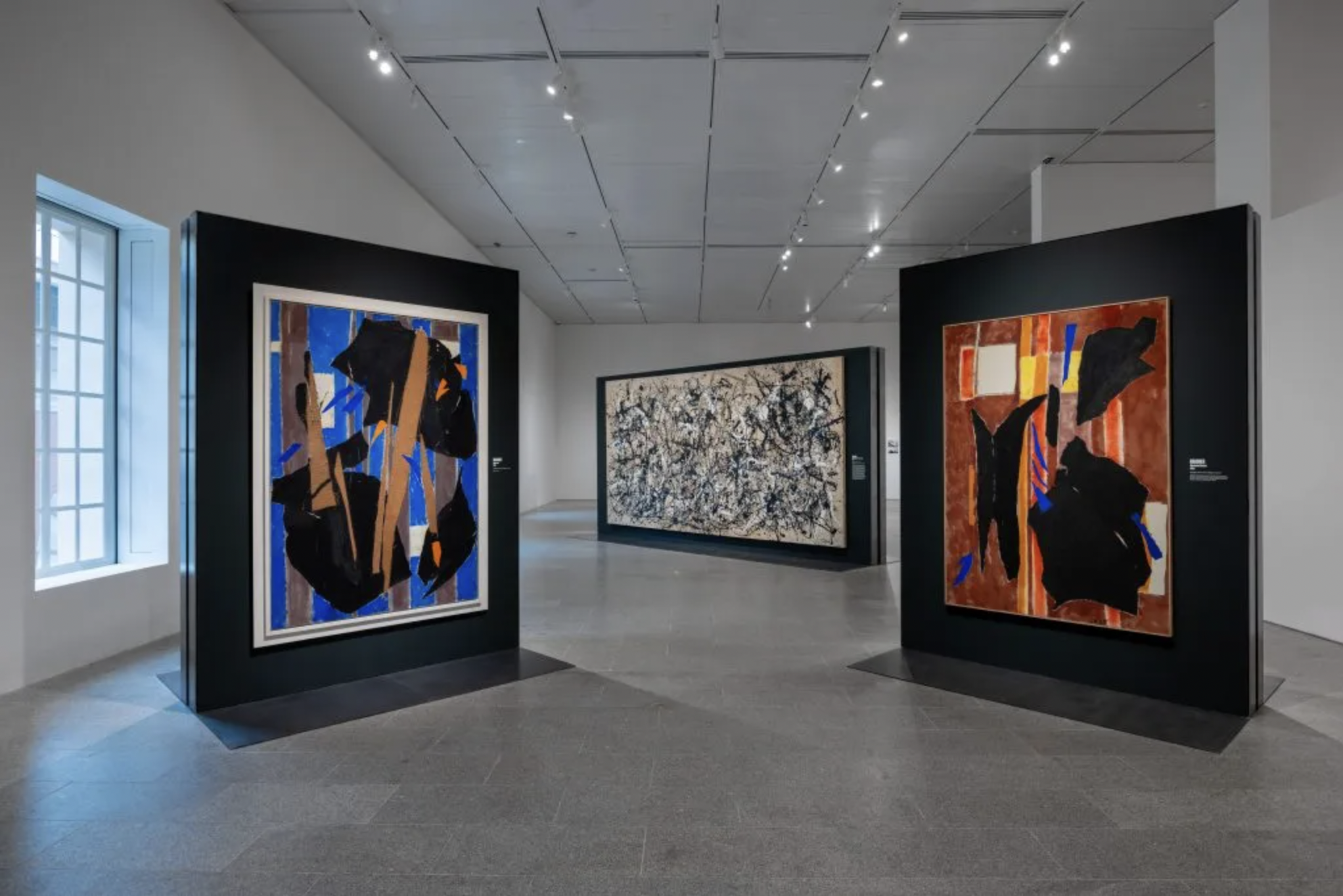
When the exhibition re-introduces Krasner we are returned to academic formalism. These are good paintings, but they have none of Pollock's galactic expansiveness. The revelation of the large scale Pollocks felt like the conclusion of the show, but it is only the summit, and we must climb down from Pisgah through Krasner’s work in the decades following Pollock’s death. The descent draws a better conclusion about the fate of art after Pollock than the one famously drawn by Allan Kaprow: that art, dissolved, could never return to the canvas and would live its afterlives in the form of happenings. Rather, painting continues, doggedly, academically, not without inspiration and moments of beauty but shackled by a dead past and sustained by devoted labor.
Pollock’s superiority only poses a problem if we accept uncritically the stultifying essentialism of the gender wars, that Krasner is Woman and Pollock is Man. Indeed, if one accepts this premise and supports the liberation of women she is all but compelled to lie about what is before her very eyes to Krasner’s advantage. Their art opens up to us only when we cut the knot.