Nixon Thirty Years Later
This year is the 30th anniversary of Oliver Stone’s Nixon (1995). In the same year Richard Nixon was sworn in as president, feminist Carol Hanisch wrote “personal problems are political problems. There are no personal solutions at this time,” or more popularly, “the personal is political.” Hanisch’s lines, which were meant to motivate a political turn in the already-overripe New Left, could just as easily serve as a kind of personal mantra for Stone’s Nixon. The identity of the personal and the political animates this Nixon, fueling his virtues and expediting his ruin — a modern tragic hero. By fulfilling Hanisch’s mandate in action, Nixon is strangely identified with the New Left, despite being the chief object of their animus during their decline. As Nixon asks of them towards the end of the film, “why do they hate me so?”
Why think about Nixon today? It’s a movie made during the triumphal height of Neoliberalism. Yet it's during this height that the film sympathetically reconsiders Richard Nixon, the last political figure of the prior form of capitalism, Keynesianism. By doing this, the film is implicitly skeptical of its own moment — Nixon was perhaps the last real political figure who occupied the American presidency until 2016. Now, we’re entering into a post-Neoliberal moment, and this moment is inaugurated by a political figure who himself marks the return of political figures, Trump. Neoliberalism then, is bookended by Nixon’s moment and our own, Nixon’s presidency seems to be recalled in Trump’s.
Nixon is very much a film of its moment, the 1990s, steeped in the popular maximalism that could be seen in mainstream Hollywood productions conducted by directors such as Oliver Stone, Tony Scott and late Coppola, and which has since fallen out of favor. But this maximalism itself was a late attempt by New Hollywood to reinvent film, to remember what film is really about. Do we know what film is about today? The ersatz cinema which fills theaters seems to tell us definitively: No. Stone’s film is much more than a cultural product of its time. It’s one of the best films of the 1990s and still has a great deal to teach us about how film works, and what it means to make a political film.
Part of Nixon’s maximalism lies in the breadth of its tool-kit. The film moves everywhere around Nixon’s life, freely moving in time from personal life events to major political moments, which are often faithfully transcribed from Nixon’s actual tapes, themselves a major motif of the film. The film occasionally even takes the liberty to show us things Nixon himself would not see, building a sense of dramatic irony, as these scenes are nearly always key moments in his fall. Despite wanting to hear and see everything, Nixon is defeated precisely when he is absent from any given scene. The opening itself is a meeting of Watergate conspirators sans Nixon’s presence. The movie deploys a wide range of filmic language which often alludes to film-historical touchstones — scenes are peppered with monumental and dramatic close-ups of political actors, riffing on Eisenstein’s Ivan the Terrible (1945). During the crisis of Nixon’s presidency, the White House is transformed into Charles Foster Kane’s Xanadu with sinking establishing shots behind the gates. A wide variety of film stocks and gauges are put into use, not dissimilar from Stone’s prior JFK, but very different in function. In JFK these changes in format are schematic and formalistic, merely signalling the back and forth movement of the timeline and the conspiratorial atmosphere. In Nixon, the film and gauge selected for any given shot operates for the same reason as the rapid back-and-forth of the film’s edit: it’s dictated primarily by the movement of Nixon's own thought, zigzagging about during the moment of his greatest crisis. At a surface-level, “maximalism” seems to suggest a throw-everything-at-the-wall perspective; at least, this is all that contemporary attempts to revive its stylistic veneer seem to have learned. At its core however, Nixon is very simple in its method, which always returns to the center. This center is established early on in flashback scenes, scenes which more properly might be called anchor scenes, as they do not simply work by creating “context,” but really act as motifs that return again and again to give a sense of Nixon’s character. These anchors are a gravitational pull that keeps the film's movement oriented towards a formal objective, begging the question that a Citizen Kane-esque newsreel asks following Nixon’s concession of the California governor race: "who [was] Richard Nixon"?
Nixon’s inner world, his personal anchors, are established early on in black and white, scenes which are then returned to and redeployed to give movement to Nixon’s character as the world seems to rupture around him. We get a prelude in the film before we break into the first key memory scenes. The film’s entire narrative is framed by Nixon sitting in the Lincoln Room listening to his tapes during the height of the Watergate prosecution. The entrance into Nixon’s personal world is through the crisis of his political personality. From these tapes we move to a private meeting Nixon has with some of his chiefs of staff, in which a key political secret is brought up: a vague authorization Nixon made against Castro as Eisenhower’s Vice President. From here through the tape sequence in the Lincoln Room, we fly backwards to Nixon’s unsuccessful debate against Kennedy, and then to the loss of his 1960 presidential bid, a moment which is punctuated by Nixon resting his head onto Pat Nixon’s breast, reflecting on his father’s life as a failure, implicitly asking, “have I become my father?” It is here that Nixon’s childhood ruptures into the story.
The young Nixon and his older brother Harold work in their father’s grocery store, Harold unsuccessfully asking his father for money to buy a suit. Our first look of the young Nixon is interacting with this older brother, who he clearly admires a great deal, but has something of that nervousness one sees with scared children around those of their friends and siblings more bold than they. The young Nixon is clearly afraid of getting in trouble, afraid of his parents. This fear is tested immediately when his mother pulls him aside into their house.
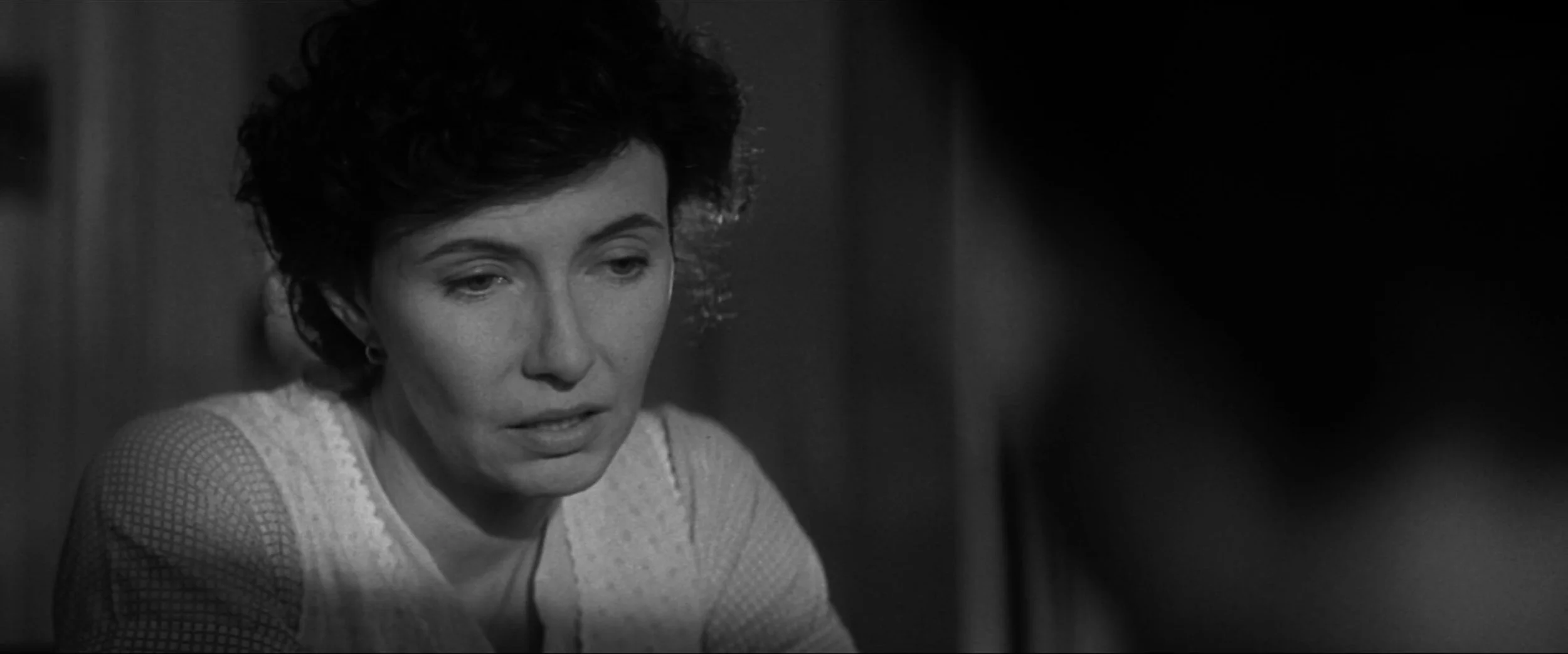
Nixon’s mother is a Quaker who the film gives the dramatic flourish of speaking in Quaker English, replacing “you” with the democratic “thee” and “thy.” Yet ironically, Mary Steenburgen plays Hannah Nixon with an aristocratic elegance one would hardly expect in the American West. Even in the black and white world of the past, she’s out of time in early 20th century California. Throughout the film Nixon refers to his mother as a saint, but she would perhaps be better described as an angel. She’s both terrifying and comforting, her love terrifies. Throughout the film, there are multiple moments when Nixon is embraced by a woman in such a way that he seems to be swallowed up by hair or clothing or skin, like the moment that leads into this flashback where Nixon buries his head in his wife’s breast. His mother becomes the origin of the self-dissolving power of women.(1)
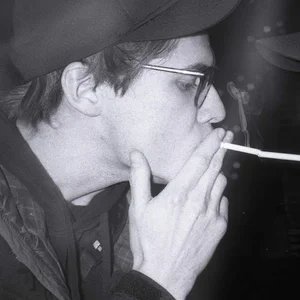
When Nixon’s mother pulls her son aside to confront him about a cigarette that his older brother gave him, he initially lies and says that he didn’t smoke. To this she concedes, traces of disappointment on her face, and it's here that the young Nixon immediately surrenders from guilt. He apologizes to his mother, withdrawing the cigarette from his pocket. She says she will have to tell his father, and the young Nixon leaps from his chair onto his knees before his mother, begging her not to. After a brief deliberation, she allows this, saying that it will be their secret, but warning the young Nixon, “Remember I see into thy soul. Thee may fool the world, even thy father, but not me Richard, never me.” The film establishes this as a key moment in the formation of Nixon’s character early on: a secret pact between mother and son, withheld even from the father. As the film progresses, the tension between Nixon’s secrecy and the desire to divulge becomes a key anchor, and it's all colored by this originary pact, which Nixon seals by devoting himself to his mother as her “faithful dog.”
This is the most important scene of Nixon’s mother, and the most important one with his father quickly follows. At dinner, Nixon’s father comes into the dining room still wearing his workwear. He proceeds to give prayer, giving a colloquial version of Genesis 3:19, “man would have to earn his way by the sweat of his face,” which he then spontaneously pivots from to scold the wayward Harold: Nixon’s brother must work to get what he wants. Following this, Nixon’s little brother Arthur asks “are we gonna pray now, daddy?” prompting laughter from the brothers and mother. Nixon’s father quickly shuts this down: “Maybe a trip to the woodshed will straighten you out?” The ethic of work is enforced with corporeal punishment in this household. This then turns into a lecture to all of his sons: “pretty soon you boys are gonna have to get out there and scratch… charity’s only gonna get you so far, even with saints like your mother around. Struggle’s what gives life meaning, not victory, struggle. When you quit struggling, they’ve beaten you. And then you end up in the street with your hand out.”
The dinner scene with his father is frequently quoted by Nixon in dialogue and quoted visually by the film, whether consciously or unconsciously. When Nixon, as president, storms into a meeting with his extended cabinet, he says “the belts are coming off and [leakers] are gonna go to the woodshed.” By this turn of phrase, the audience then knows Nixon is now sadomasochistically playing his father, the punisher, like the child acting out the imagined wrath of parents to their younger siblings or toys or pets. The expressions of different cabinet members suddenly take on the quality of Nixon and his brothers when threatened by their father. Nixon’s family’s modest dining room seems to impose itself onto the cabinet’s meeting room, despite this room's grandeur. The weight of this earlier anchor scene makes Nixon’s political world feel like a mere appendage to his world of memory in Whittier, California. Even as president he remains the scared middle child.
Nixon has total mastery of endowing meaning to images through the development of the film's montage, inflecting later scenes by bringing those images back. And because in this film, many of those images are tied to characters, phrases and events, the montage feels true to our own memory and how we often experience the world — moments in our lives are platted by earlier moments which they recall, individuals we meet seem to bleed into those we’ve known earlier in our lives, new events seem colored by ones from the past. The paranoid simile is part of the language of the movie editor: “this thing is like that thing.” So too with those who feel anchored to the past. In everything new we can’t help but see the familiar, and we’re often limited and blinded by this. Nixon expresses the rhythm of the melancholic. Every dinner scene, every moment around a table, is like the dinner scene in Whittier. The explosive everywhichway-ness of the edit nevertheless always finds its way back to the center, the inner world illuminating everything which happens in the film, even when Nixon’s inner world is totally inadequate to deal with his political world.
Nixon’s maximalism is its melancholia. Melancholia is a product of a certain divestment from the world and oneself, but it divests one of oneself through an inward turn. When Nixon learns of JFK’s death, he mopes to Pat Nixon over not being invited to the funeral. The scene then has a funny misunderstanding, where she implores Nixon to call Bobby Kennedy to offer his condolences, but he can only understand her to mean that he should call in order to be invited to the funeral, which he says won’t happen because he believes Bobby Kennedy hates him. He finally decides to call LBJ to get a funeral invite. Nixon is so lost in his misery that he cannot recognize either the sympathetic or political significance of JFK’s death. It’s both comic and tragic. It takes his wife pleading to Nixon “you know what it means to lose a brother” for him to even slightly break away from his digression about not being invited to the funeral. Yet even this ultimately throws Nixon, or rather the film’s edit, even deeper into itself, as it introduces the next anchor, a genuinely hard to watch scene of Nixon’s little brother screaming in pain from the illness which would kill him — “make it stop!” This is followed quickly by a scene of the young Nixon waiting outside of the sick room, his mother storming out, his younger brother presumably dead. Nixon approaches her, either to comfort her or to be comforted by her, and she rejects him, pushing him out of the way. So with Nixon’s mother, first we get the secret pact, then a rejection. For a child, how could two moments like these be reconciled? What does it mean to be rejected by the one figure who “sees into thy soul” — it’s a situation comparable to Adam and Eve’s banishment from the Garden of Eden. One once again recalls Genesis 3:19.
As a final credo to this sequence, we briefly return to the drawing room with Nixon and his wife, where he says “if I was president they’d never kill me.” It’s as if being killed is proof of the love they had for Kennedy, which in some ways it is: Nixon's lack of love means he thinks people would be indifferent to him, they wouldn't even bother killing him. The tragedy of JFK’s death and its ripples across America suddenly becomes like his own little brother’s death and its effect on his mother, an event which leads to the moment where she rejects her still-living son. In a twisted way, Nixon’s lack of self-love transforms into a savior complex, i.e. “if I was president, neither Kennedy nor I would be dead” — or perhaps unconsciously, “if I was the more beloved son, my brother never would have died.” The anchor images of Nixon’s little brother and JFK used throughout the film are not dissimilar either. The image of his little brother often returns nostalgically: Nixon and his little brother at play, Nixon defending his brother, his brother smiling at the camera. The principal image used to recall Kennedy throughout the film is a carefree Kennedy in sunglasses, eating ice cream on the back of a yacht. The nouveau riche New England playboy becomes like Nixon’s own little brother. The image of a relaxed and youthful Kennedy is in stark contrast to Stone’s Nixon who must struggle. In this way the film makes Kennedy like Nixon’s kid-brother, who never had to face the struggle of adulthood. Nixon’s love for his brother is also a defense against his unconscious hatred of him for leaving him behind. Meanwhile, the possibility of a sympathetic response to Kennedy’s death, let alone the possibility of extracting a political meaning from this death, is obscured because the mourning of his brother was never fully worked through. Nixon is still playing the least loved son in the political world. He is dominated by the past.
The final anchor scene is introduced during a conversation Nixon has with his chief of staff, H.R. Haldeman. This prior conversation with Haldeman uses this amazing expressive technique that I’ve personally never seen from another film. Speaking to Haldeman, Nixon, in a black and white shot, says four bodies cleared the way for his presidency. We then cut to a profile of Haldeman with Nixon in focus in the background. As focus racks to Haldeman, the shot simultaneously crossfades to this same shot of Haldeman but in color. While this moment is perhaps guilty of excessive virtuosity, it illustrates Nixon’s inwardness so well, and acts as a drumroll before we enter into this last anchor scene. We implicitly understand that in black and white, we're in Nixon's inner world, and even when we go to the shot of Haldeman, we only break from this inner world when Haldeman speaks, focus going from Nixon in his inner world to Haldeman in the outer world, color creeping back into the image. The maximalism and the virtuosity on display in techniques like this, shows that when New Hollywood had to reinvent filmmaking, they did so by reifying the cinema of old Hollywood. Emotive moments which in the past would have been handled with more subtle beats (or none at all, relying instead on the remnant accumulated experience of the audience to project upon the film) were then carried out overtly by New Hollywood, the audience receiving explicit lessons as to how film worked. This is a very ‘90s version of this kind of reinvention. The maximalism of the 1990s was, at its worst (which is what it is today), stylization, runoff from MTV, the transformation of film into video. Here however, it serves as a late effort on the part of Stone to re-establish how film works. The emergence of video meant the moving image was more ubiquitous than ever. Viewers became more “media literate” than ever, yet ironically, the way cinema worked had itself slipped away. Advanced techniques which had flowered through video are here redeployed and put to different use — the accumulation of meaning through montage that nevertheless slips away from consciousness moment to moment. You’re not meant to intellectually process that “black and white means we’re in Nixon’s personal world.” You’re meant to feel it, it sits back in your preconscious. Film is suitable for such subject matter as this. The film forms its own movement around Nixon’s self-splitting, and the audience enacts this themselves. Film moves by pushing the progressive movement of images from consciousness into the unconscious, which nevertheless influences how we experience all proceeding images — Adorno called this “psychoanalysis in reverse.” This self-repression is both a product of ambivalence and a technical matter. Technical, because the flow of images in film requires that things are 'stowed away' in order for the viewer to grasp the next moment, a process comparable to the thousands of tiny decisions a driver makes while speeding down the highway.(2) Ambivalent, because film operates on internal contradictions moment to moment which enter into preconsciousness before slipping away.(3) Film simultaneously operates on the viewer’s conscious and unconscious, inviting double meanings. Film presumes an internally split audience, otherwise they would not so easily conform with the authoritarian crowd in the cinema. Nixon saying “when they see me, they see what they are,” becomes not just a political statement, it’s a description of the movie viewer. The film asks, don’t you too experience the world in such an internally split and inward way? Aren’t you yourself, just like this man you supposedly hate?
In the conversation with Haldeman, Nixon claims four bodies cleared the way to his presidency. Haldeman asks, “don’t you mean two?” Nixon is lost in himself, a conversation about the death of the Kennedys turns to the death of his brothers. For Nixon, not only did the Kennedys need to die for him to become president, but so too did his brothers while he was still young. Nixon suddenly turns to a portrait of Lincoln on the wall, asking "how many [bodies] did you have? Where would we be without death?…” then Anthony Hopkins mutters the next line — allowing it to be heard either as “who is helping us?” or “what is happiness?” — “Is it God or is it death?" And ultimately this question is a way Nixon reposes the two characters who live inside of him, his mother and father, the religious world and the secular world, God and death.
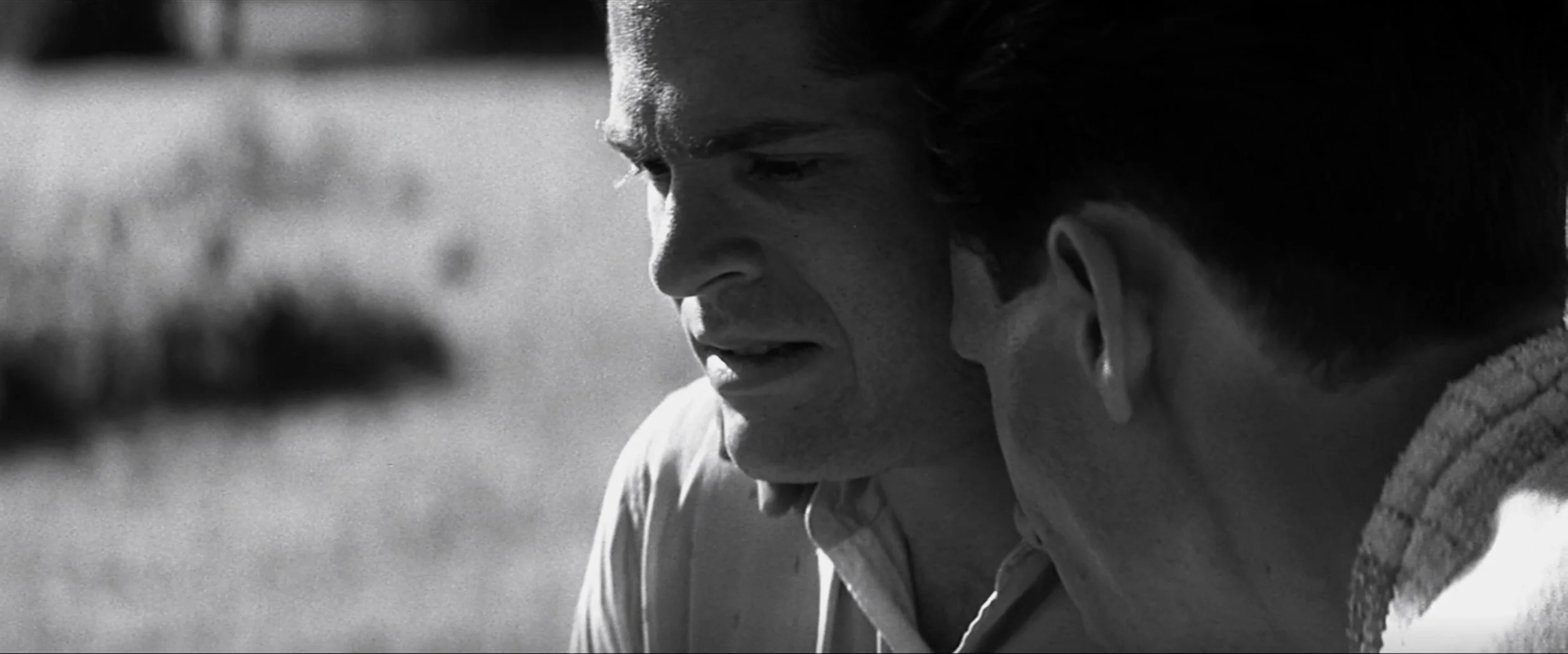
We’re then back in black and white in Arizona. Nixon’s family has gone to a desert sanatoria with the hope to help Nixon’s older brother recover from tuberculosis. His older brother is coughing up blood, and the young Nixon, now a teenager, runs from a house to help him. His brother tells him that now that he’s going to die, Nixon will be able to go to law school. The teenage Nixon nervously says “you’re not giving up on me are you?” to which his brother answers by slumping over on his shoulder. We see Nixon’s timid face as he hears his brother struggle with every breath. His brother looks out to an empty desert landscape, and tells Nixon he wants to go home.
We’re then inside the house, presumably after Nixon’s older brother’s death. His mom comes into the room and lays out Nixon’s fate: his brothers have died and therefore God has chosen him. Nixon must go to law school. The teenage Nixon is incredulous that his brothers had to die for any of this to have happened. He asks her, “what about happiness, Mother?” She replies: "You'll find peace in the center. Strength in this life, happiness in the next" From here, we then go to the adult Nixon in darkness, the background occasionally lit up by camera flashes. His expression is inward and grim. With the darkened background he’s totally alone, and the lack of sound swallows up everything except for the burst of the occasional flashbulb. Then the lights rise, and with it Nixon’s expression changes for the public, the massive audience revealed behind him, the 1968 Miami RNC.
How did we end up here? Through a moment of private guilt disclosed to Haldeman, we go into how the deaths of his brothers clear the way for Nixon to go to law school, and thus to enter political life, and his mother — the Protestant angel, the keeper of his secret, who sees into her son’s soul — delivers this fate to Nixon like an oracle. “Happiness in the next life, struggle in this one,” and from what previous anchor scenes have established, these lines correspond with mother and father, respectively. And then we’re there, on the precipice of Nixon’s great success before his speech at the Miami RNC, but we’re there from the perspective of his mother, one who sees into Nixon’s soul, bearing witness to Nixon’s “lurking inner image.” Nixon’s political persona will be what the crowds see, but in private, we see what Nixon’s mother sees: his secret personality which lurks behind his character mask. This is the power of montage. None of this is explained explicitly, associations are developed through the succession of images, scenes and sequences. This splitting of Nixon is shown in different ways throughout the film: sometimes in the middle of Nixon talking, the film L-cuts to a different expression while his voice continues, revealing his private personality for the audience beneath the mask. Sometimes the viewer is not the only one to get a glimpse of this. During a party scene a drunken woman says to him, “your smile and your face are never in the same place at the same time.”
The society of impersonal association — bourgeois society — was paired with a politics where the political role was nonidentical with the private personality. This was a product of liberalism. The politician in this way speaks above and beyond themselves in a spiritual intercourse with the political realm. Stone’s Nixon has a sense of this. After he “retires” he says to Nelson Rockefeller, "I miss making love to the people, I miss entering a room, I miss the pure acting of it.” This is not just about Nixon being “phony,” like how Ronald Reagan was derided for being an actor. Rather, this really gets at the spiritual character of politics. This is the ideal anyway, it presumes a strength of ego in which it’s possible for figures to “step outside” of their private personalities. We know what happens when Nixon enters a room, a political space: we watch his expression suddenly change, and the change is not smooth. It doesn’t seem to come so easy for Anthony Hopkins’ Nixon. You feel the fragmentation. The Dionysian play-acting is the means by which the anal-retentive interior tentatively survives. Nixon is tragic because he cannot successfully play the politician. He is held down by his private personality, and ultimately when his political persona and his private personality become indistinguishable, he is eradicated.
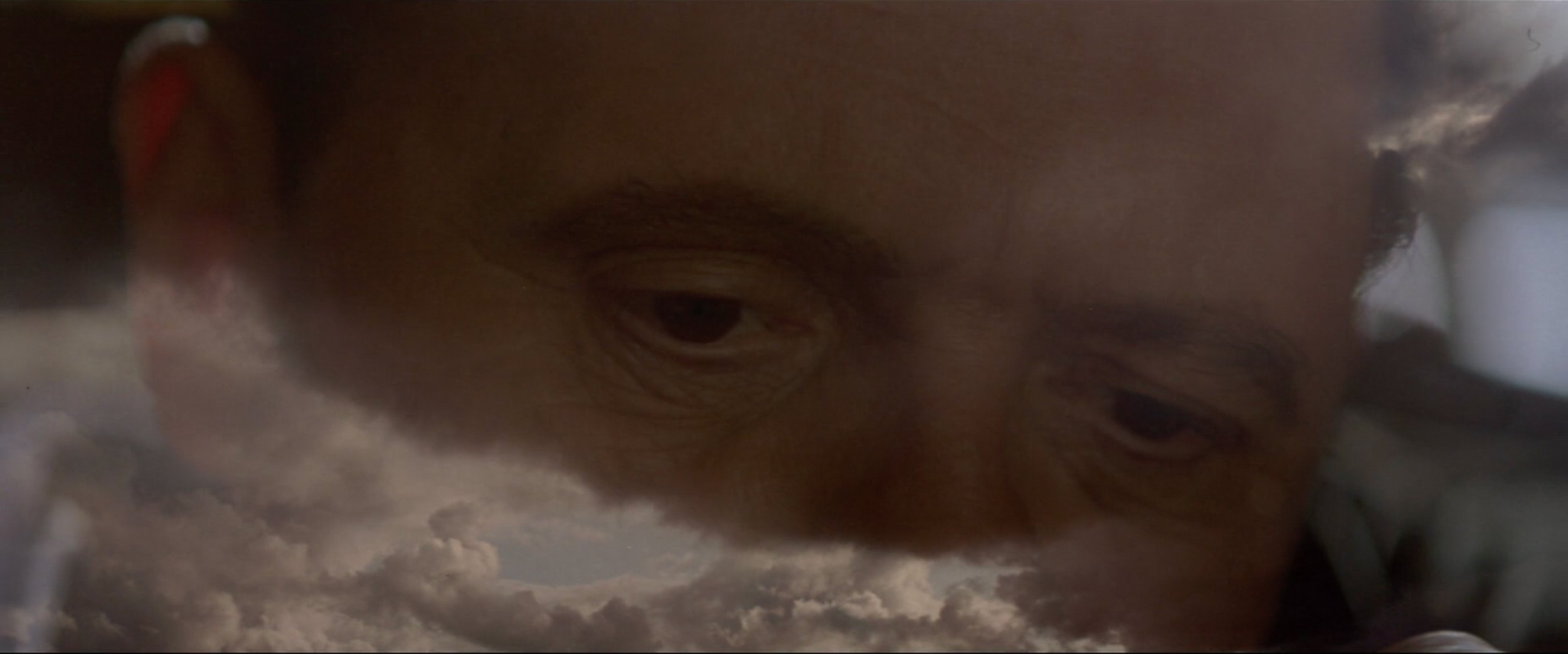
This internal war of Nixon’s personality is a reproduction of the tension between Nixon’s parents. His father is the demon which animates his political persona, and his mother becomes the angel which sees the secret personality lying beneath this persona, or perhaps even outside of himself. Nixon himself distinguishes his private personality and political persona by referring to his outward public personality as “Nixon” in the third person: “I’d like to offer my condolences for those kids [killed at Kent State], but Nixon can't.” In one way this is a method of personally handling the character drama of bourgeois politics. But a similar dissociating effect is sometimes done with Nixon’s private personality. The film places Nixon in Dallas the day before JFK’s assassination, and in a conversation with business moguls, a Cuban man hints sinisterly that JFK won’t run in the next election. Nixon selectively ignores this, and as he arrives at the airport, we hear that JFK will land in an hour. Nixon cuts through a crowd of Texan protesters, and as he walks out onto Love Field, his aid leaves him for a moment and he’s seen briefly alone in black and white. The camera then cranes up above the crowd who suddenly take on terrified expressions, and then the camera does the same upward move on Nixon. As he looks up to the sky, Nixon himself is seen superimposed onto the clouds, looking down at himself. His mother, the one who “sees into thy soul” is then replaced by Nixon himself as a kind of omnipresent super-ego, his own guilt complex. The tragic quality of the film is kitschily literalized, with the crowd of Southerners who take on the role of the Greek chorus who know the future before it happens. Nixon himself spontaneously becomes his own god, his own fate, his own mother — casting judgement down from on high.(4) It’s interesting to see how these two moments relate to each other. In one instance the private personality is removed from Nixon, becoming an omnipresent observer, in the other it’s the public personality which is removed, Nixon referring to himself in the third person. It’s as if no matter who he is, Nixon is never himself. He’s internally divided, and the sides — mother and father, religious and secular, God and death, happiness and struggle — seem to be irreconcilable. Yet, Nixon seems to push on, precisely not to work through this irreconcilability. When Nixon says to Nelson Rockefeller when he’s out of politics, “I'll be mentally dead in two years and physically dead in four” he restates his father’s line “when you quit struggling, they’ve beaten you.” In other words, to cease struggling is to die. And this begins to touch on what kind of character Nixon is in the film, which might also be partly illuminated by an extended quote from Nietzsche.
The man from an age of dissolution, which mixes the races all together, such a man has an inheritance of a multiple ancestry in his body, that is, conflicting and frequently not merely conflicting drives and standards of value which war among themselves and rarely give each other rest - such a man of late culture and disturbed lights will typically be a weaker man. His most basic demand is that the war which constitutes him should finally end. Happiness seems to him, in accordance with a calming medicine and way of thinking (for example, Epicurean or Christian), principally as the happiness of resting, of having no interruptions, of surfeit, of the final unity, as the "Sabbath of Sabbaths," to use the words of the saintly rhetorician Augustine, who was himself such a man. But if the opposition and war in such a nature work like one more charm or thrill in life - and bring along, in addition to this nature's powerful and irreconcilable drives, also the real mastery and refinement in waging war with itself, and thus transmit and cultivate self-ruling and outwitting of the self, then arise those delightfully amazing and unimaginable people, those enigmatic men predestined for victory and temptation, whose most beautiful expressions are Alcibiades and Caesar (- in their company I'd like to place the first European, according to my taste, the Hohenstaufer Frederick II), and, among artists, perhaps Leonardo da Vinci. They appear precisely in the same ages when that weaker type, with its demands for quiet, steps into the foreground: both types belong with one another and arise from the same causes.
Nietzsche, Beyond Good and Evil
But is this an accurate description of Nixon, is he such a character? Part of what the film plays with is suspending the idea that he might be, while also holding out the possibility that he is incapable of being such a man. A true description of Nixon throughout Stone’s film is a neurotic anal-retentive who secretly hopes for reprieve. The image of Nixon’s older brother vomiting blood and slumping onto his shoulder serves as a kind of wish for Nixon himself, while the persistent return of his brothers’ deaths as images act like a guilty conscience which says that “others must die for my happiness, I must keep struggling.” Nixon never gets to be happy, that’s for the next life.
After Nixon’s fall, he reveals to his wife a memory of vomiting on his mother, and says he wishes he could do that now. The fantasy, by association with the image of his brother, is both, “I wish I could let go of myself” and from the perspective of his father, for whom cease of struggle means cease of life, "I wish I could die.” Following his defeat, Nixon in his farewell speech refers to “what we Quakers call 'peace at the center'” which sounds awfully similar to “the happiness of resting, of having no interruptions, of surfeit, of the final unity,” yet also during his conversation with Mao, Nixon is confronted with the other side of himself. Mao stating “the real war is in us, history is a symptom of our disease,” proposes to Nixon that the deeds he accomplishes in the political realm might be the mere by-product of his own inner struggle. Nixon’s meeting with Mao is like a meeting with the devil (not the only such encounter in this film), sinister music plays and Mao cackles to comic evil effect as he suggests to Nixon that they are the same kind of man: killers. Nixon is internally ambivalent, part of him wants to surrender, and another part wants to turn his inner war outward. Yet neither of these two aspects of Nixon seem to be fully conscious. What Nietzsche identified in the aforementioned quote was perhaps not two kinds of men, but rather a single product of an “age of dissolution” — historical moments of transformation in which a society or civilization undergoes a “transvaluation of values.” A society in conflict reproduces this conflict within the personalities of individuals, the only question is how one is to meet the Bacchic maw of one’s own ego, with a Christian surrender, or with ecstatic glorying for the storm within oneself. What makes Nixon so tragic is not simply that he cannot master the war in himself, but that his final surrender is not even a reprieve, it’s only defeat, just as his father had said. The opposition of personalities in an age of dissolution is not an either/or, but a real contradiction which cannot simply be liquidated.
Movies from the beginning have been fascinated with the roles of great men in history, men of power — Abel Gance's Napoleon, Eisenstein’s Ivan the Terrible — yet movies come at a time when such a thing is more ideological than ever. These films pull characters from the past, when the idea of the man who makes history by his mere force of will was still viable. Cinema however, historically emerges precisely when man’s personal capacity to change their world becomes more dubious than ever — the concept of the “leader” in mass politics is a parody of the great man. It’s likely that film’s ideological insistence on the human element in history emerges from the vague fear that film itself is an inhuman form. Film liquidates and disperses the role of the individual artist.(5) Yet men still make their own history, just as they still make their own art.
The potential latent within the crisis of personality Nietzsche identified perhaps reached a zenith around his own time. We live in the aftermath of this, and yet this crisis seems to come again and again. Nixon however, holds this problem in tension. It's not a film about the past but the political personality in the present, in the aftermath of its collapse. Nixon is a damaged president, and the film moves in accordance with the fragmentation of his personality: it's a nonlinear film, it frames moments within other moments, and then dissolves them to proceed to something else. But Nixon is also the portrayal of the common man who nevertheless attempts to make history, who discovers along the way that possibilities of the political realm have been foreclosed by a system, the State, that is beyond the control of any single individual.(6) This is the real status of capitalist politics in modernity — its tragic character is that its political model stems from the image of the bourgeois revolutions, and yet these political models are no longer adequate to change the world when society’s crisis necessitates the State. Adorno and Horkheimer: “What politics ought to abolish becomes politics par excellence.”
Despite this, we still live in a revolutionary society. In such a society, every statesman in some ways must take on the role of revolutionary, those who do not fail to be political. Nixon in his 1968 RNC speech: “we can have a new American Revolution.” In Stone’s film, Nixon’s model for revolutionary statesman is Lincoln (in his own time Nixon was called the California Abe Lincoln). Lincoln becomes like a koān for Nixon, an object of contemplation, comparison, and mise en scène irony. Often the camera will dolly around and reveal Lincoln’s portrait sitting right on Nixon’s shoulder, and sometimes he directly addresses it, like the aforementioned scene with Haldeman. “How many deaths did you have?” Part of Nixon’s self-comparison and identification with Lincoln is as a president responsible for the deaths of many, it’s a product of guilt. Treating Lincoln as a great dealer of death might seem unorthodox, yet it was often how he was spoken about in his own time. Lincoln won the Civil War, but he’s also the beginning of the imperial presidency in America, something which has had a very ambivalent status since Lincoln’s own time. Why should a republic have an elected king? And yet the crisis of Lincoln’s time seemed to require such a figure, and perhaps since then, the United States has always required such an executive. From the perspective of historical Marxism, Lincoln is the first Bonapartist president (as in Napoleon III, not Napoleon Bonaparte), which was not a negative category but a critical one, an expression of the need for the modern state — an outgrowth of society — to stand over and dominate that society when it could no longer manage its own internal crises. At the founding of the American republic, it was presumed that slavery would simply disappear through society’s own activity. Yet by the 1860s, the industrial revolution had produced a crisis of labor, and slavery was pitched by the South as a way to alleviate this crisis. The new problem of mass unemployment — the Social Question — seemed like a Northern problem, while free Southerners lived like semi-aristocrats. It was the State then that enforced social right against society itself, abolishing slavery. Lincoln becomes the emancipator — the Emancipation Proclamation is a product of modern executive power.
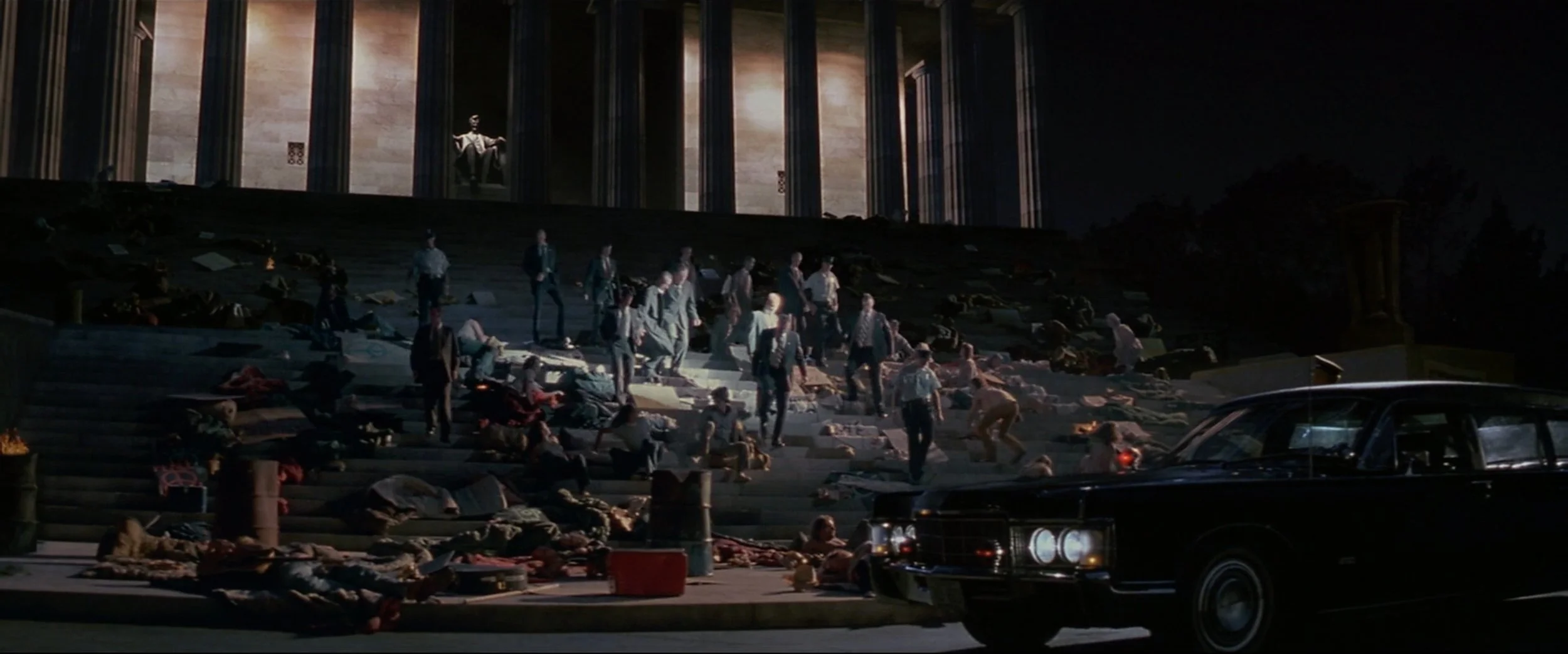
Yet, Nixon suspends the idea of Lincoln as a killer, that all of the deaths simply cleared the way for Lincoln’s own private ambition. This idea is produced imagistically: as Nixon enters the Lincoln Memorial we see an explosion superimposed behind him, montage internal to a single shot. When he leaves the Memorial we see Nixon and his entourage step over sleeping protesters which from afar look like corpses, dead before the altar of Lincoln. It’s like the stairwell scene in Battleship Potemkin (1925), and the opening of Stone’s own film Salvador (1986): dead students after the 1975 Salvadoran student massacre. Treating Lincoln as a killer takes a standpoint as if Lincoln had lost the Civil War, i.e. “what if all of the deaths meant nothing?” or to quote Nixon’s own Republican primary acceptance speech reproduced in the film, “Did we come all this way for this?” And one might imagine this as a stance that anyone in a position of political responsibility might adopt. Walter Benjamin's concept of reading history against the grain was first and foremost political — the politician reckons in contingency. If America were to collapse, would the Civil War still stand for the unfolding of freedom, or will all have been lost?(7)
Suspending the perspective that Lincoln could have been remembered as a killer is how Nixon handles the idea that he himself might be, while also expressing the hope that “history will treat [him] far more kindly than [his] contemporaries.” Nixon entering politics is a product of personal ambition, and for Stone’s film, perhaps at a deep level, it's Nixon’s attempt to redeem the death of his brothers, to make their deaths meaningful. “Did we come all this way for this?” is a question that might be as easily posed to himself. But his brothers cannot be saved. When Nixon’s political world falls apart at a climatic moment as he is going through his tapes in the Lincoln Room, it’s fitting that the film then enters into a montage where the Southeast Asian bombings, the Kent State shooting, the JFK assassination, and his brothers’ deaths suddenly go in reverse. The moment of despair speaks out, “all of this was for naught, if only it all had never happened.” The romantic desire to go back, for the present to disappear, swallows up the desire to make it meaningful. The anal retention of Nixon’s political personality, or to speak colloquially, his “locked-in” state, expresses the unconscious desire for release — Nixon’s fantasy about vomiting up his mother.
If Nixon is like Lincoln, who is he at war with? Could the late ‘60s and early ‘70s be called a civil war? While the student protesters in the New Left might have perceived that it was they themselves that Nixon primarily warred against (just as they also overestimated themselves in thinking that it was they who ended Vietnam and not Nixon), for Nixon the New Left were simply useful idiots unknowingly puppeteered by the Soviets. Maybe so. For Nixon, his real enemy became the deep state. In the first scene where Nixon speaks with the director of the FBI, J. Edgar Hoover, we see a rigged horse race. Nixon seeks to get dirt on Kennedy from Hoover, and we see a horse collapse in a huge flourish. We go back and forth to this image throughout the scene.
What makes this image so powerful in Nixon is its symbolic ambiguity. Is the downed horse Kennedy? When it collapses violently in a telephoto shot, one can’t help but think of the Zapruder film. Or is it Nixon? We already know from the beginning of the film what his fate will be. The political system was rigged against him the whole time — when Nixon loses his first presidential election against Kennedy, an advisor tells him not to contest it, because “[Kennedy] stole it fair and square.” And here at the race track he’s meeting with the fixer, trying to get the rigged system to work in his favor. Later in a key moment, when Nixon goes to the Lincoln Memorial at night and has an extended conversation with protestors, he insists to them that he and they have the same goal: to end the war in Vietnam. A young woman incredulously asks him why he hasn’t done it yet, and upon his silence she conjectures that he cannot, that the political system, the State, is out of his control. He claims he’s trying to get it to do some good, and she replies that it sounds as though he’s “talking about a wild animal.” To an expression of alarm on her face, Nixon replies “maybe I am,” and in this moment the viewer recalls the horse race scene. After the horse is downed, it rises and throws aside its jockey, running free around the track. Following this, during a walk-and-talk scene after the race, Hoover attempts to pet a horse and it violently pulls away from him. The image of the horse is spontaneously inflected with new meaning. The State is a wild animal which no man can really control, not even the supposed actors of the deep state like Hoover himself. One can only attempt to jockey it. As CIA director Richard Helms says in the film, “it developed appetites.”
The image of the horse is a useful means to consider how symbols function in film. Most take symbols in film to be heterogenous images the film injects from the outside to supply the film with “meaning.” There’s the free-floating notion of what a wild animal is, but take note that what the image transforms into as scenes unfold, are things implicit in the viewing. This image progressively moves from more solid objects into airier ones. I am calling the “wild animal” “the State,” but the film never even explicitly says this. Within the film itself, the State is more atmospheric, it might be referred to as “the system,” or one outgrowth of it could seemingly refer to the entire thing, such as the secret project Nixon signed onto as vice president. And as the symbol changes — from Kennedy, to Nixon, to the State — it doesn’t invalidate anything it stood for before, it's a loaded and flexible symbol. It relates what it refers to not only to itself, but also relates its referents to each other in an imagistic and amorphous constellation. Is Nixon like Kennedy, do they in fact ultimately want the same thing? Is the State identical with the executive, with Kennedy or Nixon? It’s unclear. From the perspective of the protesters, Nixon and the State are the same thing. But for Nixon on the inside, there is clearly a difference.
Film is impressionistic, not literary. In films (at least good films), symbols lie in the preconscious, and in this way they mimic the meaning of symbols that emerge in one's own day-to-day life. When we try to grasp an image or event in our actual life as symbolic, we're only grasping. These symbols slip, and they tell us more about ourselves than what they stand in for — this is the difference between modern symbols and ancient symbols. Antiquity had a richer symbolic world, symbolic correspondences were more immediately accessible, at least for the initiated. Culture readily supplied symbols, and one's own personal power in large part stemmed from the capacity to interpret these symbols in one's favor. In modernity, we do not have access to the symbolic world in the same way, rather we create our own symbols. Antiquity’s cosmological world of symbols was replaced by personal correspondences between the present and the world of memory, dream and fantasy. In our conscious lives we’re apparently “above” the symbolic realm, but we know from dream interpretation and psychoanalysis, how one image can actually be endowed with the impression of another one. This can even happen more consciously: “In my dream last night, you were there but as another person,” or alternatively, “in my dream, it was you, but it wasn’t you.”(8) Note how this happens in conscious life for Nixon, how easily JFK and Bobby Kennedy become mere stand-ins for his brothers in moments when he turns inward. The associative power of montage allows arbitrary image relationships to become deeply charged in the same way an image might become charged in one's own personal world — this is film’s surrealism. Film is paranoid in this way, it builds a symbolic world singular to itself, in the same way we all have a world of personal symbols that are charged for us alone. Even things which are apparently charged with heterogenous meaning become liquidated in light of the symbol-world that a film produces for itself.
Look at when Nixon speaks with Richard Helms, the director of the CIA. This scene is only in the director's cut, but it's perhaps the most important in the entire film, as in it you see Nixon really get psychically unsettled by Helms. Nixon and Helms make a deal to cover up the operation Nixon signed off on as vice-president, and in exchange, Helms remains director of the CIA. At the end of the scene, Helms quotes Yeats's “The Second Coming” at Nixon.
And what rough beast, its hour come round at last,
Slouches towards Bethlehem to be born?
In this scene, this “rough beast,” a line announced by Helms as “beautifully ominous,” could just as well be Helms himself. Stone and Sam Waterston turn Helms into State Department Satan (which, perhaps so). This is done by compounding together caricatures of Richard Helms and the prior director of the CIA, James Angleton, into this sneering Ivy League WASP demon. Helms is everything Nixon is not. As Nixon and Helms stalk each other around the room, the camera tracks with them, and their close-ups shot on anamorphic lenses pull the background around them like a large spinning wheel. As Helms quotes Yeats, “Turning and turning in the widening gyre.” Helms’ office is full of orchids, he asks Nixon if he likes flowers. He replies, “No, they remind me of death. I had two brothers die. But let me tell you, there are worse things than death, there’s such a thing as evil.” And here we get this ridiculous gag shot over an L cut: as Helms smells one of his orchids, his eyes open and they’re totally black.
Stone clearly hates Helms (in his director's commentary he fantasizes about torturing him), and the film plays with him as an ambassador of evil — per the poem, the Antichrist. But the film also puts a lot of effort towards building this compounding image of the “beast,” or “wild animal” — it's irreducible to Helms himself. Everything, once it's submitted into a film, enters into its montage's cache of accumulated meaning. All images, moments, phrases, transform into utilitarian objects in service of the montage itself. Even Yeats’s poem, one of the most famous in the English language, has its meaning in-itself liquidated to serve the accumulated meaning produced in the montage. The poem’s internal meaning regarding the “beast” becomes secondary to what Helms means of it, which itself is secondary to the accumulated image of what the “beast” conjures up through its place in the film’s succession of moments. Helms stands in for the State as a force beyond even the executive’s control, but he’s still only a stand-in. The ambassador of evil becomes ambassador of an amorphous bureaucratic state apparatus with interests other-than and opposed-to citizen government. Helms is displeased that Nixon intends to make a deal with China, claiming it's not “CIA policy.” This “CIA policy” is what Nixon wants to break from, the political consensus of the status quo that the bureaucracy exists to uphold. Despite being instituted by the citizen government, when the State is threatened by this same citizenry — Kennedy threatening to break the CIA into a thousand pieces — the bureaucracy lashes back to protect its own interests. Nixon’s deal with the State is a deal with the devil, and like all such deals it undoes him. After his meeting with Helms is when the film really begins to fragment. The fragile partition between Nixon’s personal world and political world falls apart.
Nixon is a figure against the deep state, and yet he’s an argument for the deep state. If leaders are so neurotic they cannot serve the role of a citizen-politician any longer, it seems to call for the intervention of specialists, of those apparently not subjected to personal caprice. Politics as a job, rather than a spiritual vocation. After all, was Kissinger’s “Madman theory” of geopolitics just play-acting? Paul Sorvino’s Kissinger often seems to fear Nixon, and maybe he was right to. Nixon is personally twisted, but he’s also a really historical man. Maybe historical men are precisely the ones we should fear. Helms’ quotation of The Second Coming is his own argument against such men. The poem itself was written in 1920 following the breakdown of the bourgeois political order and the failure of world socialist revolution, a breakdown which was answered for a decade later with fascism.
The best lack all conviction, while the worst
Are full of passionate intensity.
Nixon perhaps is one of those “full of passionate intensity,” but the men in suits, the “adults in the room,” do not seem to be a better alternative. Stone makes those undermining citizen government inhuman — they’re demonic. By comparison, the broken Richard Nixon is heroic, even for all of his faults, because he is still trying to have a free hand to act politically.
Towards the end of Nixon’s crisis while he listens to his tapes in the Lincoln Room, Haldeman’s replacement, Alexander Haig, comes in and discusses options other than impeachment:
“You have the army, Lincoln used it”
“It was a civil war.”
“How do you see this?”
When it is suggested at the end that Nixon could self-coup with the army, we're reminded that Lincoln himself did this, he suspended habeas corpus and imposed martial law. Once again, it all begins with Lincoln. The movie isn’t even particularly affirmative of Nixon for not self-couping, the film’s end is actually rather foreboding. It’s unclear that democracy was maintained because Nixon stepped down. Ironically, the republic perhaps would have been better served by Nixon unlawfully maintaining power, than it did from his relinquishing of it. Late in the film, Kissinger asks, “and what happens, after [Nixon is gone]?” and then the film plays a foreboding music hit. A little later, Nixon says to his wife “things won’t be the same after this.” He was right. The beginning of Neoliberalism and the so-called “end of history” ushered in an era of “unpolitical” and “post-historical” politicians. Nixon was the last of a line of American statesmen who were both conscious and open about themselves as historical actors. After him is an era of politicians which sought to bury their role as political actors beneath an administrative veneer, characters who either suppressed or lacked the “war in themselves.”(9) This was a kind of magic trick, Neoliberalism sought to make the State seem like a mere administrative body which supervised civil society, when in fact it was really the total proliferation of the State into civil society. Neoliberalism was not about privatization but the transformation of the private sphere into an arm of the state. It was the victory of the deep state against citizen government.
Nixon stepping down consecrated an unholy union between his enemy, the deep state, and his alleged enemy, the New Left. The New Left protesters who act as a kind of environmental backdrop throughout the film become the personnel who fill the ranks of the deep state amidst Neoliberalism. By the 2000s, many Democratic party apparatchiks were former Maoists. Van Jones was a co-founder of a Marxist-Leninist group. Bill Ayers of the Weather Underground, was an early and vocal supporter of Obama’s presidential run. Bill and Hillary Clinton were themselves McGovernites. But were all these men and women the “enemies” of Richard Nixon?
When Nixon accepts the 1968 Republican presidential primary nomination, the film goes into a speech, a bricolage of three different Nixon speeches, hitting upon all of the major themes of Nixon’s 1968 campaign, in particular the “silent majority.” Yet, when Nixon speaks of “the quiet voice of the majority of Americans who have been forgotten,” the film instead shows us the protesters, who Nixon calls “the shouters.” Are we seeing the protesters because they’re who Nixon is speaking against, or because they’re who he’s speaking about? And if they’re who he’s speaking about, is it because the protesters are the real silent majority, or is the montage hinting at something more ambiguous? A swelling John Williams score which quickly moves from unease to triumph throughout the speech highlights this, the ambivalence of popular politics. When Nixon says “by committing ourselves to the truth, to find the truth, to speak the truth, and to live the truth” images of MLK and other Civil Rights leaders fade in over Nixon’s face. Is the film speaking out against Nixon, implicitly claiming that these men are the real representatives of truth while Nixon himself lies? Or is fading MLK on top of Nixon suggesting that they represent the same thing, both acting as emissaries of the truth. When we see images of protest and discord, is it only because this is what animated the silent majority to vote for Nixon, or are the silent majority and the protesters really the same kinds of people? The scene doesn’t give an answer to this, it plays with the idea as much as it dashes water over it. At one point, the composited backdrop of the audience before Nixon fades away to be replaced by footage of riot police. Maybe the silent majority is just the police response that the New Left craved. At the end of the scene, the film immediately goes into the secret bombing of Cambodia and Laos. Is this the revolution? Clearly the film is extremely uneasy about all of this, perhaps because it feels the danger of politics, but it nevertheless hints that there is something similar to the protesters and the silent majority. They all represent discontent about something being deeply wrong by the late 1960s, both are the mass-political outgrowth that will motivate the next political consensus within capitalism — Neoliberalism. When Nixon ends his speech by proclaiming “we can have a new American Revolution!” it's directed not just to the silent majority but to the protesters as well — it’s a revolutionary proposition. Nixon is trying to play the political role that the moment calls for in order to usher in something new. Yet ultimately, Nixon’s defeat means it's the unity of the state apparatus and the New Left that would shape this revolution.
After 50 years of Neoliberalism, the present seems to be asking us if we can still tolerate citizen government. The ambivalence towards Trump as a figure, a genuinely historical character like Nixon, only sustains this question. Allegedly, times are more divisive than they’ve ever been. Yet, America is a country that had a Civil War — it has been so divided that the country literally declared war against itself. We are not in such a condition today, that would presuppose a kind of vitality that’s in fact lacking politically right now, the issue has already been settled by the last election. Trump is cited as the origin of contemporary political division, but really his second election marks a new political consensus — both American political parties are transforming to meet this new consensus. In Stone’s director's commentary too, his primary gripe with Nixon’s presidency seems to be his divisiveness. This sentiment found its way into the film — one of the movie’s major tricks is making Nixon’s inner war and his outer war eventually indistinguishable. But the issue isn’t reducible to the problem of war. If there’s a war, who are the sides? As stated earlier, figures like Helms are only stand-ins for the State. For the protesters, Nixon himself is the stand-in for the State. But in fact, the State is not a mere matter of the people who make it up. The State is a systemic problem, it expresses a social need on the part of a society which has outstripped its basis, and yet we have become dominated by the excrescence of this need. We ourselves constitute the war, we ourselves produce the form of the state. The real proposition then, is the same as Richard Nixon said in 1968: in this state of affairs, can we have a new American Revolution? To quote Benjamin Rush:
There is nothing more common than to confound the terms of the American revolution with those of the late American war. The American war is over: but this is far from being the case with the American revolution. On the contrary, nothing but the first act of the great drama is closed.
//
Endnotes
In another great scene, Nixon’s wife confronts him about their lack of intimacy, and Nixon evades her by pushing furniture out of the way and edging away from her against the wall — you don’t often see actors interact with sets and props in such an active way anymore.
See also the introduction to Clint Eastwood’s character in Honkytonk Man (1982), where he puts his cigarette in between his guitar's top strings. One gets the impression that Eastwood or the director probably saw someone do this when they were younger, rather than this act being a complete stroke of acting genius. People now interact with the world in a much more rigid way that forbids this dynamism — playing — even with objects that are supposedly theirs. This is seen in the way that in most modern films, actors seem to float around like ghosts in a completely dead and placid world, where they may look but not touch.
One of the chief challenges of filmmaking in writing, directing and editing is a product of this, balancing matters of intelligibility — things a viewer must know in order to understand what's happening — with the real aesthetic concerns filmmakers are trying to accomplish. In popular cinema, the ideal is that the former is kept invisible while the latter is made visible. Such films are often called “elegant.” Unfortunately, the prior concern is often made the only concern in today’s ersatz cinema.
See David Fae’s article “Recombinant Reels: Reassessing Jurassic Park’s 3D Revival” in Caesura for a more elaborate account of this, as well as Chris Cutrone’s “In Defense of the Star Wars Prequel Films.”
The tragic element becomes even more acute when one considers Stone’s own perspective on JFK. To him, JFK was perhaps the last opportunity to smash the deep state. The deep state then kills him, and these scenes with the business moguls and at the airport imply Nixon himself is silently complicit in this murder. It is Nixon’s own character — instantiated through his parents — which makes this possible, yet his Christian morality — also instantiated by his parents — seems to torture him for it. When Nixon is later forced into a war with the deep state, it is he himself who unknowingly set in motion the events which allowed the deep state to become indestructible, making his war unwinnable. His defeat is ultimately self-defeat. Personally however, this author does not share Stone’s optimism about what kind of political opportunity Kennedy posed.
Watching a film does not allow for the full development of an enclosed and individual experience. Avant-garde filmmaking only suppressed this. Part of the medium-specific character of film is that it does not merely speak to the viewer as an individual, but as one in the crowd, in Brakhage as in Spielberg. The plastic arts presumed (if ideologically) the insularity of the sympathetic resonance between subject and object in the art experience. Film emerges at a time when the personality capable of such experience is being blown apart, the film viewer is buffeted by the film’s flow of moments and the energy of the surrounding audience, sympathetic resonance giving way to empathetic-sadomasochistic identification. The ego is no longer strong enough to sustain itself against the art-object. And this is not confined to film, now even the plastic arts are viewed as if they were film. Film is the dominant model of all art, despite the fact it has disintegrated as a form. The go-to of the snob deriding a work of art: “it’s too cinematic.”
Auteur theory itself was ideology, it attempted to reconstruct bourgeois art within a form that both pointed beyond bourgeois art and was a product of that art’s decay. The reassertion of the bourgeois artist within film does not reconstruct the experience of bourgeois art, just as the 20th century dictator did not reconstruct the 17th century monarch. Auteurism demands that a single individual be responsible for the unfolding of images which film-goers masochistically subject themselves to — perhaps an impossible demand, every great director is more often than not, a great delegator. However, auteurism was also meant as a proposition rather than a statement of truth, it was posed against a mass production apparatus which was incapable of being held aesthetically responsible. The fact that auteurism is just taken as either factual or wrong is a distortion — the director as auteur must still be critically supported, even if it does not exist.Compare this with Ridley Scott’s recent Napoleon, the real man of which was in his own time a “man of power” — “history on horseback” — and yet Scott revenges himself on a superior past by endowing this character with a weak personality which really belongs to our own time. Scott ultimately even allies himself with the British against Napoleon, he allies with the international counter-revolution! As ideological as Gance might have been, he had it one hundred times more correct than Scott, because he grasped the spiritual character of history.
To put it in another way, can Potemkin still be experienced as a product of victory after the failure to realize socialism? After all, Potemkin was itself a redigestion of 1905 after 1917, as the failure of 1905 had transformed into a mere stepping stone on the way to the victory of 1917. Yet 1917 turned out to be a failure in the absence of world revolution. Can we still watch Eisenstein’s film as viewers did in 1925?
The world of dreams is much more complicated than it was in antiquity. In antiquity the dream world was often filled up with singular symbolic images and divine messagers, but they rarely seem to have the movement that ours do today. Our dreams feel like movies. In Adorno’s Dream Notes he writes of his dreams as having scenes. Compare this with the dreams often cited in Plutarch’s Parallel Lives, where dreams are strictly functional. A messenger appears and tells the dreamer that he must or must not do something. Our creative faculty has developed historically, even in the world of the unconscious (perhaps the ancients lacked the unconscious). Art has been the great facilitator of this.
By the time Stone gets to W (2008), he can’t even take George W. Bush seriously, consistently undermining his own better impulses as a filmmaker by making Bush simply ridiculous. While Nixon is a tragedy, W hardly distinguishes itself from the Adam McKay comedies contemporaneous to it. But maybe we shouldn't blame Stone. Perhaps politicians became more difficult to narrativize as characters when the question of their private character became more invisible, when they became “just suits.”